Dujiangyan Special: Traditional current flows through water festival


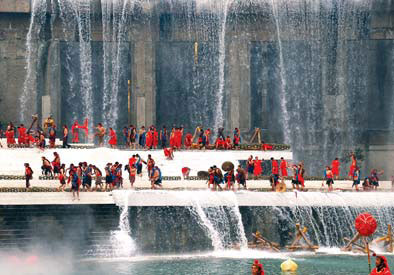
| Residents of Dujiangyan, Sichuan province, open the gates of the city's ancient dam as part of a local festival observed during the Qingming Festival. The city government hopes UNESCO will include the water-releasing festival in the world intangible heritage list. Photos Provided to China Daily |

| Locals in traditional costume celebrate the festival. |
Qingming Festival is usually a private event in which families honor their lost loved ones by burning paper money at their graves, but in Dujiangyan, Sichuan province, the occasion is marked by a torrent of rushing water.
On the morning of April 4, the opening ceremony of the 2012 China Dujiangyan Qingming Water Releasing Festival drew thousands to the banks of the Minjiang River, which lies to the west of the city.
The festival will run until April 12.
With a three-volley salute followed by shouts and laughter from the spectators, the river's water started gushing down as workers removed a dam built of bundled limbs and bamboo cages filled with mud and stones. The event took place at the Dujiang Weir, which was built more than 2,200 years ago as a part of an ancient irrigation system.
"It is our Thanksgiving Day," said the organizer of the three-day festival, explaining this thousand-year old tradition is to honor Qin dynasty provincial governor Li Bing who built the weir in 256 BC to tame frequent flooding in the region.
For people in western Sichuan, this annual event is almost as important as the Spring Festival. This region has been known across the nation for its fertility since the weir was put in use, he added.
Around 59 kilometers west of Chengdu, the capital city of Sichuan province, the Dujiang Weir is the oldest functioning water-control project in the world.
The weir, which has stood for nearly 2,300 years, silently diverts water to irrigate nearly 70,000 hectares of farmland, which contributes almost one-third of the province's total grain output. It survived the disastrous Wenchuan Earthquake unscathed in 2008.
The longevity of this architectural feat is mainly due to regularly scheduled annual repairs dating back to the Han dynasty (206 BC-AD 220).
When the Minjiang River enters into its low water season in the winter, a temporary dam is built at the weir so the local people can repair the banks and remove the alluvial deposits from the waterway downstream.
And as the high water season arrives in the spring, a ceremony is held to celebrate the surge of water that will irrigate the farmland after the dam is removed.
Since the year 978 AD, the Qingming Festival has been the officially designated day to celebrate the event.
Over the past thousand years, what was once a simple ceremony has evolved into a whole set of rituals to remember Li Bing, honor man's conquest of nature and pray for a bountiful harvest.
In recent years, this local ceremony has also grasped the world's attention. The Dujiangyan government invited 62 diplomatic envoys from 33 countries to the opening ceremony of the festival this year.
In a speech, Munshi Faiz Ahmad, Bangladeshi ambassador to China, said the weir is a great water-control wonder worthy of the highest praise.
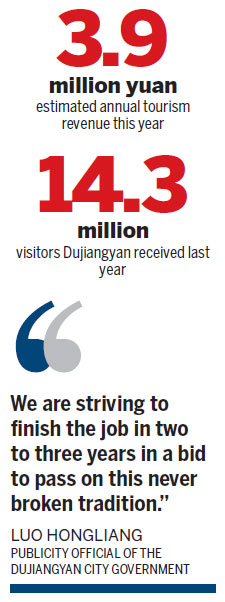
The festival is expected to attract more than 70,000 visitors this year and generate a revenue of 3.9 million yuan ($0.62 million), said a city leader.
As part of a strategy to better conserve this tradition, the city in 2012 plans to propose that it be included on the UNESCO's Representative List of the Intangible Cultural Heritage of Humanity, said Luo Hongliang, a publicity official of the Dujiangyan city government.
"Now the documentation has been filed to the Ministry of Culture, and we are striving to finish the job in two to three years in a bid to pass on this unbroken tradition," Luo added, noting the festival was already included in China's list of intangible cultural heritage as early as 2006.
The city is keenly aware of the move's potential benefit now that it is already home to world cultural and natural sites - the Dujiang Weir and the Qingcheng Mountain.
Offering unique attractions on its 36 peaks, the Qingcheng Mountain has long been recognized as the birthplace of Taoism, a major religion in ancient China.
UNESCO's expected addition of the festival will enable the local government to pool more resources for conservation and will give the city the rare distinction of being home to three types of world heritage.
Tourism boost
The increasing popularity of this festival will boost local tourism to a new high, officials say. The official statistics show that Dujiangyan received 14.3 million visitors in 2011, a 23 percent increase year-on-year, and they brought 6.3 billion yuan to the local economy.
In 2015, with the help of the festival, its tourism industry is expected to attract more than 20 million tourists, reap 16 billion yuan in revenue and offer more than 160,000 job opportunities, according to the city's 2008-2020 master plan.
This blueprint includes plans to develop Dujiangyan into an international tourism city.
An economic pillar of the city, the tourism industry at one point created as much as 51.3 percent of its GDP and employed over 200,000 people before the earthquake in 2008, which damaged more than 80 percent of urban buildings and 95 percent of rural and mountainous houses in Dujiangyan.
Four years later, the city has largely bounced back through resilience and hard work. Fueled by the time-honored tradition of the water-releasing festival, Dujiangyan is now making further headway towards its goals.
liyu@chinadaily.com.cn
(China Daily 04/09/2012 page7)