Young Noguchi's Chinese mentor


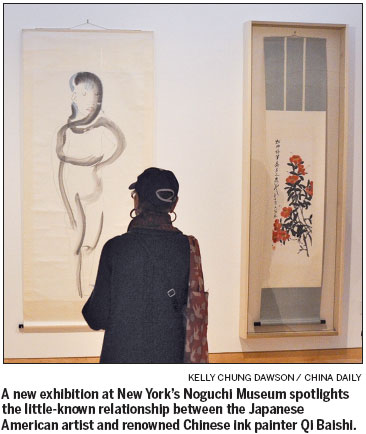
In 1930, long before Isamu Noguchi would make his name as an internationally renowned Japanese American furniture designer and sculptor, the young artist spent six months in China under the tutelage of Qi Baishi, an ink painter widely considered to be among the most influential Chinese artists of the 20th century. His time with Qi, then in his 60s, had a deep impact on Noguchi's later work, a connection beautifully demonstrated by a new exhibit at New York's Noguchi Museum.
Featuring more than 50 ink paintings, drawings, sculptures and calligraphic works, Isamu Noguchi and Qi Baishi: Beijing 1930 presents side-by-side comparisons examining the relationship between two important artists at different stages of their careers.
"To be able to present the first show demonstrating the unique and rare connection these two artists built is exciting and meaningful," said Natsu Oyobe, the associate curator of Asian art at the University of Michigan Museum of Art (UMMA), which collaborated with the Noguchi Museum on the show.
On what was meant to be a brief stop in China en route to Japan, Noguchi saw Qi's paintings in the collection of an American-educated Japanese national named Sotokichi Katsuizumi. He requested an introduction, and Qi soon agreed to teach the young artist at his studio in Beijing.
At the time, Noguchi was still finding his artistic style; Qi was in his 60s, and already famous for his modern take on traditional ink painting, calligraphy and seal carving. Although they shared no common language, the two formed a friendship predicated on the younger artist's deep respect and desire to learn.
Experimenting on large sheets of paper laid on the floor of Qi's studio, Noguchi applied Qi's single-stroke calligraphy-influenced brush painting techniques to subjects of his own choosing. Traditional Chinese art rarely featured nudity, but Noguchi drew inspiration from nude models of all ages and both sexes, hired by his servant from the streets and markets of Beijing.
Noguchi was greatly troubled by the war between Japan and China. On one painting in the exhibition, he commissioned a Chinese calligrapher to write a note expressing his support for the Chinese people against Japanese violence, and a reminder that Japanese culture was an offshoot of Chinese civilization. Although he remained proud of his heritage, he felt strong affection for China as a result of his time with Qi.
"That their relationship was able to happen in the small window before the war was also a miracle," Oyobe said. Noguchi, who was the son of the US-based Japanese poet Yone Noguchi and the writer Leonie Gilmour, also struggled with his heritage after Pearl Harbor, she noted. To combat any question of his loyalty to America, Noguchi voluntarily admitted himself to a Japanese-American internment camp in Arizona in 1942.
Qi, who died in 1957, never went on the record about his time with Noguchi.
"This relationship is an important part of art history, not only in Asia but in America, and demonstrates an early influence of Chinese art on an American artist," Oyobe said. "Visitors will be surprised."
kdawson@chinadailyusa.com
(China Daily USA 09/25/2013 page2)