Honey, it's all organic


Being a beekeeper is more than just gathering liquid amber when the hives are full. It is making sure colonies of bees are getting along, and that the little insects are happy and content. Sun Ye talks to suburban honey gatherer Song Xuezhou.
Beijing is not all about urban high-rises, historical sights and gridlocked traffic producing alarming levels of high particulate pollution. It is, fortunately, also home to a growing group of people who are dedicated to producing good, wholesome food that is safe from pesticides and chemical fertilizers.
In the outer suburb of Tongzhou, Song Xuezhou is one of a number of honey gatherers who roam the countryside so their bees can produce honey that is "pollution-free and all natural".
The 60-year-old retired welder has just returned from gathering caragana honey in the Renjianhuahai mountain area in suburban Miyun county. This year, he took about 70 beehives with him, driving a truck into the mountains with a tent, a tank of gas, a supply of rice and noodles and other daily necessities. He stayed for a month.
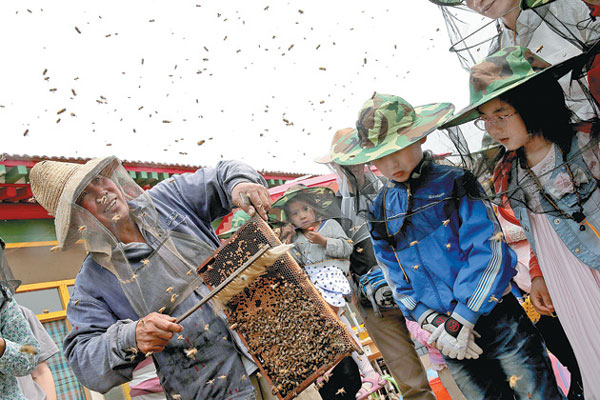
| Song Xuezhou drives away bees and shows visitors how he collects honey from the combs. Photos by Jiang Dong / China Daily |
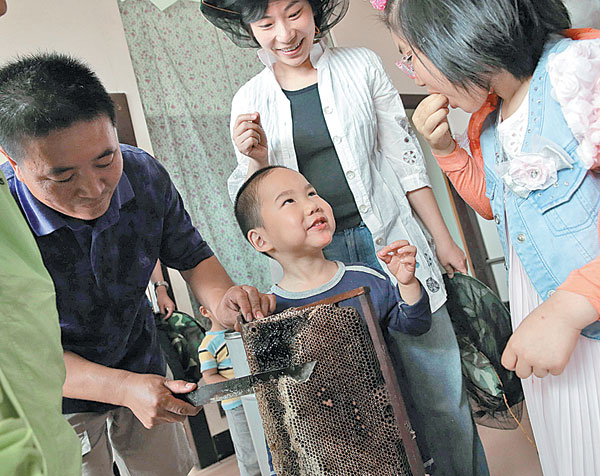
| Visitors have a taste of fresh honey at Song Xuezhou's bee farm. |
Song pitched camp away from the nearby village for fear that his bees would become agitated and sting people. He also made sure he was at least a few kilometers away from other honey farmers so there would be plenty of nectar to go around.
"A villager would send water up to me and I sometimes bathed in the river," Song says. "It's difficult living up here."
But he usually has little time to dwell on the inconvenience. The flowering season in July is very busy, with the day starting at 5 am.
"You have to extract the honey before the bees begin working. They are diligent workers themselves."
Bees constantly fly back and forth between the camp and patches of flowering caragana shrubs, and each hive produces about 40 kg of honey each season.
An experienced beekeeper has a trick to motivate the bees even more.
"The secret is to leave the right amount of honey in the hive - not so much so that the bees stop working but enough so they know you are pleased with their work."
Song also monitors the well-being of each little colony.
"I watch if the queen bee gets challenged, and watch to see who could take its throne, who's thinking of splitting the colony, which bees are going on strike and which bees have the stronger genes.
"It's natural selection," he says. "And I get to know them from my years of experience."
Although Song worked as a welder, he learned beekeeping from his father with whom he would gather honey every season. He helped his father every year until he retired, when he decided to keep hives full time.
"Beekeeping gives me an income that is slightly more than my former wage, so I do it mostly for interest."
Working with bees has another, more attractive perk.
"I don't catch cold easily," he says. Although he does not eat a lot of honey, the occasional licking of sticky fingers gives him enough of the good stuff to stay healthy.
"I like doing what I do, but too few young people are involved in the trade," Song says. His daughter, Song Dan, works in downtown Beijing and helps her father with sales and publicity, mainly through the micro-blogging community and regular stands at the Beijing Country Fair every weekend. His son-in-law helps out as well.
When Song is not in the mountains with his bees, he tends the hives at his Song Family Bee Garden in southeastern Beijing. He tells visitors to put on the veiled hats he supplies but he doesn't need one himself.
"If you know the bees well enough, there is no danger at all."
Song doesn't just keep bees for their honey, he has a true affection for the tiny insects. In winter, he uses a stethoscope to listen to the activity within each dormant hive, and adjust the heat and feed accordingly.
This is also the only season he gets a break from the cycle of extracting honey, pollen and royal jelly.
"Very few other bee raisers keep the bees alive through the winter, but I do." It's the same reason he takes less honey from his hives than others do. That's why it breaks his heart when tragedy strikes.

Once, on the farm, his bees discovered a flowering orchard of apricot trees nearby. They returned laden with honey and pollen but the next morning, Song was alarmed by the silence from his hives. His bees had all died, killed by the pesticides sprayed on the flowering trees.
Song now keeps his hives far away from fruit orchards and he sells honey with nectar collected from the spring meadows, the wild pagoda or scholar trees and the caragana shrubs in Miyun.
"His honey is fragrant, sweeter and denser than what I get elsewhere," says Rosie Zhang, a satisfied customer who posted on the Songs' online shop at Taobao. Their honey is not cheap, retailing for 100 yuan ($16) per kilo, but customers keep coming back.
This year, Song is happy with his harvests and his gathered honey will last until May next year when the flowers start blooming and his bees can start working again. "I don't know where this business will go but I'll go where my bees lead me."
Contact the writer at sunye@chinadaily.com.cn.
(China Daily USA10/25/2013 page17)