Cyber cafe waiter turned entrepreneur


iDreamsky founder sees strong future for publishing work of other gamers
Jeff Lyndon was a hard-core video game player when he was a child. His mother used to lecture him whenever she saw him playing, asking: "Can you make a living by playing games?"
Although Lyndon regarded his childhood behavior as a "bad model", the 31-year-old Hong Kong-born man has indeed made a living in China's mobile gaming industry. In fact he does much better than merely making a living.
Lyndon is the co-founder and executive vice-president of Shenzhen-based iDreamsky, a Chinese game publisher that has established its leading position through publishing some of the West's best-known mobile games, such as Halfbrick's Fruit Ninja and Imangi's Temple Run series, in China.
Riding the wave of China's rapidly growing smartphone market, iDreamsky has nurtured Temple Run to the point that it has nearly 200 million gamers in China with about 7 million daily users. Fruit Ninja has accumulated even more gamers than Temple Run because it was brought to China earlier than the latter.
"They are practically national games in China," Lyndon said proudly. Statistics from China News Games Research Co showed that there were about 223 million mobile gamers in China as of the end of September.
Getting China's smartphone owners to play mobile games is easy, but to get them to pay for those games is tough. It is also extremely difficult for foreign game developers to fight against game cloners and navigate the labyrinth of different app stores in China. That is why some developers look for a publisher to help them run their games.
Unlike the majority of Chinese mobile game companies, which both develop and publish games, iDreamsky doesn't have a dual role. "We only publishes games and we don't make our own titles," Lyndon said, adding the strategy is one of the main reasons that helps the company succeed.
Having a dual model can sometimes lead to conflicts of interest if a studio promotes its own games over a third-party title or even borrows ideas from a third-party studio.
"We are like those parents who do not have their own children. We want them badly and people can trust us to treat them like our own," said Lyndon, who started his career as a waiter in a cyber cafe in Hong Kong after graduating from high school and has since held many top positions in high-profile game companies before setting up his own in 2004.
Founded in 2009, IDreamsky, is the third company Lyndon has set up. According to him, both his first company - a virtual currency farming company - and the second one - a game consulting firm - were successful, thanks to all the games he played for years and especially the one-and-a-half years of work experience in the cyber cafe, which gave him a deep understanding about regular gamers' habits and behavior.
Starting as an outsourcing developer for smartphone applications and games, iDreamsky, the company consisting of six staff decided to get involved in the mobile game industry in 2011. "The market was not viable in China at that time, but we all believed that mobile gaming was the future, as the trend in the United States and other developed countries has shown," Lyndon said.
They decided the best way to help the startup company to transform from nothing into something in a short time was to get the contract to publish one of the top Western mobile games in China. So iDreamsky set its eyes on the top four games at that time: Angry Birds, Plants vs. Zombies, Talking Tom Cat and Fruit Ninja.
Lyndon, who speaks fluent English and is in charge of all the company's overseas business, tried the first three studios but all failed initially. "Fruit Ninja became our last and only chance," he said.
Although there were many Chinese companies wanting to bring Fruit Ninja to China, iDreamsky stood out because of its unique pitch. "Many competitors promised them money and high returns As a small company, which didn't have much in the way of capital resources, we promised them that we would help build up the game's brand in China and, surprisingly, they bought it," Lyndon said, adding that his company was the only Chinese company that flew to Australia to do a face-to-face proposal, which also proved to be a valuable tactic.
It turned out that it was a wise decision for Western mobile game developers to tap into the Chinese market in 2011 because it was not mature and therefore there was not much competition. The good timing made Fruit Ninja a big hit in China in 2012 and its success of Fruit Ninja led to the success of iDreamsky.
The days that it courted game developers and begged for their exclusive dealership rights in China are over for iDreamsky. About 600 mobiles games turn to the company every month, hoping to be published by them.
Compared with two years ago, the Chinese mobile game market has now taken off to an extraordinary degree. With China being the largest smartphone market in the world, iResearch Consulting Group, an Internet market consultancy, predictes revenues from mobile games would reach 9.19 billion yuan ($1.5 billion), this year, up 371.1 percent from 2012.
According to Niko Partners' 2013 Chinese Mobile Games Market Report, the number of gamers in China is expected to jump to 288 million in 2013 from 192 million in 2012. In 2014 there will be 390 million - more than the total population of the US.
Lyndon said that China's mobile game market will continue its boom in the coming three years with the increasing penetration of smartphones in the country, the building of the fourth-generation network and the falling prices of high speed mobile data packages.
However, he also predicted that the window for Western game developers to break into China's market is closing because of the rise of South Korean and Japanese game developers.
"The quality of (South) Korean, Japanese and Chinese mobile games has been increasing rapidly. And because of the proximity of cultures, (South) Korean and Japanese games are more suitable for the tastes of Chinese players," Lyndon said.
To prepare for the change, iDreamsky has already signed Cookie Run, a top game in Korea and Sonico Dash, one of the most popular game brands in Japan. Lyndon said that his company has worked on the localization of the two games and plans to launch them in China in 2014.
Despite the fact most of the games iDreamsky has brought into China are big in their home countries, it doesn't mean the company makes easy money.
Lyndon said in Fruit Ninja, iDreamsky added Chinese blades for cutting the fruit and localized backgrounds. In Temple Run, the company had to optimize the Western monetization strategy, which asked players to buy virtual gems to revive their character.
In the Chinese version, players can revive their character either by buying virtual gems or directly paying two yuan. Lyndon said it is all about impulsive buying behavior.
He is confident the launch of Cookie Run and Sonico Dash will help iDreamsky continue to secure its leading position in the mobile game industry in 2014.
Lyndon refused to reveal iDreamsky's revenue, but he said that the combined monthly revenues of Fruit Ninja and Temple Run exceed 50 million yuan. According to China Mobile Games and Entertainment Group Ltd's most recent financial report, the Nasdaq-listed company reported revenue of about 98 million yuan between July and September.
Lyndon said money is not a big issue for iDreamsky, while admitting that the mobile game market in China is changing rapidly with a new batch of competitors.
Apart from companies such as China Mobile Games and Entertainment Group Ltd, which both develops and publishes games, Tencent Inc, whose mobile chatting app WeChat has more than 400 million users, has also developed its own games and gained an increasing share of gamers on its service.
Lyndon said there will always be room for channel operators, for example Tencent, in China's increasingly crowded mobile game market. But it doesn't mean that there will be no room for independent publishers such as iDreamsky, he added.
There were more than 600 mobile game publishers in China at the last count. Lyndon predicted that in another year or so, there will be consolidation, which will leave two to two dozen players in the mobile game publishing sector.
"We started to invest in game studios in 2012 to offset the risk of not developing games ourselves. Now we just need to focus on what we do best," he said.
mengjing@chinadaily.com.cn
|
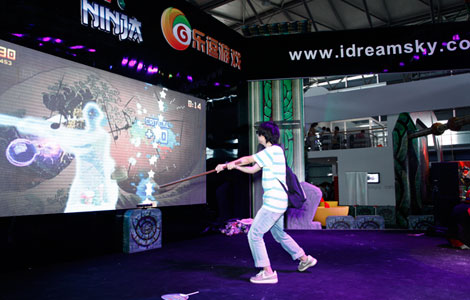
Mobile game developers and publishers promote games at an international Internet exhibition in Nanting, Jiangsu province. The number of mobile gamers in China is expected to jump to 288 million in 2013 from 192 million in 2012. Provided to China Daily |

(China Daily USA 12/26/2013 page16)