A new vision for building on the past


Japanese architect Norihiko Dan has worked on many major buildings, but he now has his sights set on a smaller project - to build a modern Buddhist Zen temple in China. Sun Yuanqing reports.
For the past decade, China has been a playground for the world's boldest architectural ideas. But a Buddhist Zen temple? It's still new territory. And Japanese architect Norihiko Dan wants to be among the first explorers.
Dan is a designer who thinks big - and has previously been commissioned to work on major projects - but now he is looking for an opportunity to work on an expansion project for a small temple on a secluded island in Ningbo, a port city in East China's Zhejiang province.
A permanent member of the Japan-China Cultural Exchange Association, Dan has devoted himself to Sino-Japanese cultural exchange for more than a decade. And now he wants to visually express his understanding of the Sino-Japanese connection with this Zen temple.
"Many people think of China as a market, but this project is not about that. It's for cultural exchange and that's why I'm excited," says Dan, 58. He led a delegation to China to commemorate the 60th anniversary of the Chinese People's Association for Friendship with Foreign Countries in May.
Tucked away on scenic Meishan Island, the Qingxiu Zen Temple has been a religious center for the local community since the 19th century. As the number of pilgrims grows, especially during the annual Fanfo Festival, an event commemorating a late philanthropic abbot, the temple is seeking an expansion. And Dan envisions it as the base for a modern structure that will echo with its past, something still new in China but prevalent in Japan.
"The new temple will have purely modern architecture, not just imitate the old one. That's the challenge," Dan says.
While the proposal is still in its early stages and the detailed sketch is still to be made, Dan has been drawing inspiration from Zen poems, and he has a clear vision of how the temple will serve the local community.
"It should be a space where people can meditate, touch the nature of Zen and refresh. I hope it's not just for people who believe in Buddhism but also for a much larger number of citizens."
Singaporean Evi Sari, creative director of the Beijing-based Tim Yip Studio, first recommended Dan to the abbot of the temple after Tim Yip, the Oscar-winning art director, was asked to be the design consultant of the project. Sari was impressed by Dan's efficient and eco-friendly expansion scheme for the Taiwan Taoyuan International Airport in Taipei when she was working for an architecture magazine in Taiwan, which co-hosted the design bidding for the airport project.
"For a place like Meishan that has so much natural beauty, Dan's architectural concept would fit very well. The idea of a modern temple is very new for everybody, so we are still figuring out what they want and what Mr Dan can do. It's a very meaningful project to him, not just as an architect but also as a Sino-Japanese ambassador and as a Buddhist."
Dan's family has a long history with China. His great-grandfather Takuma Dan, the then director-general of the Mitsui Group, was assassinated in 1932 by rightist-wing fanatics because he was against Japanese invasion into China.
Dan's father Ikuma Dan, a renowned composer of classical music and former chairman of the Japan-China Cultural Exchange Association, came to China dozens of times to take part in cultural exchanges. He passed away after a heart attack during a cultural exchange mission in Suzhou in 2001. And Dan has been carrying on his work ever since.
"This project is extremely significant to me. The cultural center of Zen Buddhism has historically been China, and many important Japanese Zen priests, such as Dogen Zenji and Myoan Yosai, learned Zen Buddhism in Ningbo in the 12th century and brought it back to Japan, which became the very core of Japanese culture."
One of the three architects originally commissioned to plan the site for the World Expo 2005 at Aichi in Japan, Dan fought with the Japanese government for two years, protesting their disguised plan that would have destroyed the Kaisho forest. The campaign finally alerted the World Wide Fund for Nature, the International Exhibitions Bureau and the public, who stood up to protest and the Kaisho forest was preserved.
"Architects have such small power yet sometimes we have to stand up. I realized the architects' role is not just to build something, but to show our ideas or at least to encourage good discussion," Dan says.
Dan first came to China with his father in 1978 and has witnessed how China's urban landscape has changed in the last few decades as skyscrapers replace traditional buildings. While he is cautious about commenting on his counterparts work in China, he says similar trends are in fashion in Japan.
"The situation in Japan is the same. Everybody wants to build the highest building. The high-rise towers, in many cases, destroy the traditional urban design," he says.
"Architects always try to add something and make it better, but we should not complete. All we can do is open up for the future. If we complete it too much, nobody in the future can touch it. If we totally erase it, of course you can draw what you want, but that probably won't last long."
Contact the writer at sunyuanqing@chinadaily.com.cn
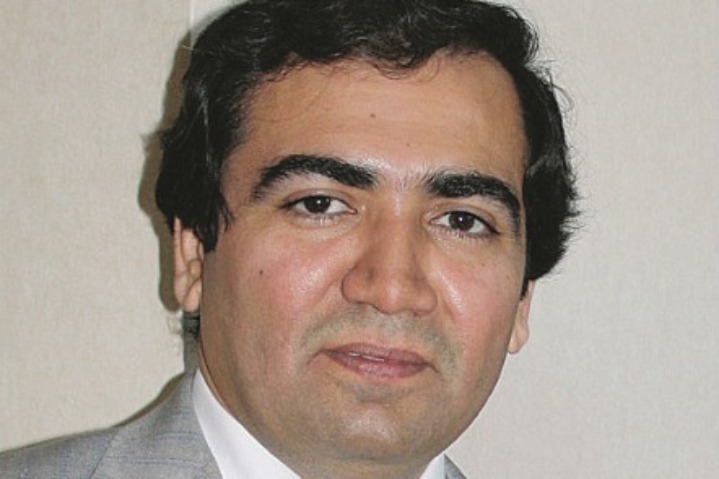
| Norihiko Dan is looking for an opportunity to expand a small temple on a secluded island in Ningbo, Zhejiang province. Jiang Dong / China Daily |
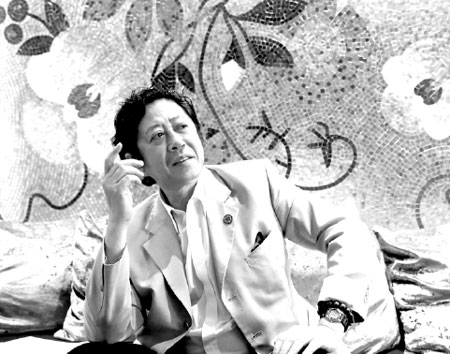
| Norihiko Dan was the architect for an expansion project of the Taiwan Taoyuan International Airport in Taipei. Provided to China Daily |

(China Daily USA 06/19/2014 page9)