His spiritual Shangri-La


Artist Chen Ping spent his childhood in a remote countryside. It is now his neverland where he seeks refuge from the hustle and bustle of urban life. Lin Qi reports.
Like many of his contemporaries, Chinese artist Chen Ping, 54, spent his childhood in his parents' birthplace in the remote countryside. The young Chen was sent back to Feiwa, an inconspicuous village in Hebei province, to be taken care of by relatives, because his father - a civil servant in Beijing - was too occupied with work and his mother suffered from heart disease.
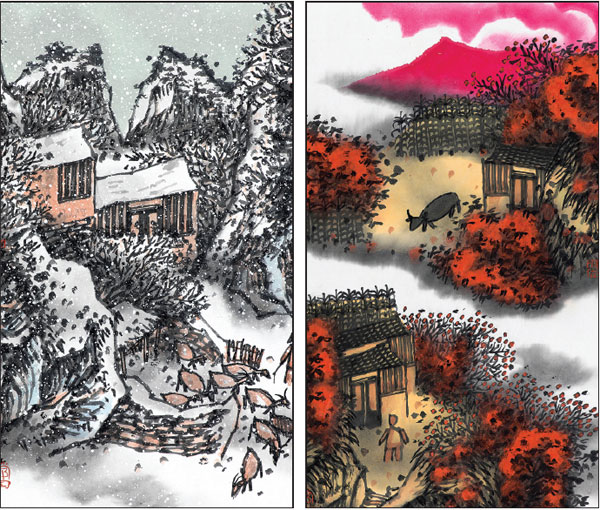
Chen's earliest memories of natural landscape were not fancy, but filled with images of the infertile land and saline soil of Feiwa, where he returned during his summer and winter school vacations from Beijing, where he was born. The thatched cottages, the elm trees, the muddy depressions where thick beds of reeds flourished ... all had left indelible impressions, based on which he created the idyllic Feiwa Villa.
He revisits the motif from time to time and has enriched the presentations by adding what inspired him when traveling extensively at home and abroad over the years.
Chen, who now heads the Chinese painting department at the China Central Academy of Fine Arts, has perfected the Feiwa Villa into a neverland where he seeks refuge from the urban hustle and bustle and retains inner peace. His current solo exhibition at the Yun Zhi Art Gallery in Zibo, Shandong province, offers a glimpse of that spiritual Shangri-La.
Titled Homeland Mountains in Dreams, the exhibition speaks of Chen's artistic ideal as a literati painter, who harbors strong attachments to mountains and water, according to Wang Shuhua, curator of the exhibition. Also, Chen demonstrates his development as a comprehensive, multi-oriented artist through decades of exposure to poetry, literature, painting and seal art studies.
Chinese painting was, however, not his first career choice when Chen started to learn art systematically in junior high school. Oil and gouache paintings enjoyed great popularity at the time, and Chen followed the disciplines of sketching and applying colors. Having little pocket money, he practiced on used newspapers and painted watercolors instead of using oil pigments that he couldn't afford.
Chen had planned to make a living drawing illustrations and comic strips to support his family. He was introduced to Lin Kai, an editor with the People's Fine Arts Publishing House, who agreed to tutor him. Lin's mastery of the traditional Chinese arts inspired the teenage Chen and helped steer him to change his life's direction.
"Besides comic strips, he (Lin) also showed proficiency in different genres of Chinese painting, including mountains and water, flowers and birds, and profiles, as well as calligraphy and seal cutting," Chen says. "I realized that (being a versatile artist) was what I really wanted to do and dreamed to be."
Chen never felt content with simply repeating the old teachings of ink and water. He demonstrated his experimental spirit as early as the time of his studies at the China Central Academy of Fine Arts from 1980 to 1984. He sourced inspiration from the art of American realist artist Andrew Wyeth (1917-2009), which he fell in love with when he first chanced upon Wyeth's painting album in his teens.
In his works, Wyeth adopted a rather simple and plain color scheme to build up a gloomy atmosphere, which the 15-year-old Chen felt deeply attached to. At the time, he suffered from loneliness and depression because of his mother's death.
Chen was most fascinated by the earthy yellow tone that brings out a dismal sentiment in Wyeth's works. He tried to re-create the cleanness and pureness of Wyeth's colors, for instance, by mixing ink and water colors with glue to achieve a pigmented effect on paper. He infused the transparency and fullness of Chinese painting with glossy tones.
Plums are a dominating subject in Chen's poems and his portrayals of Feiwa Villa. He injects his elegant scholarship in the plum plant, just as he once wrote in a poem, "Dense buds and various blossoms have all become dreams, while the barren tree trunk still looks strong after years of witnessing vicissitudes."
"Chen Ping has established a distinctive art vocabulary all of his own by juggling between the 'spirit' of painting traditions and the 'form' of modern art," Fan Di'an, then director of the National Art Museum of China, commented when Chen held a one-man show at the museum in 2010.
Contact the writer at linqi@chinadaily.com.cn
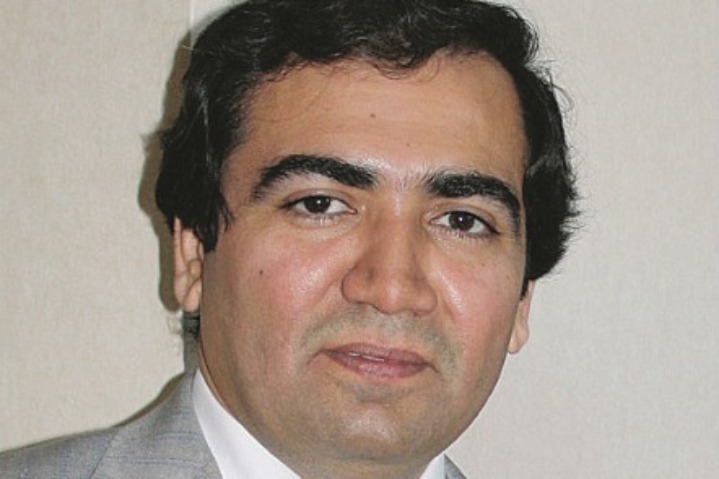
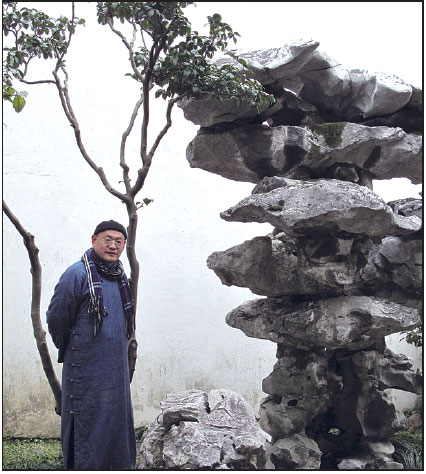
| Chinese artist Chen Ping (below) transforms the natural landscape of his rural birthplace into a Feiwa Villa series. Photos Provided To China Daily |
(China Daily USA 01/06/2015 page9)