Condensed Qin Dynasty serial set to reign


Sun Haohui continues to show he's a historical writer of historic proportions.
The self-taught historian's nonfiction series The Qin Empire is so popular that the multitudes of zealous fans' questions forced his latest book release event to run late at the Beijing Book Fair on Jan 9.
Thirty minutes after the scheduled end time, the host had to halt the Q&A, leaving many disappointed they didn't get to pose their queries.
Sun was presenting the abridged, three-book version of his best-selling 11-book series, The Qin Empire.
The new version condenses the 5 million-word franchise into 1.2 million words.
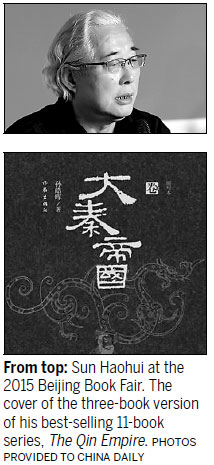
Its publisher estimates the new version will sell at least 100,000 copies.
The books chronicle the dynasty's trajectory from its 221 BC birth until its 206 BC fall and challenges many accepted pieties about the period's rulers.
"People often believe Qin rulers were brutal tyrants," Sun explains.
"And many criticize (founding) emperor Qin Shihuang for not respecting Confucianism. I believe the Qin Dynasty represents the peak of China's cultural diversity. It was a time when bravery and masculinity were fully respected."
Also, a comprehensive set of laws was applied, which was an advanced concept at the time, he says.
Sun's original series, which was published in 2008, is recognized as the only full literary account of the entire Qin era. It was adapted into a top-rated China Central Television serial in 2009 that brought him provincial-level and national awards.
The author was born in the empire's capital Xi'an - today the capital of Shaanxi province - in 1949 - the year of New China's founding.
He quit his job as a law professor to devote all his time to researching and writing about the Qin.
Critics have lauded the depictions of the dynasty's economics, politics, military affairs, diplomacy and customs.
The books vividly depict how the Qin state prospered through reform during the Warring States Period (475 BC-221 BC) and how Qin Shihuang conquered six other states to establish the dynasty.
They also compare the states' scientific progress, philosophies and geography.
The abridged series cuts commentaries on the Qin state's rivals and plotlines unrelated to the dynasties, such as records of witchcraft practiced during the period.
He also reworded the books for readability.
"I hope more readers will become interested in the period after they read the novels and reflect upon what we could learn from our ancestors," Sun says.
liuzhihua@chinadaily.com.cn
(China Daily USA 01/14/2015 page9)