Chinatown memories inspire


To Kam Mak, the designer for the Lunar New Year stamps by the US Postal Service, the festival starting Feb 19 is not only a holiday but connected to a string of happy, noisy, lively and colorful memories in Manhattan's Chinatown.
"When I go visit my relatives, my joy was to go after the tray and take all the candies that I wanted. ... And my grandmother would tell me, "Don't leave the shells [of watermelon seeds] on the table.' It's about family. It's about togetherness," Mak said.
In an interview with China Daily, the 53-year-old at times tilted his head slightly rightward, as he recalled what inspired his design for the stamp for the Year of the Ram - tray of togetherness, or chuen hop in Cantonese, which was used to fill snacks and serve guests.
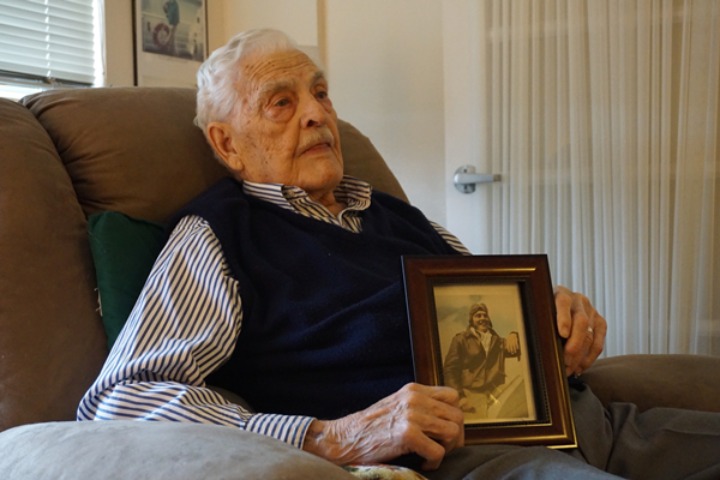
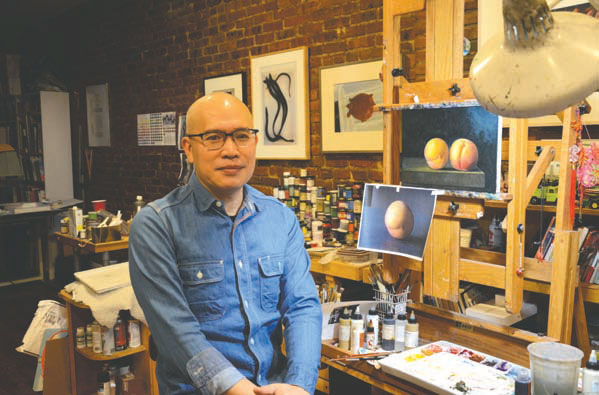
| Kam Mak, the illustrator for the USPS Celebrating Lunar New Year series, is at his studio in Brooklyn, New York on Monday. Lu Huiquan / For China Daily |
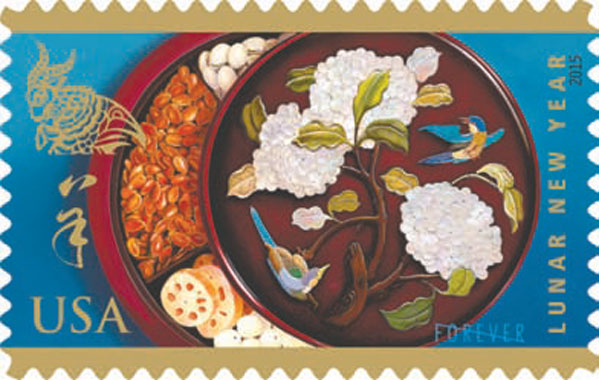
| The stamp for the Year of Ram issued by United States Postal Service features chuen hop, or the tray of togetherness. Provided to China Daily |
"We didn't have a lot of food," he said. "It was tough for us. And my mother saved and saved just for the holiday," said the artist, whose father worked at a Chinese restaurant and mother at a sweatshop. "Extra food," he said. "Delicious food."
Mak was born in Hong Kong and immigrated to America in 1971. From 2008 to 2019, he was commissioned by the USPS to design the 12-year series Celebrating Lunar New Year. The first series on this topic went from 1992 to 2007, as a result of the lobbying efforts of the Organization of Chinese Americans to honor Chinese Americans in the country.
The series, which included 12 stamps and two souvenir sheets, featured Chinese calligraphy and paper-cuts of animals in Chinese zodiac.
Mak and Ethel Kessler, the art director of USPS, have worked on the second series since 2006.
"He and I first thought we would of course create a series using the symbols of the animals for each year, but on further research, we saw that every country approaches Lunar New Year this way," Kessler said.
They also thought the previous series was "very well designed and thought out ... so what to do to maintain that standard?" said Kessler. Then over dim sum, they sat, pondered and came up with the solution to use Kam's childhood memories to define what the Lunar New Year is about.
"I enjoy the series and like the new round of designs as they introduced people to the symbolism beyond the animals," said John Dunn, publisher of Mekeel's & Stamps magazine and U.S Stamp News magazine. "I do think the series has been met with approval. Postage stamp collectors tend to be more inquisitive and worldly."
Calligraphy and paper cuts of the previous versions are incorporated into the new series. "Lunar New Year is more than those animals," Mak said. "It is about those traditions, what my mother and my grandmother would prepare before the New Year."
On this year's stamp, the tray of togetherness is half-opened. The cover of the tray is based on an inlaid design from antique Chinese furniture Mak saw at the Metropolitan Museum of Art. It features hydrangeas flowers, which represents love, gratitude, and enlightenment, and singing birds.
Inside the tray are dried, candied lotus root meaning abundance, dried watermelon seeds representing happiness and fertility, candied lotus seeds for fertility; and pistachios, which mean health and good fortune.
"Even though something might not be followed any more, deep down, people can still identify with the elements I chose," he said. "It just makes the stamp tell a better story and how beautiful our culture is."
The illustrator has been interested in art since he was a child. When he first arrived in the US, he could barely speak English and was not a good student. But his love for art ultimately made him quit local gangs.
With the help of the art teacher whom he called Mrs. Vicky, he was admitted to LaGuardia High School and then the School of Visual Arts on a full scholarship. He is now teaching at Fashion Institute of Technology, part of the State University of New York.
Once or twice a year, he brings children to Chinatown and tells them his stories and memories about the neighborhood.
"We immigrants tend to hold on to our tradition much more," Mak said. "Many immigrants don't speak Chinese anymore, but they still know all about Chinese culture."
Lu Huiquan in New York contributed to this story.
(China Daily USA 02/05/2015 page2)