Progress widely apparent


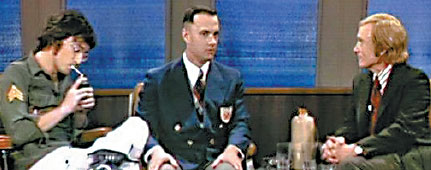
Movie fans will remember this from the film Forrest Gump (1994): During an interview with rock star John Lennon, Forrest says, "In the land of China, people hardly got nothing at all." Lennon, lighting a cigarette, responds, "No possessions?"
Fast-forward 20 years. The ark in the movie Farewell Atlantis was built in the Tibet autonomous region because it "would be impossible for another country to finish it in time". The lost female astronaut in the movie Gravity used a rescue capsule to reach a Chinese space station, Tiangong, and then got back to Earth on a Chinese Shenzhou spacecraft.
In the 36 years since China and the US established formal diplomatic ties, the progress of relations from suspicion and testing to mutual trust and win-win cooperation is not only visible in movies but also in culture, education, politics and the economy.
Now let's start with a can of Coca-Cola to track the development of China-US ties.
| Scene from Forrest Gump |
Economy
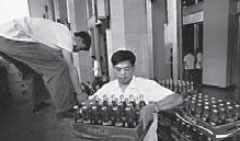
Coca-Cola enters the Chinese mainland
On Dec 13, 1978, after several rounds of negotiation, Chinese and US companies signed a deal in Beijing Hotel stating that the US company Coca-Cola would provide production equipment to major Chinese cities and tourist areas and set up special plants to fill Coca-Cola cans and sell the products in China. Thus Coca-Cola became the first foreign company to enter the Chinese mainland.
Chinese authorities then gradually scrapped import quotas and licensing of foreign carbonated beverages, and Coca-Cola started its expansion in China by building new plants, bringing more of its drinks to Chinese consumers.
Meanwhile, various made-in-China products were pervasive in the US market, ranging from groceries, fresh vegetables, meat, fish, eggs and milk to clothing, shoes, kitchenware, furniture, televisions and computer screens. Besides exporting goods, Chinese companies invested directly a total of up to $46 billion in the US, creating more than 80,000 jobs, between 2000 and 2014.
"As long as I have my job and the economy is upbeat, I don't give a damn who owns the company," said a US worker at a Chinese company in the southeastern US.
Politics
Dialogue started with "ping-pong diplomacy"
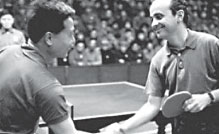
There were no people-to-people exchanges between China and the US for more than 20 years following the founding of the People's Republic of China. That changed in 1971 when ping-pong players from both countries met and exchanged gifts. "Ping-pong diplomacy" thus became a landmark event in the history of China-US exchanges.
| Chinese ping-pong player Yang Ruihua (left) shakes hands with US player Dick Miles before a match in Shanghai on April 15, 1971. |
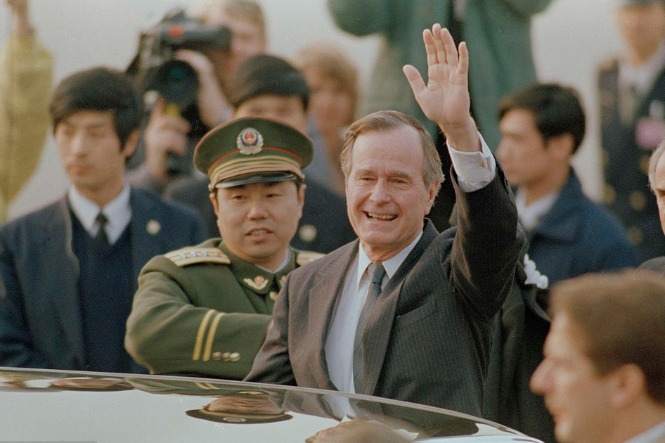
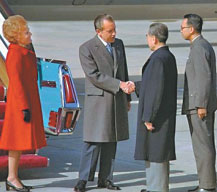
US president Richard Nixon comes to China on Feb 21, 1972.
Then-US president Richard Nixon's visit to China on Feb 21, 1972 signaled the normalization of China-US relationship. Seven years later, when Chinese leader Deng Xiaoping visited the US, on Jan 29, 1979, the two countries signed agreements on cooperation in science, technology and culture, which deepened mutual understanding, friendship and trust.
Now candid political exchanges between the two countries have become the norm-a big step from "ping-pong diplomacy".
| Richard Nixon (center) and his wife, Pat, arrive in Beijing. |
Culture
From taboo to trend, Chinese elements come to forefront
Among all forms of cultural exchanges between China and the US, movies have the longest history and also the widest reach.
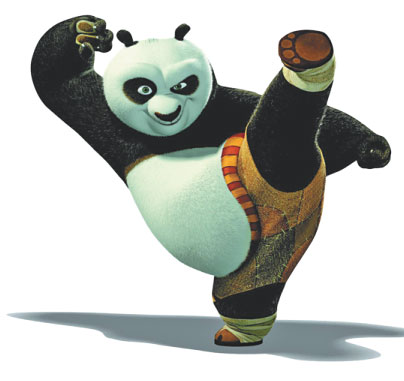
As early as the 1920s, "No China-man in the story" was upheld as an iron rule in Hollywood. Nowadays so many Chinese elements are featured in Hollywood films that Chinese faces and Chinese styles have become fashionable. China has also become a synonymous with high-tech, reliable friends and even saviors in many great movies, including Kung Fu Panda, Gravity and Farewell Atlantis.
The changes are inseparable from the growth of China's comprehensive national strength and also the elevation of China's international prestige. Misunderstandings, prejudices and estrangement may remain for some time, but positive changes are surely underway.
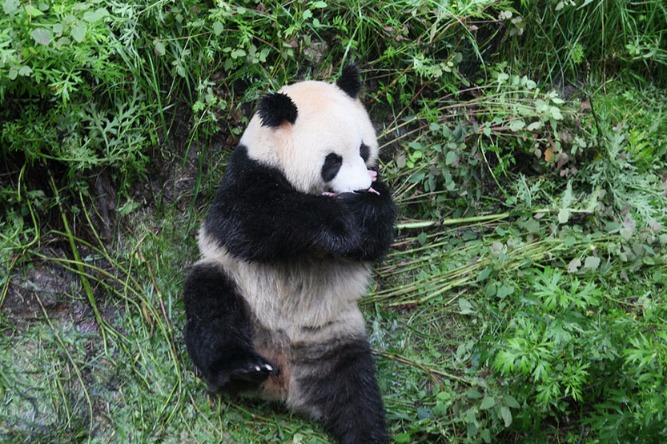
Kung Fu Panda
Military
New type relationship overcomes obstacles
Speaking of Chinese and US military ties, some people are still talking about "Who would win a war?" or "Who has better weapons?" The fact is, bilateral military exchanges between the two countries have gone much further.
In January 1980, Harold Brown, then-US defense secretary, visited China, raising the curtain for China-US military exchanges. It was the first time ever that a US defense secretary stepped on the Chinese mainland since the founding of the New China in 1949.
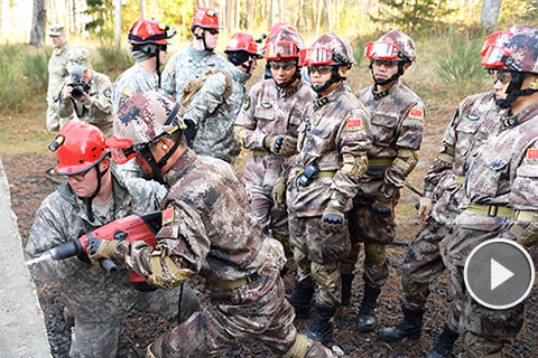
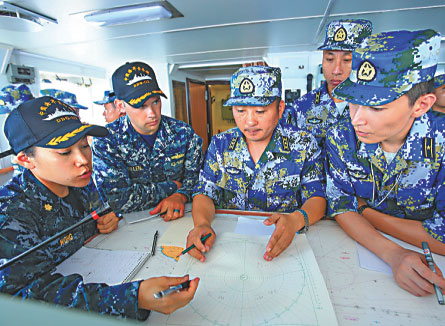
There have been frequent exchanges between the two armies since 2013, including a China-US anti-piracy naval drill in the Gulf of Aden, the Sino-US joint naval search and rescue drill and the 2014 Rim of the Pacific drill. Such joint exercises were beyond imagination decades ago.
A US Navy observer was aboard the Chinese destroyer Qingdao during a Sino-US joint naval search and rescue drill.
It's an inevitable trend for China and the US to increase mutual trust, and the US also needs to know and evaluate China's intentions and capacity. A new type of military relationship has been an essential component of the new model of major country relations between China and US, and also a topic in previous meetings between President Xi Jinping and President Barack Obama. Military ties may become a highlight of Xi's upcoming visit to the US, according to military experts.
Despite all the differences and conflicts, China and the US have always had more common interests than differences in the past 36 years. It will require efforts on both sides to build a new model of major-country relations featuring non-conflict, non-confrontation, mutual respect and win-win cooperation.
| Chinese and US military personnel work together on a joint operation. |
(China Daily USA 09/24/2015 page3)