A hit with Western readers


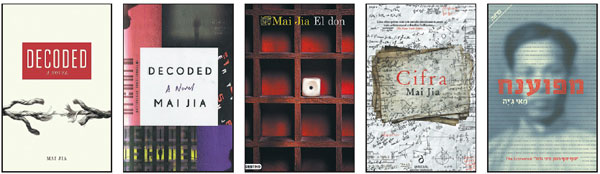
Mai Jia's first novel, Decoded, which was included by The Economist in its top 10 fiction list in 2014, has been translated into more than 30 languages. Here, the author reveals where he draws his inspiration from. Yang Yang reports.
The Mao Dun Literature Prize winner Mai Jia is one of the most popular contemporary Chinese writers among foreign readers. The first contemporary Chinese writer included in Penguin Classics after Lu Xun, Qian Zhongshu and Eileen Chang, he is regarded as China's Dan Brown or John Le Carre.
His first novel, Decoded, which was included by The Economist in its top 10 fiction list in 2014, has been translated into more than 30 languages.
This month, Mai Jia is going to Denmark, Germany, Switzerland and Austria for the publication of the Danish and German versions of Decoded. He will then go to London for the publication by Penguin of the English version of his second novel, In the Dark. That work won the Mao Dun Literature Prize in 2008.
In May, the Hebrew version of Decoded will come out in Israel.
In Decoded, protagonist Rong Jinzhen is an autistic math prodigy, recruited by the national secret service 701 to crack two highly advanced codes - Purple and Black.
In the Dark, which comprises three parts, has stories about espionage told through seven narrators. The lead characters in the work are also geniuses.
In Mai Jia's novels, the prodigies wrestle alone with riddles, puzzles and secrets, seeking the truth and finally die or go mad.
This is why his work is different from typical spy novels.
A fan of Argentine writer Jorge Luis Borges, a key figure in Spanish-language literature, Mai Jia tries to explore the inner conflicts of a human being and his fate. His postmodern storytelling style typically includes diaries, interviews and excerpts besides the omnipotent narrator.
The 52-year-old writer says life is lonely and mysterious, and full of contingencies.
"There is a saying, which is also true for me - do not try to understand your fate," he says.
This recognition is based on his personal experiences.
Mai Jia, the pen name of Jiang Benhu, was born in a village in Zhejiang province, not far from Hangzhou, in 1964.
When he was little, his father always told him that the family must leave the home they had lived for generations. The reason was that in front of their fine house, the family's old enemy had built a house at a higher level and had painted the outside red.
The enemy wanted to ruin the Jiang family's feng shui, and ruin their luck. Strangely, after the red house was completed, the fortunes of the Jiang family began to decline.
To fight the curse, Mai Jia's grandfather tried a lot of things, including turning to Christianity. Whatever the reason, the family's fortunes then began to improve, and more grandsons were born.
However, in the 1950s and 1960s, the practice of Christianity was frowned upon in China, and Mai Jia's father thus tried other methods to get the curse lifted, including raising dogs, putting stone lions in front of the gate and killing roosters.
For decades, the aim to get rid of the curse made the father work hard to revive the family's fortunes. In the end, in 1996, the father sold the house, going against the tradition that descendants should not sell houses built by ancestors.
Mai Jia's father's long battle with the red house opened a door for little Mai Jia, leading him into a world of mystery and secrets.
Later, the turning points in Mai Jia's life seem always mysterious.
Although he was a mediocre student in high school, somehow he passed his examinations, becoming one of just three students from a class of 54 to enter college. Fate then led him to military school, although his score was far lower than the requirement.
Even the translation of Decoded was a coincidence for him.
According to his story, in 2010, after Briton Olivia Milburn, then an assistant professor of Chinese literature at Seoul Natonal University, finished visiting the Shanghai Expo, she strolled to the bookstore at the airport because of a delayed flight and came across the Chinese version of Decoded.
There were hundreds of other books and magazines there. So why Decoded?
It was because of the blurb for the book which said it was "a story about a cryptographer" and Milburn's grandfather used to be a codebreaker.
After reading the book three times, Milburn decided to translate the book for her grandfather. Later, she was persuaded by a friend to publish the translation.
Pointing to the coincidence, he says: "If her flight was not delayed, or her grandfather was not a codebreaker, then what?"
Besides mystery, Mai Jia's personal experiences also lead him to explore loneliness.
"I write because of loneliness. I thought that if I write the loneliness out, I will feel better. But the loneliness only gets more intense. Maybe, some people are born to be lonely. Loneliness, like a birthmark, grows together with you. A lonely person of course can create only lonely characters, just like me," says Mai.
As Mai Jia's grandfather was a landlord, and his father was a Christian and was categorized as a rightist, he suffered a lot during the "cultural revolution" (1966-76). He was bullied by not only students but also by teachers. He felt isolated and lonely.
Young Mai Jia started to keep diaries at 11, and by the time he started to write, he had 36 volumes. Then, when he read J. D. Salinger's Catcher in the Rye, with its themes of teenage angst and alienation, he realized that he could write a novel like that. The floodgates were thus opened.
In 1991, Mai Jia started work on his first novel, Decoded, and over 11 years he rewrote the work of 200,000 characters three times. It was rejected by publishers 17 times because of its sensitive content.
Like the protagonist in the novel, Mai Jia also battled loneliness as he wrote.
When the book came out, it was a great success with millions of copies sold. His other novels, including In the Dark, The Message and Whispers on the Wind, are also very popular, and have been adapted into TV series or movies.
The TV series based of Decoded is under production.
Despite its popularity in the West and The Economist calling Decoded the best Chinese novel in 35 years, Mai Jia modestly says this is because of the "ignorance" of the West about contemporary Chinese literature.
"Many contemporary Chinese writers are inspired by Western literature," he says, "but due to cultural differences, the things we care about and the way we express ourselves do not interest the West. Also, as a result of being bombarded by Western influences, and having got used to them we try to adapt to their ways, not the other way around."
Contact the writer at yangyang@chinadaily.com.cn
| Mai Jia's novel Decoded has been translated into more than 30 languages and published in different countries. Photos Provided To China Daily |
| |

(China Daily USA 03/02/2016 page07)