Personal items of famous Qing scholar on show


He was a renowned calligrapher and Confucian scholar, who was also involved in politics in imperial China.
More than a century after Weng Tonghe (1830-1904) is said to have been sacked from office as a minister by Empress Dowager Cixi after they fell out over a campaign, his personal belongings return to Beijing in the form of an exhibition tour of the city.
Titled Specific Artifact Exhibition of Two Emperors' Tutors, Weng Tonghe, and the Weng Family, the show opened in the Beijing Stone Carving Art Museum last week as part of a four-stop tour.
It runs through May 10.
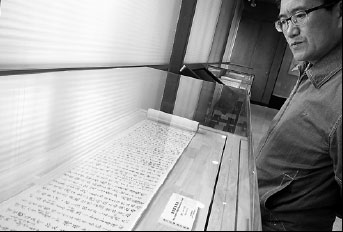
More than 70 sets of exhibits, including calligraphy works, porcelain collections and a memorial to the throne, borrowed from Changshu Museum in Jiangsu province, reflect his life.
Born in East China's Changshu city, Weng, an influential figure in Chinese history, was the teacher of Qing Dynasty (1644-1911) emperors Tongzhi and Guangxu, and became a politician. He was in charge of several ministries in the Qing Dynasty, including as head of a diplomatic agency and revenues.
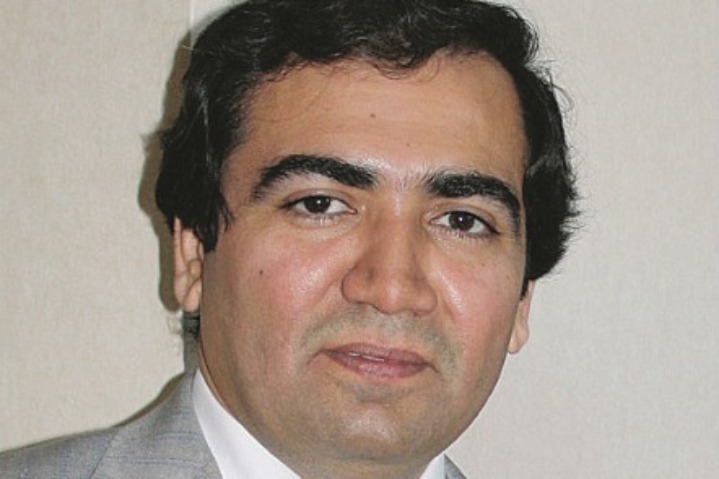
"He was a microcosm of figures in Chinese history who worked for the country's revival," says Wang Dan, director of Beijing Stone Carving Museum. "The exhibition is also a look at the Qing Dynasty history through Weng's eyes."
After Weng left his office in Beijing, he returned to his hometown and focused on studying ancient Chinese calligraphy. He lived there until his death.
"That is why a complete set of his personal belongings was left in Changshu," says Qian Ke, deputy head of the cultural relics department at Changshu Museum.
All the exhibits on display in Beijing are original pieces rather than replicas, and some have never been seen in public before, says Qian.
A memorial to the throne is among the show's highlights.
Most earlier exhibitions on Weng covered his calligraphy, but this exhibition presents a wider frame on him.
"If visitors aren't all fans of calligraphy, they might find an entire show on calligraphy a bit boring. But that won't happen with this show," she says.
For example, 24 sets of his colorful porcelain collection are also on display. The pieces were made during the reign of Emperor Guangxu (1875-1908), representing the best porcelain works of the time.
Some sketches of the landscape in Changshu are also among the exhibits.
"Most artworks were drawn in response to invitations, but the impromptu sketches which were created in a cozy atmosphere seem to best reflect a person's mind," says Qian.
"We can feel Weng's optimistic attitude toward life despite his political troubles."
According to Zhou Ming, deputy director of Art Exhibition China, which is an affiliate of the State Administration of Cultural Heritage, the event is part of its projects to introduce scattered resources in local museums to higher platforms, though the organization used to focus on Sino-foreign cultural exchange shows.
"Many cultural treasures are hidden in small-scale museums, but it is significant to share them with more people to improve the public's understanding of history and fine art," says Zhou.
wangkaihao@chinadaily.com.cn
| A visitor looks at the calligraphic works on display at the Weng Tonghe show in Beijing. Wang Kaihao / China Daily |
(China Daily USA 04/19/2016 page9)