New generation of imams preaching peace and harmony


Recently graduated religious leaders are working to generate and reinforce positive images of Islam to help Muslims identify and avoid extremism. Cui Jia reports.
People often find it hard to reconcile Ma Jiacheng's youth with his status as the imam, or religious leader, of the biggest mosque in North China. They expect to meet a grave, elderly man, not a smiling 26-year-old who left college only last year.
Ma is one of a number of recently appointed young imams taking a new approach to religious teaching. They combine their understanding of Islam with new ideas in the hope of generating and reinforcing positive images of China's Muslims.
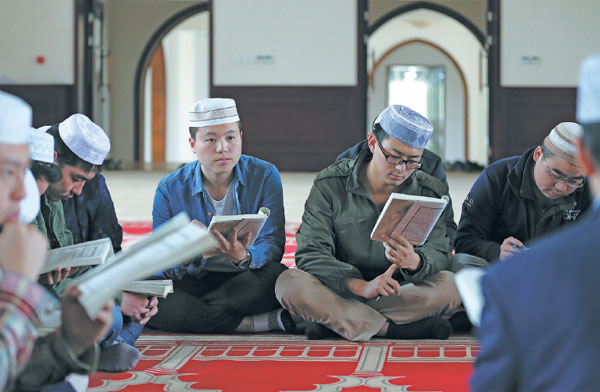
| Students read the Quran during a class at the China Islamic Institute, the country's top academy for Quranic studies, in Beijing. Wang Zhuangfei / China Daily |
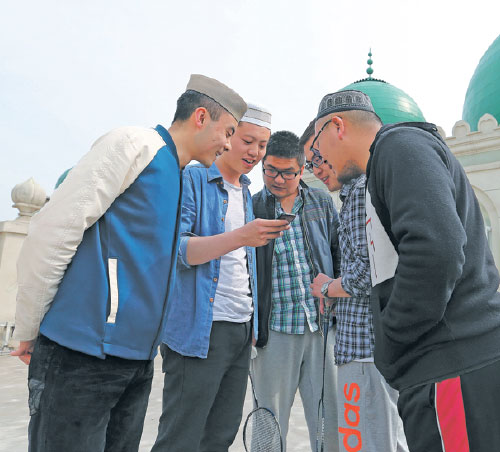
| Students at the institute, many of whom are expected to become religious leaders, read a message on a smartphone during a class break on April 12. Wang Zhuangfei / China Daily |
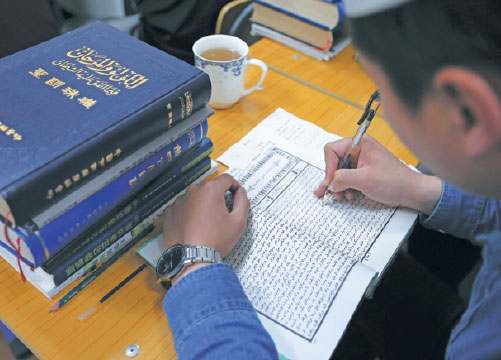
| A student takes notes during a class at the institute. Wang Zhuangfei / China Daily |
Ma first visited the Doudian Mosque in the Fangshan district of Beijing in 2013, when he was a student at the China Islamic Institute, the country's top center for Quranic studies. Now, he is entering his ninth month at the religious center, which features a prayer hall big enough to hold 2,000 worshippers.
He was appointed to the post after he graduated last year, replacing the previous incumbent, who had retired. Five of his classmates are now imams at mosques around China.
Young graduates of institutes across the country have become a major force in driving Islam forward in China, helping young Muslims to identify and reject extremism.
Ma, from Shihezi, a city in the Xinjiang Uygur autonomous region, came to Beijing to study at his "dream school" in 2011. Last year, he was one of the first 26 students to be awarded a bachelor's degree in Islamic studies by the institute, which had only awarded plain certificates of graduation before then.
The member of the Hui ethnic group said he loves to speak in a loud voice, which he calls a characteristic of men from China's northwestern regions, and that helps when he's leading prayers.
Narrow perspectives
His father and grandfather are both imams in Xinjiang, and learned about Islam from older religious leaders in the local mosques. Although religious leaders have traditionally been trained that way, Ma said younger imams are concerned because they feel the system may promote a narrow religious outlook.
"It has flaws. For example, the students only learn from one imam and are easily influenced by his views, so they think they are the only correct ones to hold. My family always wanted me to go to the institute to master the knowledge they never had the opportunity to learn and to develop my own perspective during the process," he said, dressed in a white robe and matching taqiyah, the prayer skull cap worn by many Muslim men.
Despite his short time at the mosque, Ma has already developed his own style of leading the congregation. "I want people to feel I am easy to talk with, or just have a laugh with. I don't want or need to appear serious all the time just to show my authority."
His appointment was initially greeted with skepticism by worshippers at the mosque, which was completed in 2013. They felt Ma's youth would prevent him from fulfilling his responsibilities, but they've gradually been won over by his cheerful nature and deep religious knowledge.
Liu Qingli, who owns a restaurant next to the mosque, said he enjoys Ma's addresses during Jumah, the Friday prayer meeting that is the most important gathering of the week. The session is usually attended by about 100 worshippers, including Muslims from overseas, and some members of the congregation visit Doudian just to participate in Ma's services.
"He is young, but he is very capable of leading the mosque. It's great to see new blood in the mosques around China. They (the young imams) are like a breath of fresh air," said Liu, a 46-year-old Hui man. "Ma gets on well with the older believers because he respects them, and young people like to talk to him because of his down-to-earth attitude."
Ma said: "I am much younger than most of the followers who come to the mosque. I always say that I am their child in our personal lives because they can teach me so many lessons, but in our religious lives, I am their leader."
Kindness and respect
He said mosques are built to promote religion, respect and kindness. "An imam who encourages violent behavior is not an imam anymore, but simply a wolf in sheep's clothing. Those who recite the prayers five times a day and then commit violent acts will cause great damage to the community because people will believe the atrocities are being carried out by devout Muslims. But are these people really devout Muslims?
"People must ensure they make the right decisions, especially if someone praises Allah and then encourages people to pick up a weapon and kill," he said, adding that he often discusses such issues with the faithful and encourages them to learn more.
"In addition to learning about Islam, my studies at the institute gave me a broader view of Muslim life in China and the world outside; even my father is learning from me now," he said, adding that he teaches his father how to pronounce Arabic words correctly when the older man recites the Quran in his heavy Xinjiang accent.
Founded in 1955, the China Islamic Institute is situated in Niujie Street, the spiritual home of more than 10,000 Muslims in the Chinese capital.
"About 70 percent of our lessons are about religion, while 30 percent focus on other topics, such as Chinese literature and history," said Cong Enlin, vice-president of the institute, which has seen about 20 percent of its graduates become imams.
"I believe Islamic institutes will gradually become the mainstream of China's Islamic education, which is traditionally conducted in mosques," said the 51-year-old Hui man who is also a graduate of the institute. "The knowledge acquired by many older imams is no longer sufficient to answer many new questions, especially those posed by younger people."
To meet the rising demand for graduates, the institute plans to double enrollment to 50 in September. At the moment, most of the students are Hui, but the college will open a class specifically for Uygur students from Xinjiang. A new campus has already been built, he said. In addition to awarding bachelor's degrees, the center plans to offer postgraduate and doctoral courses in the future.
"The young students are the future leaders of China's Muslims, so it's crucial to make sure they don't go astray," Cong said.
Essential skills
The prayer hall at the institute also serves as a classroom where the students learn essential skills, such as interpreting the Quran and leading prayer gatherings.
On April 8, Xie Shunchao addressed the Jumah as part of a practical lesson for final year students. "We have a responsibility to keep the traditions while adapting to social developments," said the 24-year-old student, clad in a white ceremonial robe that failed to hide his Converse-brand canvas shoes.
He said life at the institute is never boring, and even though they are studying religion, the students are a lively group, and they enjoy playing computer games, watching NBA games and shopping online. The institute is just like any other college, except these are no women, he said, with a laugh.
Like many of the students, Xu Fuyao studied at a mosque in his hometown for a year before taking the 2012 entrance exam for the institute, where about one in five candidates is offered a place.
The 24-year-old Hebei province native often visits other colleges and universities to attend lectures on Middle Eastern history and Islamic cultures around the world, something he would not have been able to do if he had continued studying at his local mosque.
"My friends now often use social media apps to seek my help if they have problems understanding the Quran," said Xu, who plans to continue his studies overseas after graduation, before returning to China and training as an imam.
He said people sometimes ask for his views on religious extremism, which the authorities say has been behind a series of deadly attacks in China and elsewhere in recent years. "If one day I became an imam, I will tell my followers that violence is always wrong, no matter what you believe. When Muslims start to kill, they are not Muslims anymore, just devils," he said.

Xu said he wants to help his coreligionists to gain more confidence, "which is badly needed".
Unlike Ma, some graduates may be appointed to mosques where older imams are still working, meaning they have to learn to handle a delicate relationship.
"Young and old imams at the same mosque can learn from one another and together. Just like any great team, it takes time and patience for them to adjust to each other's values and perspectives," said Cui Wei, a 24-year-old student from Northwest China's Gansu province.
Walking along the carpet that runs down the middle of the prayer hall at Doudian Mosque, Ma said it is the path he takes to lead the Jumah.
"It always reminds me to lead China's Muslims on the right path. It is a great responsibility," he said.
Contact the writer at cuijia@chinadaily.com.cn
(China Daily USA 05/03/2016 page6)