London's V&A museum reveals a brief history of underwear


Exhibition reveals undergarments both the practical and sexual reasons for their use
Think of it as Victoria's (and Albert's) secret. London's Victoria and Albert Museum has peeled back fashion's layers to expose everything from long johns to lingerie in Undressed, an exhibition tracing the hidden history of underwear.
It's a story about covering up, and also about showing off. For centuries, people have worn undergarments for practical reasons of protection, hygiene and comfort - but there has always been an element of sexuality and drama as well.
"Something we wanted to correct in the exhibition is the assumption that all historical underwear is plain," researcher Susanna Cordner says.
She said early underwear involved a simple cotton or linen garment next to the skin, "but then you would get little fashion flairs and little bits of exhibitionism."
"Any period of history with underwear there's an implied viewer - there's someone else in the room."
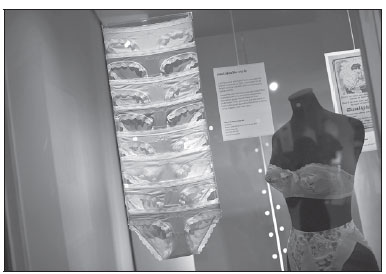
That viewer has often been presumed to be male and the wearer female. The show, which features more than 200 items made between 1750 and the present day, is dominated by women's undergarments: corsets and crinolines, stockings and shifts, chemises and stays.
They range from cotton drawers worn by the mother of Queen Victoria (the V&A museum is named for the 19th-century monarch and her husband), to a Swarovski crystal-studded bra and thong.
But there are men's unmentionables, too, including 18th-century shirts, which were considered underwear because they were worn next to the skin - only the collars and cuffs could decently be shown. More recent items include David Beckham boxer shorts and crotch-enhancing Aussiebum briefs.
Female designers
Curators of the show have emphasized the contribution of female designers and innovators such as Roxey Ann Caplin, whose "health corset" - designed to shape the body without crushing the internal organs - won a medal at the Great Exhibition of 1851.
Waist-constricting corsets run through the exhibition, in versions that range from functional to fetishistic. There are 19th-century models with whalebone stays, a modern-day red and black rubber corset by House of Harlot, and one worn by burlesque artist Dita Von Teese with a wince-inducing 18-inch waist.
Looking at the riot of corsetry, it's hard not to think "Hurray for the bra". The exhibition traces the history of brassieres, from their development as "bust supporters" in the 1860s through their wide adoption in the early 20th century to the introduction of Lycra in the late 1950s.
Edwina Ehrman, the exhibition's curator, says Lycra was "a fabulous breakthrough" - and a reminder that the evolution of underwear is a story of technology as well as creativity.
Blurred lines
The exhibition reveals that the line between underwear and outerwear has long been blurred. Ehrman says people have been revealing their undergarments since at least the 16th century.
"Fast young women in the early 1800s would show the frills around their long underpants when they sat down," she says. "And stockings were a great way of showing your legs. ... So this trend has always been here, but we've carried it to extremes today."
Many of those extremes have been seen on fashion catwalks, and the exhibition's glass cases are full of wild and wonderful underwear-inspired designs: a sheer Liza Bruce slip dress famously worn by Kate Moss in the 1990s; a wispy lavender chiffon and lace gown by Ellie Saab; an extravagant gold-corseted Alexander McQueen gown.
Recent years have seen the line blur even further, as tracksuits, onesies and other loungewear moved from the living room onto the streets.
Ehrman says that after years of more and more exposure of the body, the next trend in underwear may involve "more covering-up."
But French lingerie designer Fifi Chachnil - whose signature Babyloo playsuit is on display in the exhibition - thinks we will always want to show off our skivvies.
"I don't like to make a bra that will not be seen," she says.
"I think life is a stage, and every woman is playing a part."
| A museum worker poses with mannequins during a media event to promote Undressed: A Brief History of Underwear at the V&A Museum in London.Photos By Dylan Martinez / Reuters |
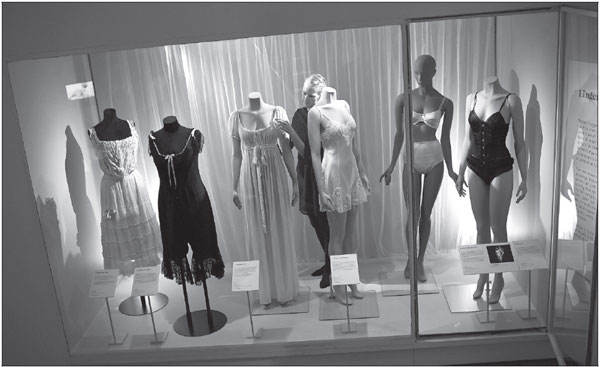
| Underwear is displayed in an exhibition that aims to tell the story of the changes in undergarment design since the 18th Century. |
(China Daily USA 05/10/2016 page10)