Choosing his battles


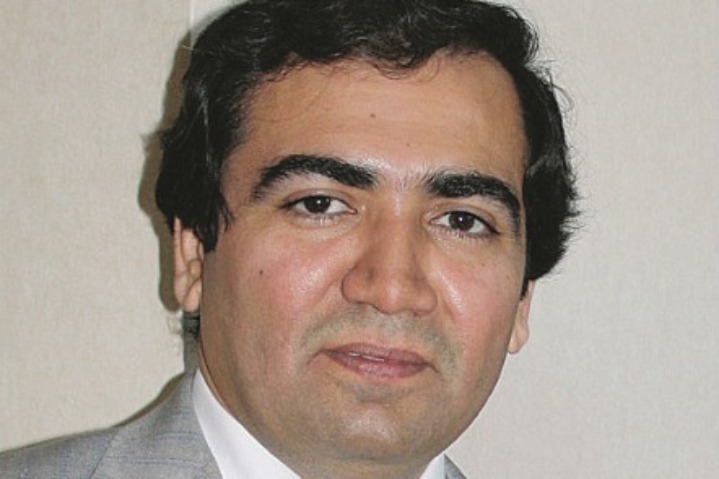
China's most-popular military TV series' producer is fighting for big changes in how the genre is presented on the small screen. Wang Kaihao reports.
He's arguably the man who brought China its answer to Band of Brothers.
When TV producer Wu Yi brought the 30-episode series Soldiers Sortie to the small screen in 2006, he had little inkling it'd become one of the Chinese mainland's most-celebrated military dramas. It's still widely acclaimed as such.
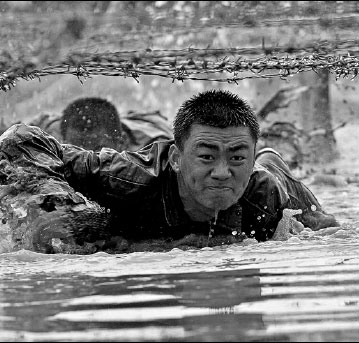
Soldiers Sortie follows Private Xu Sanduo - a shy village boy sent to the army by his father in order to make a man out of him. He grows through perseverance from his entry into a People's Liberation Army mechanized-infantry unit until he becomes a core member of an elite force.
"I'm not boasting," Wu says, sighing.
"I regret no other military drama has reached this level over the past decade."

Soldiers Sortie has 9.1 out of 10 points on China's major film-and-TV criticism website, Douban.com, making it the highest-ranking Chinese military TV series ever. It has 8.1 points on Douban's US-based equivalent, iMDb.com.
Wu adores military themes, although most of his ongoing projects are about urban romance or Qing Dynasty (1644-1911) legends.
"Attitudes decide what's produced," he says.
"We must venerate our audiences."
Wu is calling for a rejuvenation of the genre. He's president of the Tianyi Media group behind many military dramas.
He's bothered by how the genre is often presented. For instance, the proliferating productions portraying the War of Resistance Against Japanese Aggression (1937-45) seem to exaggerate Chinese fighters' bravery while depicting Japanese soldiers as buffoons.
"If an ordinary Chinese person could kill 20 or 30 invaders alone - as is shown on TV series - why'd our war last so long?" he asks.
"It's the wrong direction. It's disgraceful when our forebearers' sacrifice is treated like a shoot-'em-up computer game."
Wu grew up in a family working for military enterprises and served two years in the PLA.
This background has contributed to his insistence on the accuracy of details when depicting military affairs.
He believes China should observe some universal principles for great wartime TV and movies followed by the rest of the world.
"We must create vivid characters full of humanity and explore their inner worlds if we want to tell stories overseas audiences can understand," he says.
This outlook can be seen in another of Wu's acclaimed productions, the 43-episode My Chief and My Regiment (2009). The series tells the story of a scattered troop of Chinese expeditionary soldiers, who are reunited and defend the front line against Japanese invaders modern-day in Myanmar in 1942.
"These soldiers don't want to fight but are eager to win because they can then go home," Wu says.
"That spirit is shared all over the world."
Soldiers Sortie is actually a mainstream production showing the modern development of China's defense capacity, he says.
"However, when a grand theme is conveyed from a regular person's perspective, it's approachable to audiences, who often share a stereotyped view that mainstream films and TV series are propaganda."
Wu is exploring new topics, although he believes it's impossible to found a new genre on Chinese TV.
For instance, he plans to tackle South China Sea disputes in upcoming productions.
"Film and TV have a responsibility to inform future generations about history," he says.
"Our industry should have the courage to voice Chinese sentiments and win more say in international media when our sovereignty in the South China Sea is violated."
Wu believes more subjects will become available for military-themed TV dramas to address.
Chinese TV has hardly touched upon the Korean War, for instance.
But this year's The 38th Parallel has become wildly popular since it depicts the war from not only a Chinese perspective but also remains neutral toward the Republic of Korea and United States.
"Our country now deserves the cultural confidence to review our past," he says.
"But an expansion of wartime dramas should never advocate bellicosity nor exaggerate individual heroism. They should tell people war is cruel, and we must cherish peace."
Contact the writer at wangkaihao@chinadaily.com.cn
|
My Chief and My Regiment, one of Wu Yi's best-known productions, tells the story of a troop of Chinese expeditionary soldiers, who defend the front line against Japanese invaders in Myanmar in 1942. Provided To China Daily |
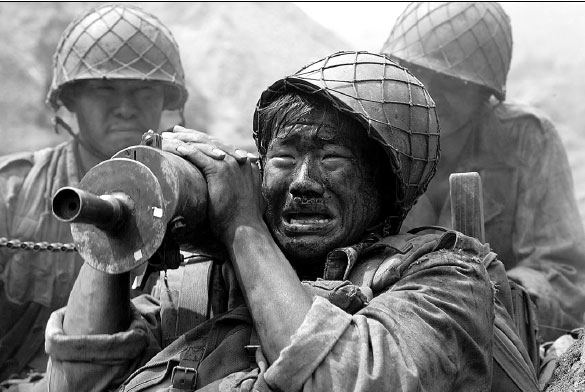
| Soldiers Sortie, produced by Wu Yi, is acclaimed as one of the most-celebrated military dramas on the Chinese mainland. Provided To China Daily |
(China Daily USA 08/11/2016 page10)