Life on the tiles


A team of retirees, average age 71, has become a leading force in international mahjong, an ancient Chinese game that's becoming increasingly popular overseas. Zhang Yi reports.
Since Wang Guiying retired 13 years ago, she has made it her mission to ensure she has interesting things to do to keep her occupied. Now, she is one of the world's leading players of mahjong, a Chinese game, whose nearest Western equivalent is the card game bridge, where contestants attempt to collect groups of colored tiles.
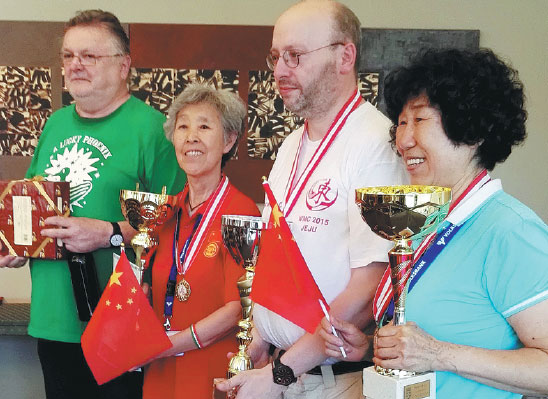
In July, in Baden, a spa town in Austria, Wang captained a team of eight senior players to win the 11th Austrian Mahjong Open. Team member Tian Ying, 71, took the top spot at the competition, which was held on July 9 and 10, while another member, Cao Lihua, 72, came third. Wang was placed 10th.
Every player on Wang's team is age 67 or older, with the oldest being 77-year-old Qing Zheyong. The average age of the team is 71.
With the help of about 180 fellow enthusiasts, Wang runs the Shaanxi Mahjong Association, which was established in Xi'an, capital of Shaanxi province, in 2003. On Wednesday, the 67-year-old will lead her association's team at a regional competition in Anhui province.
"I needed to feel fulfilled after retirement. Many people suggested that I should follow my senior peers and take part in square dancing in the city park, but I thought I could do something more challenging to keep my brain ticking over. Now, I really love playing mahjong. In my opinion, it's a healthy mental workout for senior people and a natural way to develop friendships," the Xi'an native said.

Failure and success
"Winning a championship doesn't happen overnight. We had a disastrous failure at an international competition in France two years ago. We learned a good lesson from that," Wang said.
At the fifth Open European Mahjong Championship, held in Strasbourg, France, in 2014, the highest-ranking Chinese player claimed 30th place, while the team came in 37th. Given that mahjong originated in China, it was a humiliating result.
"Our team arrived at Strasbourg just one day before the competition. We were exhausted from the long flight and couldn't overcome the jetlag. As a result, we didn't perform well," Wang said.
In contrast, she and her team arrived at Baden three days before the competition, so they had two full days of rest before competing against some of the 60 contestants from 10 countries.
Few international mahjong competitions are sponsored, so the players had to pay for their own trips. Despite the cost, they enjoyed the visit and regarded the event as cross-border communication about Chinese culture, according to Wang.
She said players take part in mahjong competitions out of their love for the game, and her association has about 60 regular members who play every Tuesday. Betting on the results of games is strictly outlawed.
Brain exercise
Team member Tian is one of the regular players.
"I practice with association members every week. Mahjong is good brain exercise. I believe that playing the game reduces the risk of seniors developing dementia," she said.
"Life dealt me a few blows several years ago. Playing mahjong helped me through family tragedies. With the help and support of the members, I have become more sociable since I joined the association, more extrovert and optimistic," she added.
Jiang Xuanqi, executive director of the organizing committee of the China Mahjong Open, said the game's growing global popularity is a channel that connects China with the rest of the world.
Last year, players from more than 20 countries and territories participated in the fourth World Mahjong Championship, held on Jeju Island, South Korea, according to Jiang, who said the number of competitors at international events is constantly rising.
In recent years, Alexander Doppelhofer, an Austrian player who was ranked second in the Baden competition, has participated in numerous competitions around the world, as well as games in China, including those held in Chengdu, capital of Southwest China's Sichuan province, and the western municipality of Chongqing.
Jiang said mahjong is becoming increasingly popular in Europe and at least 50 major events are held across the continent every year. He believes the game is one of China's leading cultural exports.
"When I was assigned the job of organizing mahjong activities as a sport more than a decade ago, I didn't fully understand the game's charm and philosophy. After a few years of playing and organizing games, I realized mahjong involves a high degree of intelligence and a bit of luck. It also helps people in other countries to develop an interest in Chinese culture through an entertaining game," he said.
Communication channel
Wang said players from all over the world like to chat during breaks at international competitions, and exchange souvenirs and small gifts with players from other countries.
"A casual game and the repetition of tile selection make mahjong an effective way of learning a little Chinese," she said.
"I have received dolls, small bottles of alcohol, woodcut flowers and glass crafts. In return, we give away Chinese knots, paper carvings and shadow puppets, as well as other handmade craft items. During breaks in the games, foreign players usually approach us, point at tiles and ask how to pronounce their names in Chinese. I don't speak a second language, but we were able to communicate through the language of mahjong."
Contact the writer at zhang_yi@chinadaily.com.cn
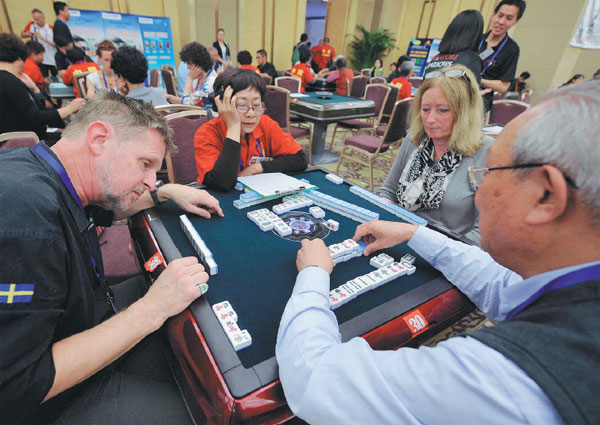
| Contestants from 20 countries and regions compete in the Third World Mahjong Championship in Chongqing in 2012. Yu Xiao / For China Daily |
| Chinese players Tian Ying (second from left) and Cao Lihua receive their awards at the 11th Austrian Mahjong Open held in Baden, Austria, in July. Tian, 71, took the top spot at the competition, while Cao, 72, came third. Wang Guiying / For China Daily |
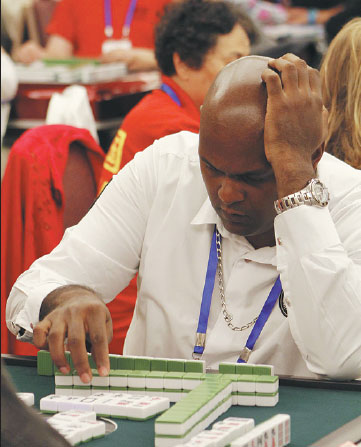
| A player studies his tiles during the Third World Mahjong Championship in Chongqing. Wang Huazhong / China Daily |
(China Daily USA 10/12/2016 page6)