World's biggest library grows with China


In stunning detail, watercolor posters detail conflict between China, Japan in Library of Congress display
On Sept 16, two days before the 85th anniversary of the "September 18 Incident", which marked the beginning of Japanese troops' invasion of northeast China, the Library of Congress website published a blog written by Yuwu Song, Chinese reference librarian with the Asian Division at the library.
The blog, Posters on the Sino-Japanese War of 1937-45 at the Asian Division, Library of Congress, presented rarely seen watercolor posters originally created during the Chinese People's War of Resistance Against Japanese Aggression.
Massacres and atrocities were common. The casualties from this devastating war, lasting from 1937 to 1945, numbered 35 million, according to President Xi Jinping in a speech he gave at the commemoration of 70th anniversary of the end of World War II in Beijing last year.
The posters shown by Song's blog brought the brutality of war into today's light.
|
Die with the Enemy, a hand-drawn poster depicts a Chinese pilot deliberately diving into a Japanese bomber, a scenario that could happen if a Chinese plane was hit or ran out of fuel. Provided to China Daily |
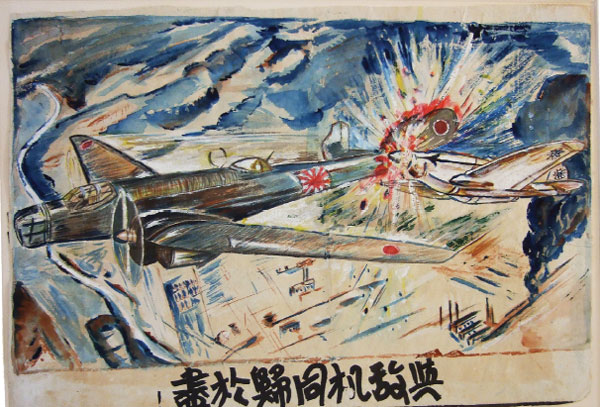
The hand-drawn Die with the Enemy depicts a Chinese pilot deliberately diving into a Japanese bomber, a scenario that would happen if a Chinese plane was hit or ran out of fuel.
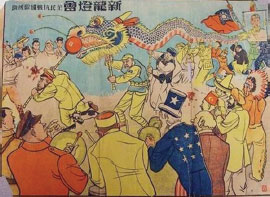
Another poster, New Dragon Dance Parade: Total War with International Assistance, illustrates a Japanese militarist getting bitten by a dog and chased by dragon dancers, with recognizable characters in the crowd looking on - such as Uncle Sam, Charles de Gaulle and Winston Churchill - symbolizing the international alliance against Japan.
| One of the rarely seen hand-drawn watercolor posters originally created during the Chinese People's War of Resistance against Japanese Aggression, Thunder, shows a group of fighter jets flying over China and the South China Sea with an eagle in the background, which could exemplify speed and power. The posters are part of 6000 items pertaining to the war collected and preserved by the Library of Congress' Chinese collection. Providei to China Daily |
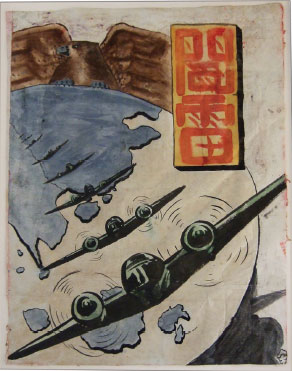
The poster was donated to the Library of Congress by the family of Nelson Trusler Johnson (1887-1954), the US ambassador to the Republic of China from 1935 to 1941, according to the blog.
Evidence from a Chinese Air Force recruiting poster suggests that some of the posters were transferred to the Library on October 17, 1944, and were possibly brought back by Flying Tigers crews or other American military staff as souvenirs of the Chinese Air Force.
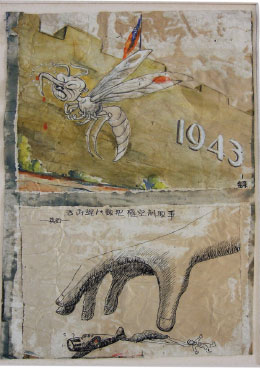
| The Year of 1943 delineates a buglike Japanese plane running up against a stone wall, a symbol of fortified Chinese defense, and Strive for the Control of the Sky and Get the Enemy Out of Our Territory, outlining a large hand reaching down to seize a downed enemy plane with the Japanese pilot bailing out, are part of 6,000 items pertaining to the war collected and preserved by the Library of Congress' Chinese collection. Provided To China Daily |
According to Song, the library's Chinese collection contains more than 6,000 items pertaining to the Sino-Japanese War of 1937-45.
"These posters first came to light in the summer of 2009 when librarians at the Asian Division accidentally ran into some old WWII newspapers and Chinese Air Force propaganda materials in the Chinese book stacks," Song wrote on the blog.
The watercolor posters shown in Song's blog are among the many unique Chinese materials in the library's Asian collection.
|
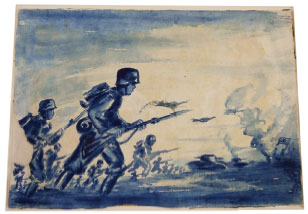
This untitled print shows Chinese foot soldiers running after the fleeing enemy while shielded by Chinese warplanes. The posters are part of 6,000 items pertaining to the war collected and preserved by the Library of Congress' Chinese collection. Provided To China Daily |
And they're just the tip of the iceberg of the more than one million China-related items housed in the library today.
Officially established in 1928 and followed by reorganizations and name-changes over the years, the Asian Division at the Library of Congress, or Asian Reading Room, now holds the largest Chinese collection outside of the Chinese mainland.
Chi Wang, former head of the library's Chinese section at LC, witnessed the growth of the Chinese collection from 300,000 to 1,000,000 in his 48 years career before retiring in October 2004.
In 1973, shortly after President Richard Nixon's 1972 visit to China, proposed and arranged then premier Zhou Enlai and US National Security Advisor Henry Kissinger, officials from the National Library of China visited the Library of Congress, which started the rapid growth of the Chinese collection, according to Chi Wang.
| New Dragon Dance Parade: Total War with International Assistance is a poster illustrating a Japanese militarist being bitten by a dog and chased by dragon dancers, with recognizable characters in the crowds looking on - such as Uncle Sam (United States), Charles de Gaulle (France) and Winston Churchill (Great Britain) - to symbolize the international alliance against Japan. Provided to China Daily |
As of the end of the 2015 fiscal year, the Chinese collection consisted of 1,178,304 monographic volumes, 20,000 rolls of microfilm that cover 800 entries of monographs, 500 periodicals, and over 200 newspapers, along within major full-text electronic databases and resources made available to patrons in the Asian Division Reading Room.
And the collection continues to grow rapidly, gaining in stature as a national asset in the US as well as one of the principal contemporary China collections in the world.
"Part of our uniqueness is that some of our collection cannot be found anywhere else in the world, not even in China (the Chinese mainland)," said Jeffery Wang, reference librarian at the Asian division, who is from Taiwan and has been working as a Chinese collection specialist at the library for 12 years. "The Asian division here served as a shelter for some of the rare books."
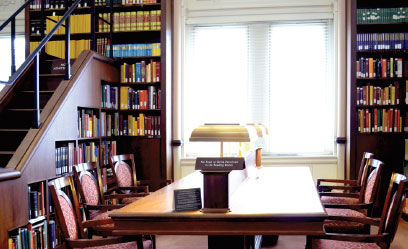
| The Asian Division Reading Room of the Library of Congress is now one of the largest Chinese collection outside of China with more than 11 million volumes of books and over 2 million journal issues. The Chinese collection began to develop when Emperor Tongzhi gave 10 works in 933 volumes to the library in 1869. Yuan Yuan / For China Daily |
"We have more than 5,000 titles of the rare books, books that were published before 1796," Wang said. "We also have ancient versions of various chorography, which attracted those who want to study Chinese local history."
The Asian division also holds 10 percent of the existing codices of the one-time world's largest encyclopedia, Chinese Ming Dynasty's Emperor Yung Lo's Great Encyclopedia.
The encyclopedia, compiled for the emperor by some 2,000 scholars between 1403 and 1407, was the earliest and largest in the history of China. The original was completely destroyed during the final days of the Ming Dynasty (1368-1644), but fortunately a manuscript copy, made between 1562 and 1567, survived. However, largely destroyed by fire in 1900, only a few hundred of the original 22,000 volumes survived.
With 41 volumes collected, the library now has the largest holding of the encyclopedia outside of China. The British Library and the Bodleian Library of the University of Oxford hold 24 and 19 volumes respectively, according to David Helliwell, curator of the Chinese collections at the Bodleian Library.
Along with Chinese-language materials, the collection also houses several thousand volumes in Manchu, Naxi and other minority languages.
Established in 1800, the Library of Congress is the oldest federal cultural institution in the United States. The library is not only a research library that officially serves the Congress but also functions as the national library of the US.
The library's Chinese collection was started in 1869 when Qing Dynasty Emperor Tongzhi gave the library 10 works in 933 volumes of Chinese books.
By 1912, the collection had grown to 16,900 volumes through acquisitions, donations and gifts from notable diplomats, such as Caleb Cushing and William Rockhill, and gifts from the Chinese government at the conclusion of the Louisiana Exposition of 198 works (in 1965 volumes) in 1904.
"Caleb Cushing, also known as Gu Sheng, represented the US government in signing the Sino-American Treaty of Wanghia in 1844, the first diplomatic agreement between China and the US," Jeffery Wang said. "He donated not only Chinese books but also books in languages of the Manchus and the Moslems."
"Another noticeable donor was William Rockhill, who as a US representative signed the Beijing Treaty after the end of Boxer Rebellion in 1901," Jeffery Wang said. "He was very fond of and interested in China, and he collected a significant amount of books."
These early acquisitions paved the way for the growth of the Chinese collection.
Today, nearly 70 percent of newly acquired materials are purchased through book venders in China, according to Jeffery Wang.
The Asian Reading Room at the Library of Congress is elegant and spacious. Sunlight streams through the half-closed blinds onto the dark-wooden reading table. The smell of books, newspapers and periodicals from the wooden shelves create a fantasy come true for book lovers.
"There were barely any readers when I started in 1958," Chi Wang said. "Then thousands of readers coming every year by the time I left, which was in 2004."
"The Chinese collection takes an active role for research on the study of China," said Jeffery Wang.
"Chinese materials have been extensively used by US government agencies, research and educational institutions, academic scholars and the reading public as well," Jeffery Wang said.
"We take an active role in the development of the library's resources for research in Chinese studies," Wang added. "Also, our Congressional Research Service is dedicated to serving Congress, collecting and translating needed materials for them. It's our responsibility to partner with and assist them."
"When staff from the offices of Congressman or Senators need to write reports about China-related topics, they sometimes turn to us," Wang said. "And we help CRS with translation as well."
Researchers who want to conduct studies at the division need to be established scholars from formal academic institutions. They also need to provide a report explaining their studies and prepare detailed plans and a list of required books.
"The majority of general public who come to the Asian Reading Room are Chinese or Chinese Americans," Wang said. "In a lot of the cases, they read modern and contemporary books, such as Sanmao's novels."
Although books from the library cannot be checked out, readers are always welcomed to go to the reading rooms to read.
"I think learning Chinese is the first step to being able to dig into Chinese culture," Wang said. "We may not teach the readers a whole lot about Chinese culture, but we do interest them sometimes. Some of them might start learning Chinese from there."
Yuan Yuan contributed to this story.
leshuodong@chinadailyusa.com
(China Daily USA 11/04/2016 page12)