West Lake on a plate in conjurings of classic Hangzhou dishes


Only a few minutes' walk from picturesque West Lake is Cheng Zhong Restaurant, where foodiess can enjoy the classic dishes of the Hangzhou area as well as Cantonese-style dim sum. Innovative dishes and dim sum are prepared with local ingredients from Hangzhou, Zhejiang province.
"It's important to inherit the essence of the traditional food, while at the same time try something new," says Yu Feipeng, the Chinese executive chef. "It's also great value-for-money, with affordable prices for delicious cuisine."
The restaurant is in the Midtown Shangri-La, Hangzhou, but has a much lower prices than other restaurants of the brand's hotels, he says. The average cost here for one person is about 100 to 120 yuan ($15 to $18) for lunch and 130 to 150 yuan for supper.
He says his kitchen team tries its best to offer guests foods that contain good quality ingredients but few additives.
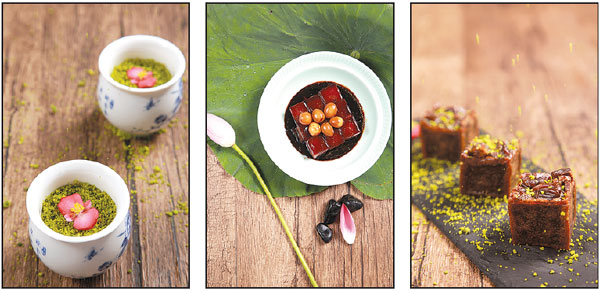
| From left: Cream pudding with Longjing tea sauce; pork braised in brown sauce; walnut cake. Photos Provided to China Daily |
For example, monosodium glutamate is not allowed. Food is colored with natural ingredients such as green spinach juice and red yeast rice.
Pork braised in brown sauce is a common homemade dish that may remind Hangzhou residents of their mom or grandma.
Yu has his own method to make guests mouth-watering of the layers of pork skin, lean meat and fat. The result is fatty but not greasy, soon melting in one's month.
"If there is no oil in the dish, it will not be tasty," Yu says.
His secret to balance the flavor is to choose the best streaky pork. He only uses one small part of the pork belly with the perfect ratio of lean meat and fat.
The livestock is from an organic farm on a mountain nearby the city. One whole pig only offers enough meat of the right quality for 10 plates of this dish.
He then stews it for several hours with slow fire, so the lard will soak into the lean meat.
He uses quail eggs instead of chicken eggs because it's easy for the quail eggs to absorb the flavors and the food plating will look more delicate.
The "four beauties" dish uses four precious ingredients - matsutake mushrooms, fish, water shield (chun cai) from West Lake, and crab roe. It originated from a recipe in a book by scholar Li Yu from the Qing Dynasty (1644-1911).
The thick soup is fresh and tasty, allowing the flavor of each ingredient to shine through.
One of the signature dishes is walnut cake, which is inspired by a traditional Chinese rice cake. It takes two hours to stew the caramel and integrate it with Hangzhou's famous walnut to make the cake.
Chef Yu says it's better to have the tasty dessert with Hangzhou's well-known green tea Longjing.
Guests can have a sip of the tender tea buds picked before Tomb Sweeping Day in early April, which is believed to be the best time to pick spring tea. The delicate fragrance is a perfect match with the sweet dessert.
As a symbol of the city, Longjing tea ("dragon well" tea) is also used in some innovative dishes. Cream pudding with Longjing tea sauce is like a potted flower, delivering the tea's bitter taste followed by bright sweetness.
"In modern society, one's likes about food are different compared with before. For example, about 30 years ago, we all like oily dishes, but nowadays, the trend is to have light food due to concerns such as health," he says.
He says both hotel guests and other customers have access to the restaurant because it's located in a shopping mall.
One has to make a reservation at least one week in advance, and people often line up to get in.

"Our popularity proves that high performance-price ratio is in accordance with consumer expectations. It's a new trend, to target the masses with favorable price."
He says there are not so many business meals; most customers are young people and families.
"Our tableware adopts colors and styles that match our dishes - simple and clean, and to highlight the ingredients themselves. Only a bit ornament is sufficient, such as the patterns of lotus, lotus leaves and lotus pods."
Food is served on slabs of black stone or green porcelain to reflect the beauty of nature.
One of Yu's favorite parts of the decor: The big traditional porcelain teapots because they used to be a popular daily necessity of the locals, and they make guests feel nostalgic.
xulin@chinadaily.com.cn
(China Daily USA 11/07/2016 page10)