


Thrills designed for 'wimps' make giant leap in tourism industry
Self-deprecating 'wonang travel' trend prizes comfort, minimal exertion over adrenaline rush










'No-sweat ascent'
Shenxianju, a national park in Zhejiang's Taizhou city famed for its volcanic rock formations and sea of clouds, has also attracted more visitors since it adopted a "painless ascent" two years ago.
For years, the park's breathtaking scenery, ranging from long suspended walkways to stunning sites like Guanyin Rock (a natural rock formation resembling the praying Goddess of Mercy) and misty waterfalls, came with a physical toll.
Reaching the views required hiking endurance.
But a few years ago, the park management began to think of ways to make the hiking less strenuous, which gave rise to one of the hottest wonang travel trends.
Wu Yan, a Shenxianju administration deputy general manager, said: "We realized that the traditional climbing model no longer met modern travelers' needs."
"More families, seniors, and even young people wanted a friendlier, less strenuous way to experience nature," she said.
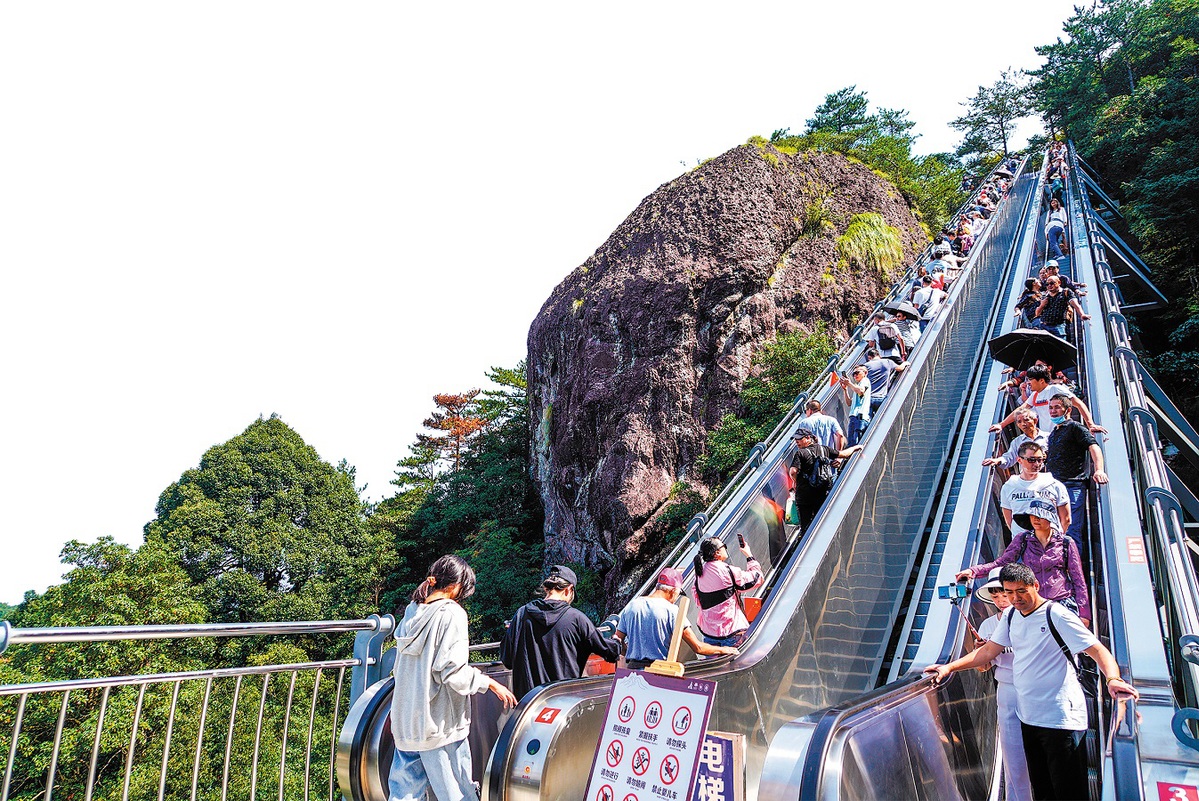
So the park designed a "no-sweat ascent", launched in October 2020, that consists of a carefully engineered system of cable cars, and escalators built into the mountainside, along with gentle walking trails with almost no perceptible incline.
Even the cliffside plank paths were cleverly designed between 750 and 850 meters above sea level, diffusing a 100-meter elevation gain into nearly flat, leisurely walks.
"Where it's still steep, we use escalators. It's all about preserving the views and the comfort," Wu said.
The park now offers more than 10 tailored routes, including those for classic photo opportunities, quiet forest loops, wilderness trails, and family adventure zones.
No matter the path, the goal is the same — let each visitor explore at their own pace.
This year, the online buzz around the "no-sweat hiking" at Shenxianju topped 300 million views, Wu said. Visitor numbers are up 15 percent year-on-year, with a notable rise in international guests and a sharp drop in complaints.
"The fact that 'no-sweat travel' has gone viral shows that tourists now value the experience over exertion," she added.
When asked how many visitors still choose stairs over escalators, Wu was frank. "Basically no one. If there's an escalator, they'll take it. That's just how modern tourists are," she said.
The most powerful endorsement came from a 105-year-old World War II veteran who, with the help of escalators and gentle paths, reached the summit with his family in 2023.
"He played the piano in the mountaintop cafe and took a four-generation family portrait, and said he was grateful to have seen such beauty," Wu said.
Li Wei, dean of the institute of urban planning and tourism landscape design at Northwest Normal University, said wonang travel should not be mistaken for "surrendering", as it reflects a broader transformation in travel values.
Modern travelers, particularly younger generations, are rejecting the "tough it out" mentality in favor of more sustainable and self-aware approaches, he said, adding that mountains and rivers are not there to be conquered, but to be enjoyed and embraced.
The worth of a journey is not measured by its intensity or a checklist of sights, but by genuine comfort and a sense of fulfillment, he explained.
He believes the trend signals the maturation of "emotional consumption" among Chinese youth. At its core lies a pivot from external validation — showing off living the "good life" — to an inward search for personal contentment.




