


Robotics, AI innovations put elderly care on fast track
Aging population benefits from policy support, development of smart devices, services










Boosting institutional rehab
Elderly care institutions and rehabilitation hospitals are important application sites for AI-powered robots, as they require higher degrees of functionality and stability.
The Beijing Taikang Yanyuan Rehabilitation Hospital in Changping district provides integrated medical and elderly care services to Taikang community's 3,700 permanent residents, while also opening its doors to patients from outside the community. The facility uses special lower-limb robots and smart mattresses to support patient rehabilitation and monitoring.
"The devices are easy to operate, comfortable for patients to use, and can help the elderly with hindered mobility regain limb functions," said Zhao Huanhuan, a rehabilitation therapist at the hospital.
A nursing transfer machine is used at the nursing center of Yan Garden. Yi Meijing, a nurse, said the machine helps to safely transfer the elderly, preventing falls, fractures and other risks.
"It can also help to prevent muscle atrophy and pressure sores among bedridden seniors, significantly reducing the physical burden on caregivers," she added.
At a public-private elderly care institution in Haidian, the X-SPA Rehabilitation Therapy Robot from Agile Robots is highly favored.
The device, which integrates visual guidance and AI technology, incorporates three functions — moxibustion, precision vibration and endogenous heat, providing customized therapy for different pains.
Xu Duo, a company employee, said that when a session is selected on the operation end, a traditional Chinese medicine program is automatically activated and the device concentrates on the acupuncture points of the body.
"The most used functions by the elderly, moxibustion and endogenous heat, help regulate the energy flow in the body and relieve fatigue, respectively," Xu said.
As the first domestic company focused on developing products for the nursing needs of elderly people who have lost self-care ability, Shenzhen Zuowei Technology Co manufactured intelligent bowel management robots, intelligent beds, portable bathing machines, transfer machines, walking-assistance robots and dining-assistance robots.
These have been widely used at nursing homes and high-end sanitariums in more than 20 provincial-level regions.
"The intelligent bowel-management robot achieves four fully automatic functions based on the patient's condition without manual intervention, helping the elderly maintain their dignity, which is very important," said Cai Yitong, an assistant to the company chairman.
The dining-assistance robots use AI visual recognition and voice interaction technologies to achieve their tasks, providing an independent and dignified experience for those with upper-limb mobility issues. "During the whole process, we achieve another goal of easing the workload of caregivers," Cai added.
Beijing AI-Robotics Technology Co, a pioneer in the exoskeleton robot industry in China, has seen its rehabilitation series products enter 379 medical institutions nationwide, including Peking Union Medical College Hospital and the Chinese PLA General Hospital, helping numerous elderly patients who are undergoing gait rehabilitation training.
"Many elderly people require rehabilitation training due to lower-limb injuries, muscle function loss, or skeletal issues," said Zhao Pengcheng, a marketing representative of the company. "Our 'Aikang' and 'Aijia' series robots can effectively improve joint and muscle strength through scientific gait training, helping patients stand and walk again."
At the 11th China International Silver Industry Exhibition held in late November in Guangzhou, Guangdong province, a variety of intelligent senior care products focused on health and rehabilitation, attracting industry professionals and visitors to experience them firsthand.
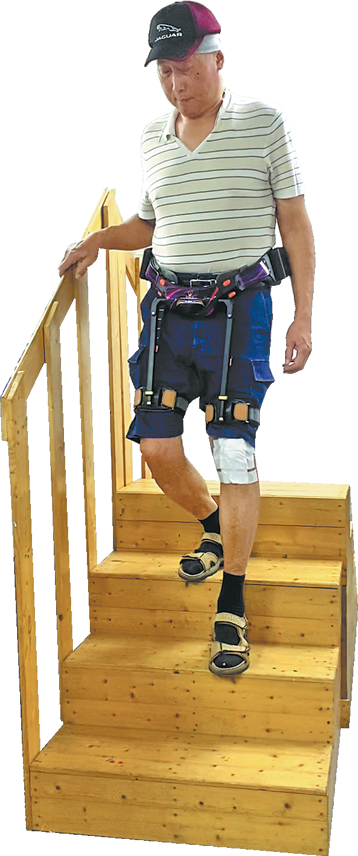
The "Youlong" bilateral hip-assist exoskeleton from Changsha Eulon Robot Co garnered significant attention.
"The smart wearable device can accommodate different body types and straps on for a snug fit," said He Feng, the company's marketing director. "It precisely maps the user's movements and provides adjustable assistance in scenarios such as walking, climbing stairs and hiking, effectively reducing lower-limb burden."
The "Youmai" smart wheelchair, developed by Suzhou Medical System based in Jiangsu province, is designed specifically for senior care institutions. It features easy joystick controls, supports movement in all directions and includes automatic obstacle avoidance, significantly reducing the workload of caregivers.
The product can also be equipped with modules for monitoring vital signs, such as heart rate and blood pressure, with automatic alarms for abnormalities.
"Our products are popular in the overseas markets," said Liu Jiacheng, an employee of Suzhou Medical System. "In the future, we hope to lower costs through technological optimizations, benefiting more ordinary senior care institutions."




