Greenland marks Europe's transition as it draws redline










European states have drawn an unprecedented red line against Washington, signaling that the era of automatic deference in the transatlantic relationship may have ended. In an unexpected answer to United States President Donald Trump's renewed threats to annex Greenland, some European troops joined Denmark in reinforcing the island's security.
It is the first time since Trump's return to the center of international politics that Europe has directly confronted the US president. The move follows a tense trilateral meeting between US, Denmark and Greenland officials that ended without resolving what Copenhagen described as a "fundamental disagreement" over the island's status. Within hours, Trump declared that he still intended to take control of Greenland and that "there's not a thing that Denmark can do about it".
Danish Foreign Minister Lars Lokke Rasmussen added that Greenlanders would never choose to join the US, even if Washington were to pay the rumoured price tag of $700 billion.
Any diplomatic progress was swiftly offset by Trump's mockery of Denmark's military capacity, joking that the country had added "a second dog sled" to its arsenal. But rhetoric matters less than facts on the ground. And on the ground, European military personnel are arriving in Greenland.
The gesture has a deep geopolitical significance. It is an assertion of strategic sovereignty at a moment when Washington is following a diplomacy of intimidation in its bid for territorial expansion. By intervening in a coordinated manner, European states have signaled that they are prepared to collectively defend the territorial integrity of one of their own.
Greenland occupies a central position on the Arctic chessboard. The region is increasingly contested because of emerging maritime routes and its vast mineral and energy resources. By responding to Trump's threats, Europeans are not merely protecting Denmark; they are reaffirming the Arctic as a space governed by multilateral norms rather than a free zone for unilateral adventures. In this sense, the deployment is as much about the rules of the international order as it is about the island itself.
This marks an unprecedented inflection in Europe's posture: less reliant on the political umbrella of the US and more conscious of the need to act as an autonomous geopolitical actor. Militarily, the deployment is modest. Politically, it is weighty. It marks the transition from a reactive Europe to a Europe capable of imposing redlines — even vis-à-vis Washington.
Notably, this is not a European Union decision. The troops were sent by individual states, not by Brussels. Here the optimism starts fading. The EU, riven by internal divisions and long accustomed to strategic subordination to the US, would struggle to take such a step collectively.
Will European countries actually fight the US in the event of an invasion? The question is no longer theoretical. Legally, Denmark would be entitled to invoke collective defense mechanisms, whether through NATO, the EU or bilateral commitments. Politically, a direct military clash with the US remains almost unthinkable.
The European deployment is therefore best read as deterrence rather than preparation for combat: a physical reminder that Greenland is not unclaimed territory and that any attempt to seize it would entail costs, reputational and strategic, that Washington has not faced since the end of the Cold War. The objective is to raise the threshold of action, not to wage war.
Deterrence, however, only works if the threat is credible. That credibility rests less on troop numbers and more on unity and resolve. By acting together, even outside EU structures, European states are constructing a minimal but visible line of defense; one that transforms Trump's rhetoric from theatrical bluster into a concrete test of transatlantic relations.
Europe's response over Greenland is thus fragile, partial and experimental. But it is also unprecedented and reveals a continent tentatively learning to think in terms of power, boundaries and deterrence, even when the challenger is its traditional protector. If this bodes badly, it is because it does. The post-war order was built on the assumption that US power, however overwhelming, would be exercised within a shared framework. Trump's Greenland gambit destroys that premise. Europe's reply suggests that it is beginning, very late, to grasp the implications.
Meanwhile, we had Trump's discourse at the World Economic Forum in Davos, which reinforced the coercive ambiguity that now characterizes Washington's approach to Greenland and, more broadly, to Europe. In Davos, Trump explicitly ruled out the use of force while simultaneously issuing veiled threats of long-term retaliation should Europe refuse to acquiesce, thereby combining reassurance and menace in a single discursive move.
Later he claimed to have established a "framework" for a future deal on Greenland with NATO, despite the absence of consent and protests from Denmark or Greenland. The reported discussions about US sovereignty over portions of Greenland territory for military bases, modelled on British bases in Cyprus, suggest an emerging search for face-saving compromises that stop short of outright annexation but still test European red lines.
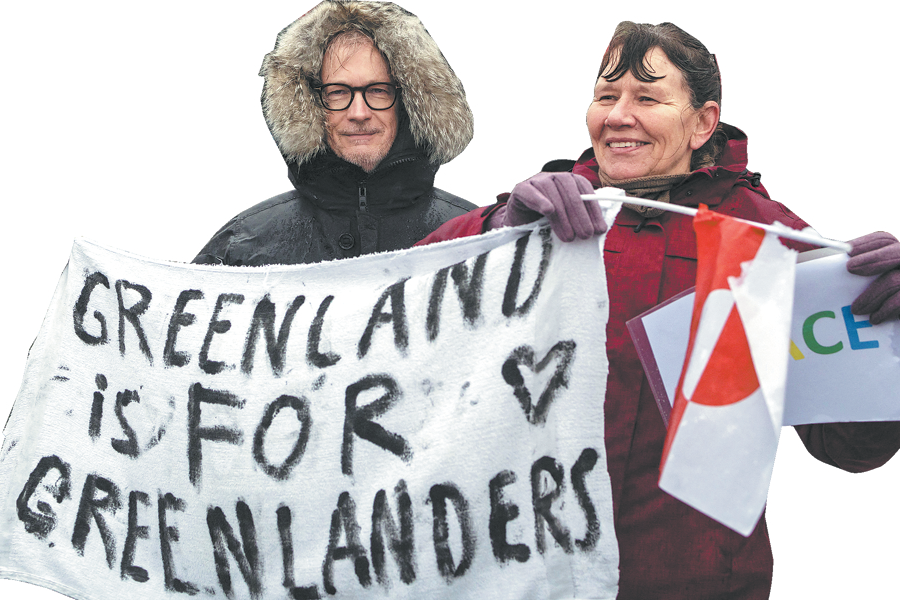
Yet Greenlandic representatives forcefully rejected any negotiation conducted "about us, without us", exposing the democratic deficit inherent in such back-channel bargaining.
Overall, Davos marked less a de-escalation than a recalibration: economic pressure was temporarily eased, but strategic pressure intensified, pushing Europe to confront the reality that even core questions of territorial integrity are now subject to transactional deal-making within the Atlantic alliance.
The transatlantic alliance is already broken, some European officials say. At the very least, the illusion of automatic reliability has been eroded.
The author is an independent researcher and international analyst based in the Netherlands.
The views don't necessarily reflect those of China Daily.
If you have a specific expertise, or would like to share your thought about our stories, then send us your writings at opinion@chinadaily.com.cn, and comment@chinadaily.com.cn.