Chinese edition of Technological Singularity comes at right time


In his book The Singularity Is Near, American computer scientist Ray Kurzweil had predicted a decade ago that by 2045 non-biological intelligence will have exceeded biological intelligence on Earth due to exponential changes in infotech, biotech and nanotech. Basically, man and machine will become one.
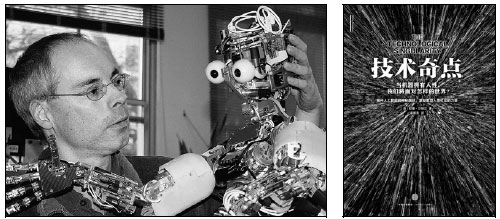
But Murray Shanahan, a London-based cognitive robotics professor, disagrees with Kurzweil's theory in his more recent book, Technological Singularity.
"Kurzweil was very precise (about time)," Shanahan tells China Daily in an interview in Beijing. "Technological singularity has a very dramatic impact on humanity."
But for Shanahan, it is a thing of the future that may or may not come, and in which human-level artificial intelligence is quickly followed by super AI.
When human-level AI is realized, it has the ability of self-improvement. As a result, a machine's intelligence will surpass that of people.
It's a revolution that is expected to bring various benefits to society, but also possible threats that force us to think about moral problems in building super smart machines with or without a human heart.
A Chinese edition of Technological Singularity was recently published by China Citic Press. It comes at a time when such concepts are being hotly discussed in the domestic infotech industry.
"The book is easy to follow as the author, a veteran researcher, has used simple language to explain AI and technological singularity," says Bi Yiling, the editor at Citic who is responsible for introducing the book to Chinese readers.
Scientists and engineers are now trying to build human-level AI in three ways: One is to scan the brain and copy its biological behavior through a computer; next is to build human-level AI from scratch, like neural networks used in the machine learning system of AlphaGo; and the third is to combine the first two approaches.
Shanahan, 51, teaches AI and computational neuroscience at Imperial College London.
When British director Alex Garland was preparing for his later Oscar-nominated film Ex Machina, he came across Shanahan's previous book Embodiment and the Inner Life, which is about cognition and AI consciousness.
In the film, AI maker Nathan tries to find out if his work Ava has consciousness.
"The movie is not only about intelligence, but also consciousness. Certainly, Ava seems to have human-level AI," Shanahan says, adding that one needs to keep in mind that it is a film.
"My book isn't meant to be science fiction, but is a speculation about the future. It's meant to be real," he says.
In his book, Shanahan prods readers to think about where humans are going as they face a future that may be totally incomprehensible based on our current knowledge of things.
AI is expected to bring us more convenience. Today, many people use "personal assistants" on their mobile devices, such as Apple's Siri, Cortana on Microsoft and so on.
Although self-driving cars will likely cause unemployment issues, they are expected to be more energy-efficient and safer.
A large number of people die or are badly injured in car accidents because of human error, but self-driving cars would be able to stop at short notice when sensing an obstacle, he says.
In his book, Shanahan argues that two misunderstandings exist in media. One, that AI has been achieved or is coming soon and two, that the universal possibility of human-level AI is a fantasy.
Earlier this year, Google's AlphGo, a robot built with a deep learning system and a one based on trial and error, beat human players in the games of Go, a more complex game than chess, in which field robots have long beaten people.
Although AlphGo is quite clever and even made creative moves in playing the games, it can't do anything else.
But the victory of machines raises questions such as: Are robots going to take over the world?
Shanahan says we are still a long way from achieving human-level AI due to limited computational and cognitive powers as well as current machine learning technologies.
Although he doesn't know by when it will come or what will mark its arrival, Shanahan is confident that technological singularity will eventually happen.
"The human brain can do it."
yangyangs@chinadaily.com.cn
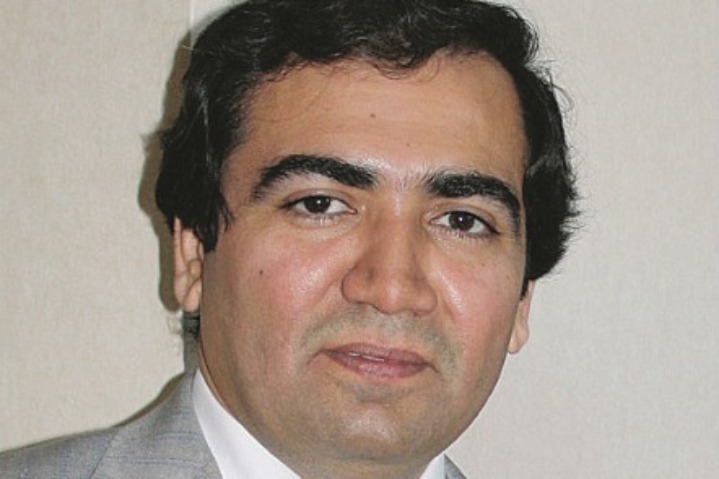
| British author Murray Shanahan says his new book on AI 'isn’t science fiction but speculation about the future'. Photos Provided To China Daily |
(China Daily USA 05/25/2016 page10)