Lots of Chinese influence in the great master's works


Although Spanish master architect Antoni Gaudi never visited China, oriental elements are widely seen in buildings designed by the genius from Barcelona, experts said at the 2nd Gaudi World Congress in Shanghai in June.
Images of Chinese dragons and porcelain and ceramics seen in many of Gaudi's works and Gaudi's philosophy of naturalism are influenced by Chinese culture, says Pere Jordi Figuerola, a historian and expert on Gaudi.
The first Gaudi World Congress held in 2014 in Barcelona saw more than 500 scholars and experts from across the globe discuss the architect's life and work.
At the congress, many experts acknowledged for the first time that Chinese culture had influenced Gaudi.
More research on this was then done following the congress, according to Hou Teh Chien, the man behind last month's congress in Shanghai.
"That's why we organized the second event in China," says Hou, adding that the congress will be held every two years until 2026.
According to research, the images of Chinese dragons, which are seen on Gaudi's buildings, were taken from ancient Chinese coins, which he had access to thanks to his close friend Eduard Toda, who was a diplomat in China from 1876 to 1882.
During his six years in China, Toda collected more than 10,000 Chinese coins, and many had images of Chinese dragons and phoenixes on them.
He also acquired lots of Chinese artworks and books, and finally became a well-known Sinologist.
It was from Toda that Gaudi learned about Chinese culture.
Gaudi even brought Toda together with one of his backers, Eusebi Guell, to discuss buying Toda's Chinese coins.
"From the coins, art works, books and photos Toda carried from China, Gaudi had a fundamental understanding of the culture and later incorporated it in his works," says Figuerola, one of the founders of the Gaudi Research Institute in Barcelona, an academic institute working with the University of Barcelona.
Figuerola says that the two tortoises under two giant stone pillars in Gaudi's signature work Sagrada Familia are definitely Chinese elements.
The Sagrada Familia is a large Roman Catholic church. Although incomplete, the church is a UNESCO World Heritage Site.
Construction of Sagrada Familia commenced in 1882 and Gaudi became involved in 1883, taking over the project and transforming it with his architectural and engineering style.
Gaudi devoted his last years to the project, and at the time of his death at age 73 in 1926, less than a quarter of the project was complete.
Construction passed the midpoint in 2010, and the project now has an anticipated completion date of 2026, the centenary of Gaudi's death.
Other Chinese elements that Gaudi used in his works include porcelain and ceramics.
Hou says that Gaudi put lots of things from nature into his works to show a harmonious relationship between humans and nature, which in Gaudi's time was inspired by Chinese philosophy.
Hou, who was one of the first Chinese experts to study Gaudi, began that work in the 1980s.
Last year, Hou set up Gaudi Shanghai Projects to boost research on the architect as well as increase exchanges in culture and art between Spain and China. It's authorized by the Gaudi Barcelona Projects, a company formed to spread and apply knowledge all about Gaudi issued by the Gaudi Research Institute.
He plans to open a Gaudi-themed restaurant in Shanghai later this year, featuring menus inspired by Gaudi's art.
"The architect created so many marvelous works influenced by Chinese culture. Why can't we learn from him and do something in China in return," says Hou about his works on Gaudi and the plans related to him in future.
In fact, many foreign master architects influenced by Gaudi are now designing buildings for China, such as Italian architect Benedetta Tagliabue.
Tagliabue, who attended the congress in Shanghai, admits that her obsession with curved lines comes from Gaudi.
The Italian architect gained fame for her design of the Spanish Pavilion for the Shanghai Expo in 2010 and the new Scottish Parliament, a joint effort with her husband Enric Miralles.
Tagliabue is now designing the Zhang Daqian Museum in Neijiang - Zhang's hometown in Sichuan province. In her work dedicated to Zhang - one of the best-known and most prodigious Chinese artists of the 20th century - she integrates many oriental elements, such as bamboo and gourds.
She says it's very interesting that she is now doing architecture for the Chinese after she was influenced by Gaudi, who was first influenced by Eastern culture.
Hou says Gaudi's influence in the world is not only limited to architecture but includes many other fields - art, city planning and even food.
He hopes all this can be used by the Chinese to develop more creativity in the future.
dengzhangyu@chinadaily.com.cn
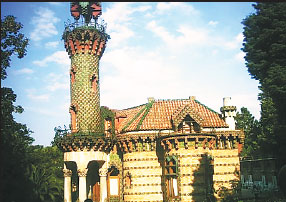
| El Capricho de Gaudi, a summer house built from 1883 to 1885 by Gaudi in Comillas, bears the green glaze and brackets that are unique in China's ancient architecture. Provided To China Daily |
(China Daily USA 07/05/2016 page7)