A lake brimming with culture


Diverse experiences emanate from Xianghu's rippling waters, Xu Lin discovers.
Hangzhou's Xianghu Lake is often called West Lake's "sister".
Visiting the water body indeed enables travelers to understand Zhejiang province's history.
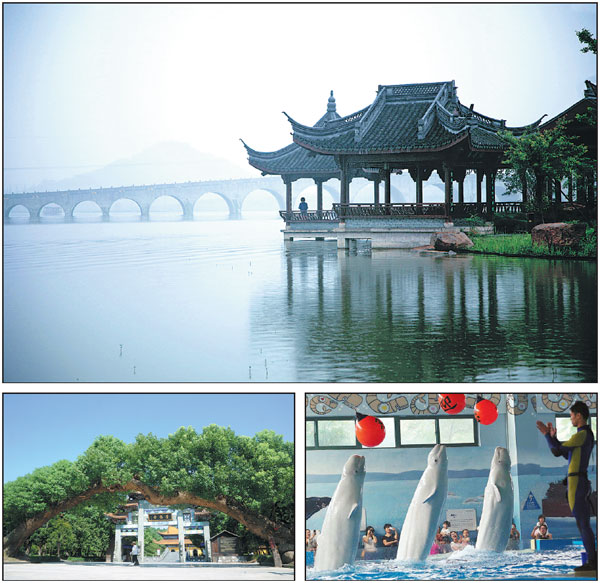
| Top: Hangzhou's Xianghu Lake features culture and natural landscapes, and is considered West Lake's "sister". Above left: Traditional architecture at Hangzhou Oriental Culture Garden. Above right: White whales dance at the daily shows at Hangzhou Polar Ocean Park. Photos by Xu Lin / China Daily and Provided to China Daily |
Xianghu Lake Tourism Resort offers a perfect platform for this.
Visitors can enjoy culture and leisure in scenic spots scattered along the banks, by foot or boat.
The Kuahuqiao Site Museum hosts an 8,000-year-old canoe and is shaped like one itself. The actual watercraft was repaired with tree sap by its builders.
It also houses pottery and prehistoric stone, bone and wooden artifacts.
Kuahuqiao culture's discovery pushed the known history of Zhejiang's civilization to eight millennia ago, 1,000 years earlier than previously believed.
The exhibition room is in the original site - beneath Xianghu Lake's surface.
Machines monitor humidity, which is high given the location, and cracks in the canoe.
"It's tricky to prevent threats like mold and microorganisms," curator Wu Jian says.
There's no precedent for such preservation, he says.
The museum is next to Hangzhou Polar Ocean Park, which boasts 18 animal and 1,000 fish species.
Dolphins dance and sing, and a breeder dances with a leopard shark at the daily shows.
The main characters of Finding Nemo and Finding Dory are represented - clownfish, royal blue tang fish and humpbacks.
If you're lucky, you can spot a shark's tooth at the bottom of aquariums, as they replace their teeth throughout their lives. Looking up in the arch tunnel, you may see a leopard shark resting on its belly since they're nocturnal.
Visitors often confuse languid penguins for statues - until they move.
The Snow Village Room enables guests to experience polar temperatures with the benefit of thick coats distributed at the entrances.
The park's mascots, including a turtle and a polar bear, are rendered as ice sculptures enjoying a birthday party at the beach with fruit and desserts.
It also offers bumper cars and ice slides.
Nearby, Hangzhou Oriental Culture Garden hosts traditional architecture influenced by Confucianism, Buddhism and Taoism.
The 800-year-old Yangqi Temple was rebuilt on its original site and today draws many Buddhists.
Near the entrance, a rockery, inside a fountain that splashes to religious music, serves as the pedestal for a statue of Guanyin (Goddess of Mercy), who pours holy water from a jar - and disappears when the song stops.
The beams and ceiling of roughly 2,700-meter corridor running through the garden is decorated with ornate paintings. Motifs include West Lake scenery and references to Journey to the West, one of China's four most-celebrated literary works.
The garden will host a Xi Shi stage show with an actual mountain and river as the background in November.
Its namesake protagonist - one of the "four beauties" of Chinese history - was given as tribute to the king of Wu by the newly subjugated Yue kingdom in the Spring and Autumn Period (770-476 BC). The goal was to distract him from state affairs so Yue could rise up and reclaim independence. It worked.
"It's about love, kinship and the pursuit of peace," chief planner and screenwriter Xie Guoquan says.
"The plot integrates folk culture with natural scenery to touch audiences."
The show features about 300 performers.
Special effects endow objects with human emotions, he says.
For instance, snowflakes fall and trees turn white when Xi Shi's parents escort her to the Wu palace.
Mother Nature uses natural effects to change the entire lake area's scenery throughout the year in ways that have inspired visiting poets to pen prose.
The water body is ringed by a roughly 15-kilometer cycling lane with bike rental and resting places. Two stone pathways curl up the surrounding mountains.

A total of 108 bridges of different styles and from different eras showcase the history of local architecture. (Some are original and others are replicas.)
The lake itself was recently restored to its original gourd shape and expanded to the 6-sq-km size of ancient times.
Xianghu Lake Tourism Resort Working Committee head Han Changlai says: "We hope to attract visitors to enjoy the culture, natural landscapes and good air."
Contact the writer at xulin@chinadaily.com.cn
(China Daily USA 09/07/2016 page9)