Where his story started


Lu Xun's legacy lives on in his hometown, Xing Yi discovers.
It was an overgrown lot. But it was also so much more.
Today, it's an immortal icon.
That's because it was integral to the early life of the late writer, Lu Xun, who's celebrated as China's foremost literary luminary in the early 20th century.
"There was a large garden in the rear of my house, and people call it the (Bai Cao) Hundred-Grass Garden ... Indeed, only some wild grass grew in it, but at that time it was my paradise."
So goes the opening prose of his essay From Bai Cao Garden to San Wei Study.
Chinese students today are required to recite this article about the writer's childhood in Zhejiang province's Shaoxing.
I recently visited the literary pioneer's childhood residence to see for myself the places I'd read about.
I made the 10-minute drive from the Crowne Plaza Shaoxing in the new development zone to the historical and historic part of town that hosts Lu Xun's old abode.
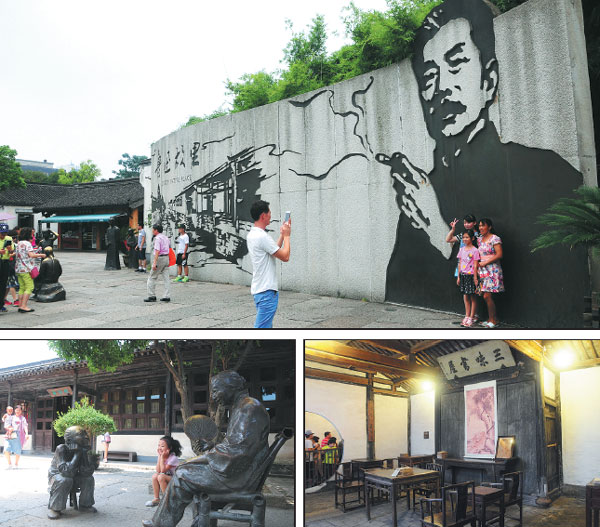
People endured extreme heat and humidity to stand in line to pose in front of a huge portrait of the man of letters painted at the entrance. It indeed depicts him in all his scruffy-haired, mustachioed, square-jawed glory, a cigarette clenched between his fingers.
Upon entering, I strolled along a cobblestone street flanked by a narrow canal. Black-tent boats bobbed languidly between two stone bridges.
Snippets of conversation that caught my ear as I wondered among old houses and parlors referenced characters from Lu Xun's works, such as Ah Q and Run Tu. Indeed, voices of people of all ages and accents speak in ways that give voice to the reality that Lu Xun remains an ingrained fixture in the Chinese consciousness.
Lu Xun is the pen name of Zhou Shuren, who was born into a large and wealthy family in Shaoxing. The first courtyard I encountered was the Zhou family's home. But the death of Lu Xun's father brought the family into decline, forging hardships in the author's early years.
His parents valued education. So Lu Xun spent most of his youth at the San Wei Study across the street, where a prestigious teacher instructed him in Chinese classics.
The name San Wei, which literally translates as "three flavors", refers to comparisons of different types of reading to different types of foodstuffs.
Confucian classics are like rice. History books are like dishes. And literature is like sauce and seasoning.
The combination of these comprises the recipe for traditional Chinese education.
It was in this strict learning environment where Lu Xun came to master a solid understanding of the Chinese classics. His desk remains in the same place he used it in the classroom.
Parents often bring their children to inspire them and remind them of the importance of meticulous study and hard work.
It was after hours of hitting the books each day that Lu Xun would unwind in Baicao Garden in his backyard.
I later visited a museum dedicated to the literary master down the street.
Lu Xun eventually left Shaoxing to receive a Western-style education in Jiangsu province's capital, Nanjing. He departed from there to study Western medicine in Japan in 1902.
His ambition to become a physician changed after he saw a documentary one day after classes at his medical school.
The film about the then-ongoing Russo-Japanese War (1904-1905) showed a scene in which a Japanese soldier beheaded a Chinese man. The crowd included many Chinese who had "come to enjoy the spectacle", Lu Xun wrote in the preface of Call to Arms, his first short-story collection.
"Physically, they were as strong and healthy as anyone could ask, but their expressions revealed all too clearly that spiritually they were calloused and numb," he wrote.
He decided then and there to quit medical school and become a "literary physician" to treat the spiritual illness of Chinese people at that time.
Lu Xun repatriated in 1909.
He worked in the new government's education ministry after the Qing Dynasty's (1644-1911) fall. He later taught at several universities, including Peking University and Beijing Normal University, and kept writing until his 1936 death.
Many of his works are based on his early life in Shaoxing.
It seemed as if characters from his works occupied the street when I left the museum.
So I headed to Xian Heng Restaurant - an eatery that features prominently in his works - for lunch. That is, to enjoy an actual meal as well as food for thought.
Contact the writer at xingyi@chinadaily.com.cn
If you go
Lu Xun Native Place
393 Luxun Middle Rd, Shaoxing, Zhejiang province. 0575-8513-2080
(The site is admission free, but visitors must show ID.)
| Lu Xun's Old Abode, the childhood residence of Chinese literary pioneer Lu Xun in Shaoxing, Zhejiang province, is a hot spot for Chinese tourists, especially parents who bring their children to inspire them. Photos By Xing Yi / China Daily |
(China Daily USA 09/19/2016 page9)