



US foreign policy shift threatens global order, stability: Experts
'Donroe Doctrine' seen to erode trust in intl law, multilateral mechanisms









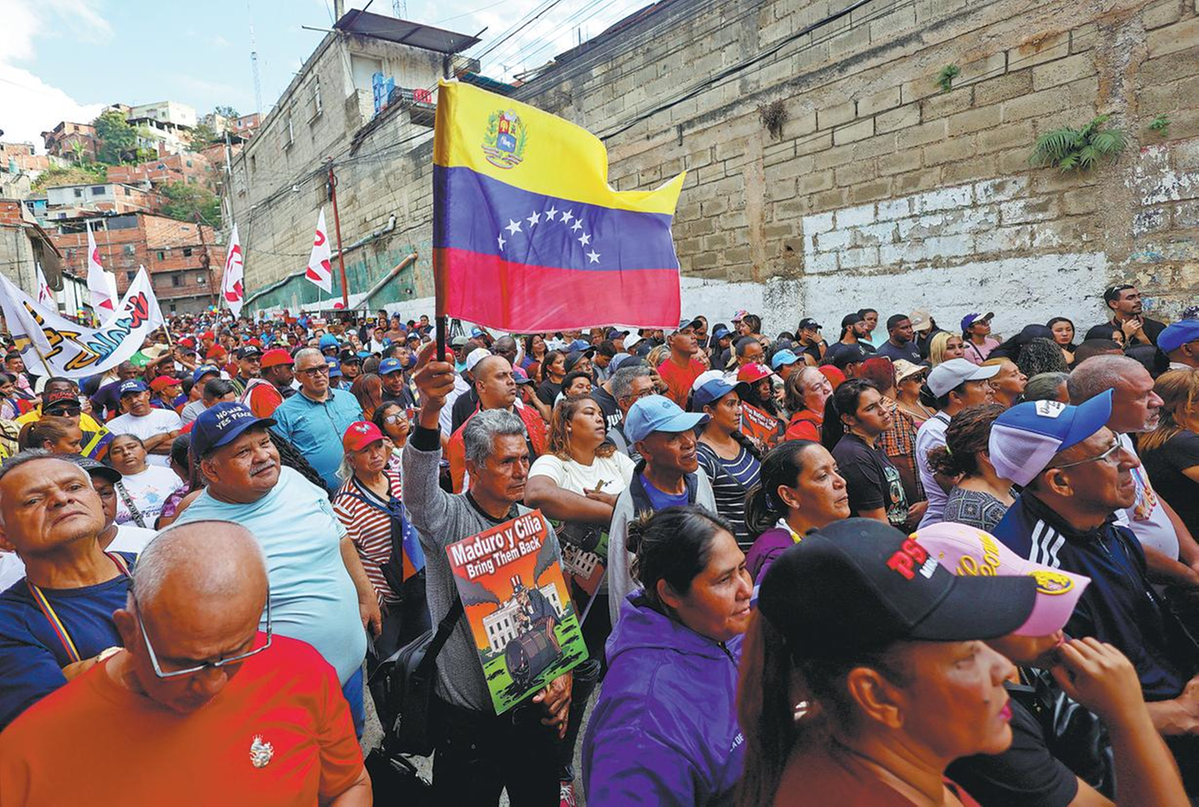
The Trump administration's recent actions, from military raids against Venezuela to reiterating its intention to annex Greenland, signal a concerning shift in US foreign policy toward unilateralism, experts said.
These actions, guided by what experts termed as the "Donroe Doctrine". They added that this new type of Monroe Doctrine, which prioritizes direct expansionary power projection over international law, is set to severely erode the current global order and stability, with a possibility of leading to military conflicts.
At a news conference on Jan 3 after US forces raided Venezuela and abducted its President Nicolas Maduro, US President Donald Trump framed the operation as part of a revival of the Monroe Doctrine, which is a US foreign policy introduced by US president James Monroe in 1823, establishing the Western Hemisphere as a US sphere of influence. "The Monroe Doctrine is a big deal, but we've superseded it by a lot, by a real lot," Trump stated. "They now call it the 'Donroe Doctrine'."
The new doctrine's practical implications have rapidly unfolded. Beyond the Venezuela intervention, the US administration has threatened further actions, including reiterating its intention to annex Greenland and suggesting potential military moves in Colombia and Mexico.

Wei Zongyou, a professor at the Center for American Studies at Fudan University in Shanghai, noted that from the explicit call to enforce a "Trump Corollary" to the Monroe Doctrine in the latest US National Security Strategy, released in early December, to the strikes on Venezuela, it's clear the "Donroe Doctrine" has become a guiding principle of the administration's foreign policy.
Wei explained that the core tenets of the "Donroe Doctrine" include viewing the entire Western Hemisphere as a US sphere of influence, with no tolerance for regimes that the US sees as adversaries or even foes within it and a willingness to use military force for regime change if necessary.
The new doctrine also aims to exclude the so-called "non-Hemispheric" powers from political and economic influence in the region and ensure US control over the region's strategic and economic interests, including key infrastructure, energy, and mineral resources, said Wei.
Sun Chenghao, head of the US-Europe program at Tsinghua University's Center for International Security and Strategy, said the US administration's upgrading of the Monroe Doctrine reflects a redefinition of the US' traditional security perimeter amid shifting global power dynamics.
While the Monroe Doctrine was largely defensive, aimed at preventing European colonial intervention in the Americas, the "Donroe Doctrine" represents a proactive approach to shaping regional order, said Sun.
Its scope has also expanded, Sun noted. "The focus of the 'Donroe Doctrine' is no longer solely on military presence. It also concerns whether non-Hemispheric countries are establishing long-term influence in critical infrastructure, energy corridors, and strategic assets".
Critical foothold
"Once external forces — especially those defined as its strategic competitors — gain a critical foothold in the Western Hemisphere, the US no longer relies on diplomatic pressure but tends to disrupt them through direct deterrence or even limited military operations to block them,"Sun said.
Wei noted that, unlike the Monroe Doctrine born in an era of imperialist expansion and jungle-law mentality, the "Donroe Doctrine" is being proposed in an era where international law exists. "It completely shatters the post-World War II international order based on the UN Charter," Wei said.
According to an interview published in The New York Times on Thursday, Trump said his "own morality" was the only constraint on his power to order military actions around the world. He then added that he needs to abide by international law, but "it depends what your definition of international law is".
World leaders are expressing growing unease. Singapore's Senior Minister Lee Hsien Loong voiced concerns about the US military intervention in Venezuela, saying that it contradicts international law and the UN Charter.
French President Emmanuel Macron accused the US of "breaking free from international rules", while German President Frank-Walter Steinmeier has criticized the US administration's foreign policy and urged the world not to let the world order disintegrate into a "den of robbers".
Sun warned that for the international community, the "Donroe Doctrine" sends a dangerous message that rules and institutions can be temporarily set aside in the face of a major power's core security concerns. "This will erode trust in international law and multilateral mechanisms, potentially prompting more countries to adopt hedging strategies or rely on a security logic of power against power."
"The international system may move further toward fragmentation, with global governance costs rising, posing long-term challenges to the predictability and stability of the entire international order," Sun added.
"The 'Donroe Doctrine' clearly poses a threat to the sovereignty and territorial integrity of small and medium-sized countries, creating a chilling effect on these countries. It is a blatant trampling of the post-World War II international order," said Wei. "The international community should vehemently condemn such actions in multilateral platforms to prevent their recurrence. At the same time, major powers within the UN should join hands to resist the bullying behavior of the US collectively."
Agencies contributed to this story.










