


Coo the music, pigeons set city's tone
Beijing breeders keep tradition of whistling wings, ornamental and racing birds alive











Harmonious flight
He Yongjiang, now 77, remembers growing up in the hutong area near Beijing's second ring road.
"Along our street, eight or nine out of every 10 households might keep pigeons," he recalled.
The birds were kept above courtyard homes and released to circle over the neighborhood. Many carried pigeon whistles, small devices attached to their tail feathers that sounded as air passed through them in flight.
His wife, Shang Liping, grew up around Taoranting, in another part of old Beijing. She remembers hearing the whistles, even during school.
"Sometimes when we were having physical education class, you'd suddenly hear the whistles in the sky," she said. "Even the teacher would tell us to stop, and we'd just listen to the pigeon whistles.
"We found it very soothing, something that drew you in," Shang said. "I always felt there was something mysterious about pigeons."
He learned to make the whistles by watching older craftsmen and gradually picked up a skill traditionally passed on by demonstration and word of mouth. He is now a representative inheritor of Beijing pigeon-whistle making, an intangible cultural heritage item of the city.
The whistles came in different shapes and sizes, but they were made to work in harmony in the sky.
In Beijing, a flock traditionally consists of 12 pigeons, He said. "You might put six different whistles on six of them, and together they form a chord," he said.
"You'd see their wings flashing in the sunlight, and at the same time hear this chord, this light music," He said. "That sound — I can still remember it now."
Pigeons fitted with whistles can become more animated, turning and circling in what keepers call shuaipan, or showing off the flock in flight. "They know they're wearing whistles," He said. "They're happy, too."
Around 2010, Shang began documenting the terminology, forms and techniques associated with pigeon whistles. The knowledge had long been passed down orally.
The settings in which the couple first encountered pigeons have changed substantially. Many low-rise neighborhoods where rooftop pigeon lofts were once common have been redeveloped, while high-rise communities offer far less space.
He said there is also the issue of community hygiene to deal with. "People can use a toilet. Pigeons can't," he said. "If they leave droppings at somebody else's home, people aren't going to be happy about it."
He and Shang now live in Yanjiao, Hebei province, just outside Beijing. Their courtyard home still houses dozens of pigeons, allowing him to continue raising the birds and testing his whistles.
Li, the veteran pigeon-keeper, has long favored ornamental pigeons. Unlike racing pigeons, they are bred in different colors for visual appeal.
"They look beautiful when they fly," Li said. "They don't go far from home — usually they just circle within about a kilometer."
His pigeons have also taken on another role as peace doves.
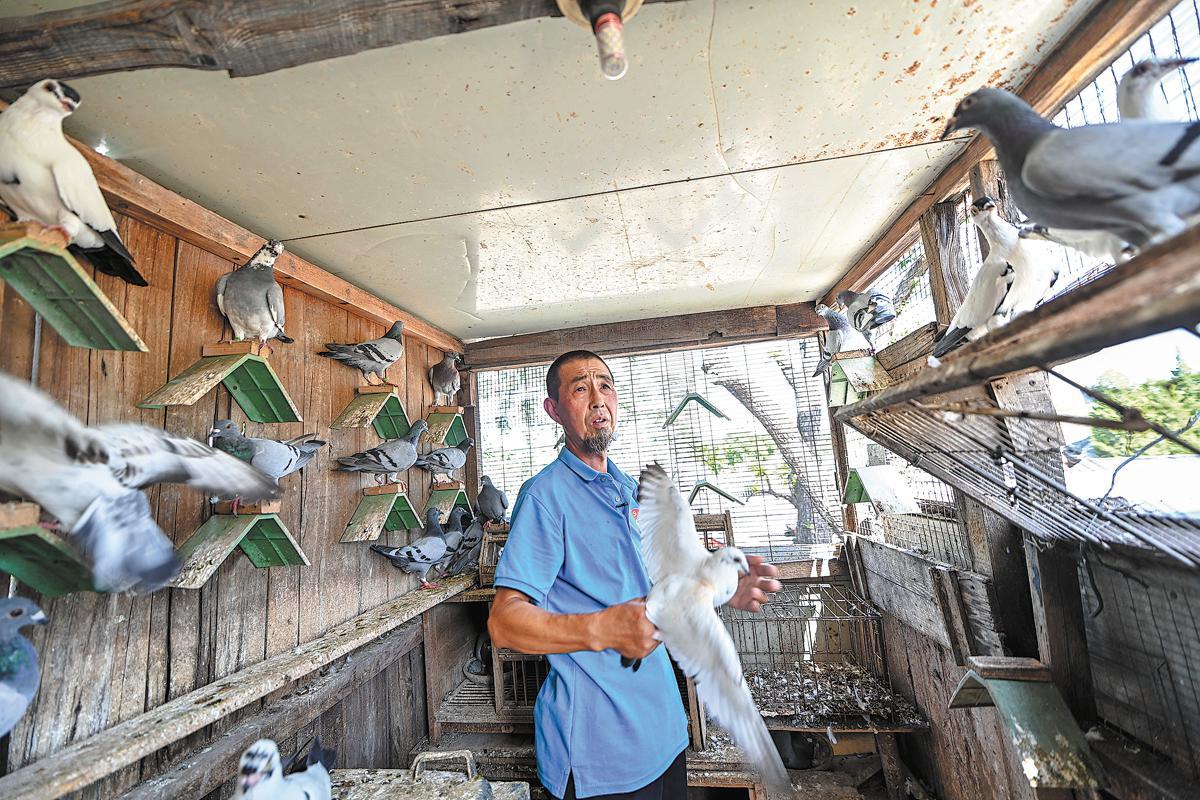
On Sept 21, some of his birds were released at the Beijing event for International Day of Peace. They were also featured at the same event last year, as well as other major ceremonies.
Large-scale releases of peace doves at major public events in China date back decades. Sun Xin, a former director of the National Zoological Museum of China, said the first large release was during celebrations for the 10th anniversary of the founding of the People's Republic of China in 1959.
At the Sept 3 commemoration last year marking the 80th anniversary of the victory in the Chinese People's War of Resistance Against Japanese Aggression (1931-45) and the World Anti-Fascist War, 80,000 pigeons were released over Tian'anmen Square. They were provided by over 3,000 pigeon keepers from 10 Beijing districts, according to Beijing Daily.
Li is proud to show videos and photographs stored on his phone of his pigeons taking part in such events.
"These pigeons have always been part of Beijing," Li said. "You see them flying around the old buildings — it makes a difference to how the whole cityscape looks."




