


Australia faces record surge of COVID cases as Omicron spreads
By KARL WILSON in Sydney | chinadaily.com.cn | Updated: 2022-01-07 18:11


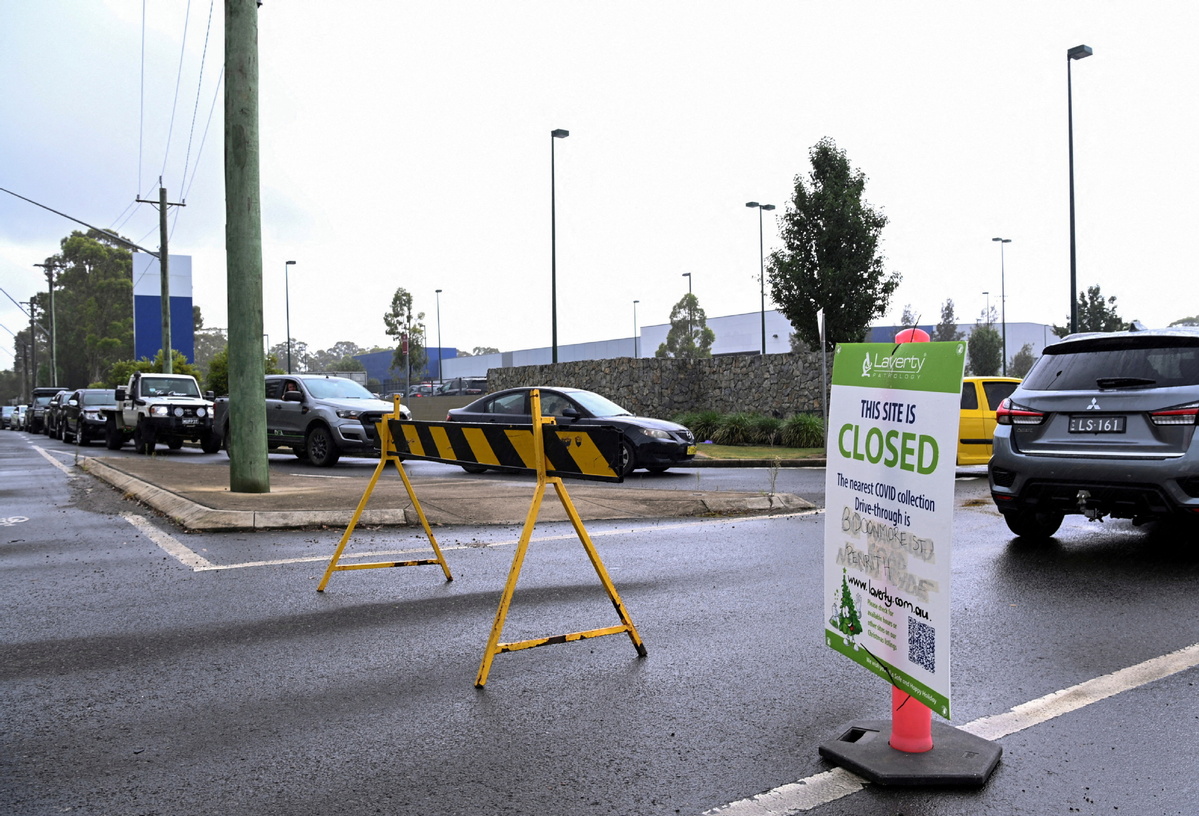
It was not all that long ago that it seemed that Australia had the COVID-19 virus under control, including the Delta variant, and people and businesses in the country could afford to relax. But along came Omicron, and suddenly everything has changed.
Even for those who have had a third booster, the new coronavirus variant has become a threat.
And Omicron takes no prisoners — it affects the vaccinated as well as the unvaccinated. And as Phelps put it, "picking off the medically vulnerable, immunocompromised people and children" as well.
With new infections soaring to record levels in recent days, putting a strain on the nation's hospitals and prompting isolation measures that is leaving some industries, particularly transportation, grappling with worker shortages, the government is facing growing scrutiny over its handling of the pandemic.
Questions are being raised as to whether authorities acted in haste in easing up on COVID curbs, including social gathering rules and border controls, and also whether they pursued the right strategy in regard to virus testing and contact-tracing.
In December, despite the emergence of Omicron and warnings from health experts that Australia faced a major health catastrophe, border closures were lifted and restrictions on all social gatherings scrapped.
The decision had more to do with business rather than health. The fact Australia has one of the highest vaccination rates in the world created a false sense of security.
Now, daily case numbers are 30 times what they were at the peak of the Delta variant, and some scientists are predicting that the worst is yet to come.
Raina MacIntyre, professor of global biosecurity at the University of New South Wales, said Australia has swung from one extreme to the other in pandemic control.
"Instead of rushing to expand capacity, state and federal governments restricted access to testing by narrowing the definitions of who is eligible for a test and of what a close contact is," MacIntyre said.
She noted that authorities had pivoted to a strategy of using rapid antigen tests, as the traditional PCR (polymerase chain reaction) testing overwhelmed testing centers and pathology labs.
"The net effect of inaccessible, restricted and expensive testing combined with vastly reduced contact-tracing has toppled two pillars of epidemic control: test and trace. Modelling for the national plan assumed these would be still standing. Without these, it will get much worse.
"The public has been left to their own devices as all our previous safeguards collapse around us", MacIntyre said.
Scott Morrison, Australia's prime minister, has repeated on several occasions that Australia and its people must learn to live with COVID.
Despite record numbers of daily Omicron infections, the government has said that Omicron is not as serious as Delta and that it will go ahead and throw open the economic gates.
Kerryn Phelps, a medical doctor and former president of the Australian Medical Association, wrote in an opinion piece in The Guardian newspaper on Jan 4: "How did Australia go from being the envy of the world with our best practice public health measures, low case numbers, a prepared health system and an economy ticking along nicely to what can only be described as a shambolic mess?
"The only example Australia is providing to the world now is a warning about what not to do with the COVID-19 pandemic."
At the start of the pandemic Australia became a role model. It saw testing, tracing, isolation and quarantine as the way forward to defeating the virus. It also pushed vaccinations as the key.
But all that seems to have fallen apart even as Omicron became a big threat.
Just before Christmas, when most Australian states required a COVID test at least 72 hours before travel, the testing centers and pathology labs in New South Wales, or NSW, and Victoria were overwhelmed and could not meet the demand.
Airlines were forced to cut services as staff reported sick. In NSW, the country's most populous state, supermarket shelves are becoming noticeably bare as supply chains become clogged due to workers coming down with Omicron.
Omicron may not be as deadly as the Delta variant, but it is having a far wider impact.
The numbers speak for themselves. On Jan 5, Australia reported 64,774 new COVID cases, up from 47,738 the day before. On Jan 6, the daily cases hit yet another record, with 72,392 new infections reported. And the number does not include figures from the state of Western Australia, which was late in its filing, according to a Reuters report.
Most of the cases on Jan 5 were in NSW (35,054), followed by Victoria (17,636). Even the island state of Tasmania, which had been COVID free until the border restrictions were dropped on Dec 15, was struggling with 867 cases that day.
On Jan 5, Australia's Cabinet decided to slash COVID testing requirements to ease pressure on testing centers and pathology labs, especially in NSW and Victoria.
Even so, doctors and health officials are saying the public health system around the country is now in crisis.
Jaya Dantas, professor of international health at the Curtin School of Population Health at Curtin University, Western Australia, said: "Like any outbreak, we need to be especially vigilant during the Omicron outbreak and need to take the spread of this variant seriously."
She pointed out that Omicron is highly transmissible, with case numbers surging across the world.
"While ICU presentations and patients on ventilators are not as high as (for) the Delta variant, its high transmissibility means we have seen its impacts felt across sectors," Dantas said.
"Hospitals, health systems, the aged care system, the retail sector, airline staff and other supply chain sectors are impacted due to workers on furlough having contracted COVID or being a close contact."
The professor added that there is also "an unprecedented burden on testing laboratories, reagents and staff, causing a backlog and long wait times for PCR tests and a shortage of rapid antigen tests".
Dantas said early evidence indicates that the Omicron variant of the coronavirus is affecting the upper respiratory tract, which results in milder symptoms than previous strains.
Asked if repeat booster vaccination is the way forward, Dantas said that while "repeat boosting can transiently reduce infection, sustainability of such strategy is unrealistic".
"It is currently unknown whether COVID-19 will join influenza as an infectious disease for which annual vaccination is required," she said.
Noting that the mRNA vaccines represent new technology, Dantas said, "A universal vaccine that protects against most SARS-CoV-2 variants may need to be developed or we need to make alterations in the existing COVID-19 vaccines to deal with variants that emerge.
"Modified vaccines may need a regulatory pathway similar to what is currently in place for flu vaccines. The challenge for COVID is what variant do you pick when modifying a vaccine."









Editor's Pick








