Changsha becomes fertile ground for startups
Business-friendly policies attracting young graduates to Hunan provincial capital
By HE CHUN in Changsha and CHEN MEILING | China Daily | Updated: 2025-12-29 08:52


In the eyes of entrepreneur Zhang Jiayu, starting a business in Changsha, capital of Hunan province, is as natural as fishing by the river or taking a walk in the park — a completely normal and fitting endeavor.
He said stories of young entrepreneurs sometimes raise doubts and distrust, but in this city, it's generally considered a consensus that young people should pursue entrepreneurship.
"The atmosphere is strong. You can see promotional slogans for startups on the streets, reception desks for entrepreneurship services at airports and railway stations, and attend various entrepreneurship events," he said, adding that the city's efforts to support entrepreneurs are unrivalled.
Zhang, 23, a post-graduate from the Renmin University of China in Beijing, set up his company Aqing (Liuyang) Culture and Technology Co at the Smart Liuyang cultural creativity incubation base in Changsha in early December, producing and selling electric firecrackers.
Compared to traditional gunpowder firecrackers, the company's wall-mounted confetti firecracker bursting machines are considered safer and greener as they realize the bursting effect via aluminum foil balloons and motor-driven explosions. They can also be used indoors, such as during weddings and when customers buy new cars at 4S stores, according to Zhang.
As part of the local preferential policies to support entrepreneurship, Zhang doesn't need to pay rent for his operations in the first three years, and enjoys government subsidies from both the provincial and city levels. He said local officials enthusiastically welcomed him and took him to visit major local firecracker producers.
He said Changsha's economy has developed fast and has attracted many manufacturing companies, creating a complete industrial chain, crucial for a startup to expand its market. "First-tier cities have many opportunities, but they may not be suitable for everyone. What's more important is to find regions where our advantages can be fully exploited," he said.
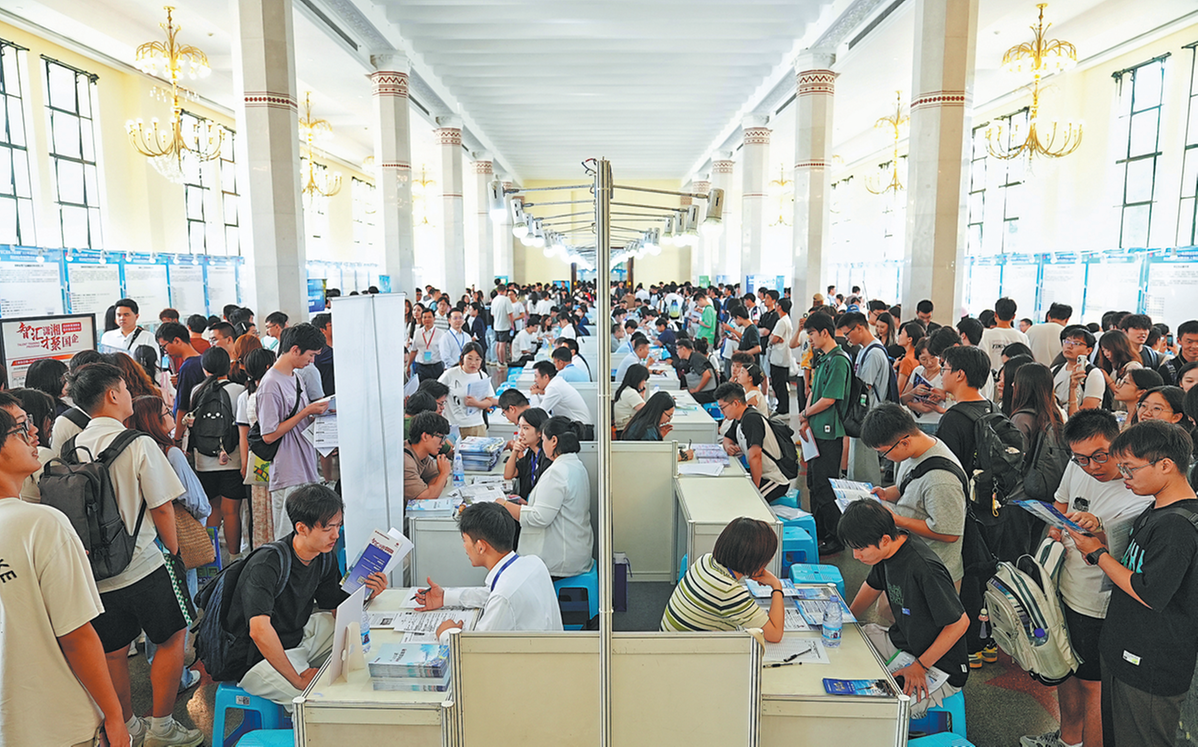
Zhang's entrepreneurship project is one of the 80 newly settled in the province after a nearly two-month promotional event organized by the provincial human resources and social security department. The event recruited college graduates and attracted entrepreneurship projects from eight cities such as Beijing and Shanghai from Sept 21 to Nov 9.
Liu Gengye, a doctoral graduate from Tsinghua University, attended the promotional event and ended up at an innovation and entrepreneurship base in Changsha's National Wangcheng Economic and Technological Development Zone. His project focuses on satellite communication terminals and on-board payloads.
He said the base provides 360 square meters of R&D and office space with a three-year rent-free period. It also offers a 200,000-yuan ($28,400) startup subsidy and an annual 100,000-yuan technical service subsidy. "It effectively alleviates the financial pressure in the initial startup stage," he said.








Editor's Pick