Japanese PM's provocations condemned
Takaichi criticized by local voices over Taiwan remarks, military expansion
By HOU JUNJIE in Tokyo | China Daily | Updated: 2026-01-31 08:16


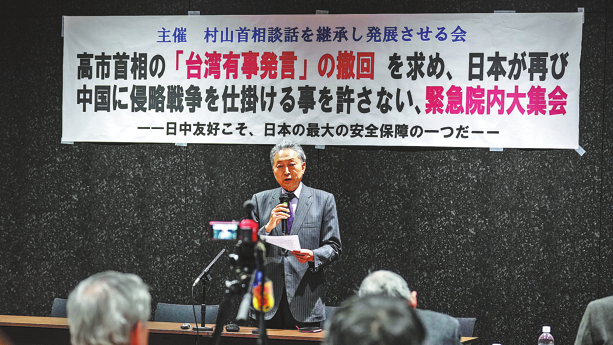
People from various sectors of Japanese society have voiced strong opposition to Prime Minister Sanae Takaichi's erroneous remarks on the Taiwan question, warning that her refusal to retract the statements and her continued provocations have further heightened regional tensions. They cautioned that the military expansion path promoted by Takaichi could push Japan toward the brink of war.
The views were expressed at a gathering held in Tokyo on Thursday. Participants called for the withdrawal of Takaichi's remarks on a so-called "Taiwan contingency" and opposed any attempt by Japan to once again "provoke a war of aggression" against China. They stressed that China-Japan friendship remains one of Japan's most important guarantees for peace and security.
Controversy intensified after Takaichi claimed during a TV Asahi program on Monday that the US-Japan security alliance would "collapse" if Japan failed to respond to an attack on US forces in a hypothetical conflict in the Taiwan Strait. The comments came shortly after she dissolved the House of Representatives and called a snap election. The remarks doubled down on statements she made in the Diet on Nov 7, in which she suggested that a contingency in the Taiwan Strait could entail Japanese military involvement.
Former Japanese prime minister Yukio Hatoyama expressed concern that Takaichi's remarks have undermined the 1972 Japan-China Joint Statement and caused a serious setback in bilateral relations. He noted that under the position established by the joint statement and related international documents, the Taiwan question is China's internal affair and should not be interfered in by Japan, stressing that this principle forms the foundation of the normalization and development of Japan-China relations.
Hatoyama said that Takaichi's remarks on a so-called "Taiwan contingency" are, in essence, an open declaration of military intervention in the Taiwan question, which he described as the core of the current problem. He called on Japanese society to seriously reflect on whether a political figure making such remarks should continue to serve as the country's leader, urging broader public awareness of the Taiwan question and its implications for Japan-China relations.
Many speakers at the gathering also expressed deep concern over a series of military expansion policies promoted by Takaichi since taking office under the pretext of "security concerns", warning that the direction poses serious risks to Japan's future.
Takakage Fujita, secretary-general of the Association for Inheriting and Propagating the Murayama Statement, said Japan is currently prioritizing a path of military buildup and moving along what he described as an "extremely dangerous road".
He noted that Takaichi's decision to dissolve the House of Representatives was essentially aimed at consolidating her political base in order to continue pushing what she has portrayed as a path toward becoming a "military power".
As the negative impact of deteriorating China-Japan relations has gradually become evident in Japanese society, Takaichi announced on Jan 23 the dissolution of the House of Representatives and the calling of a snap general election. Japanese media have said the move was intended to reshape the current political landscape and create conditions more favorable to her continued rule.
Yuko Tanaka, former president of Hosei University, warned that if political debate in Japan continues to rely on the traditional dichotomy of "right-wing" versus "left-wing", it will no longer be sufficient to accurately grasp the current situation. She said the real danger facing Japan lies in the resurgence of what she described as "new militarism".
From a policy perspective, Tanaka noted that Japan is entering a phase in which militarist forces are exerting growing influence, with one prominent manifestation being the government's attempt to sharply advance and sustain increases in defense spending. She stressed that the rapid expansion of military expenditure is not supported by stable fiscal resources but relies heavily on government bond issuance, which will inevitably accelerate the growth of national debt.
Tanaka added that discussions have already gone beyond raising defense outlays to 2 percent of gross domestic product, with some voices calling for levels as high as 3.5 percent or even 5 percent.
Against the backdrop of a weakening yen and strained China-Japan relations, Japan could face a serious risk of economic recession driven by worsening public finances, currency depreciation and external tensions, even before becoming directly embroiled in a military conflict, Tanaka warned.