


Ancient architecture bridges China and global audiences
By Shao Jie | CHINA DAILY | Updated: 2025-12-10 07:34


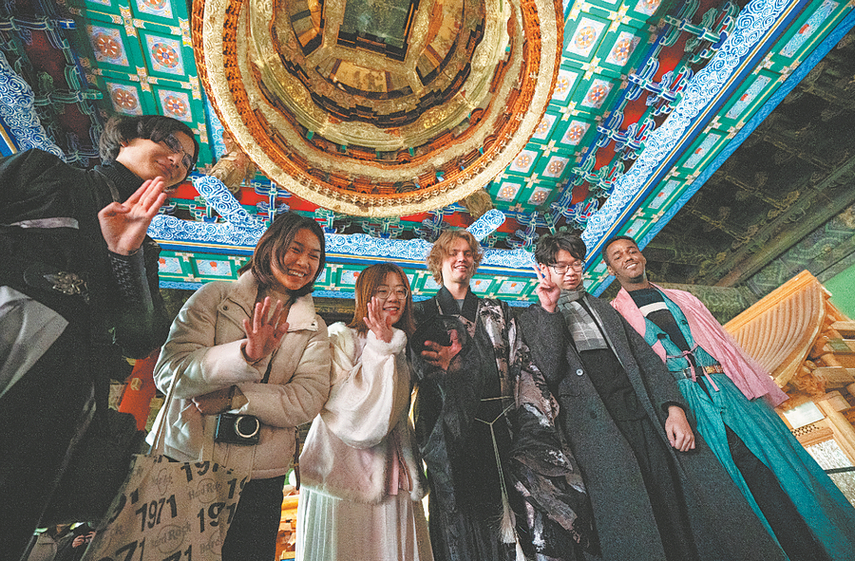
As an enthusiast of Chinese architecture, I've always wondered how to share its beauty with international audiences in a way that truly resonates. Even while working for two years at an architectural practice in the United States, that question stayed with me.
In the end, it led me back to China to pursue a doctorate under Professor Li Luke at Tsinghua University and to continue exploring how ancient buildings can be understood and cared for as living heritage.
Through my conversations with Professor Li, I came to understand that the future of urban development lies in integrating heritage with innovation — and in finding vivid, engaging ways to tell the stories behind historic buildings. With the 2024 World Heritage inscription of the Beijing Central Axis heightening international interest, I began leading English tours for international students at the Palace Museum and other landmarks along the Central Axis, introducing them to ancient architecture and its cultural significance.
As I continued guiding these tours, I began thinking about how to bring innovation to my storytelling. Together with Lin Tianshu, head of the Cross-Cultural Group within the Tsinghua University Graduates Union, I helped develop "WETrip", a student-led series of events that presents traditional Chinese culture to both Chinese and international students through activities organized, narrated, and hands-on facilitated by Tsinghua students.
One of the highlights of the series is "WETrip .Xiannongtan. The Beauty of Ancient Architecture". I led this event with fellow storytellers from Tsinghua's School of Architecture, including Liaw Qi, Chen Manyi, and Liu Peiyang. On Nov 25, we guided 45 students — from countries such as the US, Russia, Pakistan, and South Korea — through Xiannongtan, one of the 15 heritage components of the Beijing Central Axis, as they explored the beauty of ancient Chinese architecture up close.
Our storytellers walked participants through the site's ritual significance within Beijing's temple-and-altar culture, the evolution of traditional architectural forms and dougong (bracket-set) systems, the spatial logic of the Central Axis with its standardized timber-frame methods, and the decorative and color systems shaping sacred spaces.
"Standing before centuries-old halls while discussing timber joints and color systems creates an immediate sense of connection, making historic buildings tangible and accessible," Liu said. "The perspectives shared by international students also help us refine our approach to storytelling."
After the tour, we designed hands-on activities that brought Chinese and international students together to build mortise-and-tenon models, explore traditional color aesthetics, and experiment with digital conservation tools.
"I especially enjoyed learning about the symbolic meanings of roof colors and the structure of mortise-and-tenon joints," said Barrett Lindholm, a student from the US. "Building the wooden structural model myself allowed me to connect theory with practice, which was truly valuable."
Thendi Tagwa, a student from Botswana, noted that communicating and working with Chinese peers helped her better appreciate and understand Chinese culture.
The experience was equally meaningful for other Chinese students. "International students brought diverse perspectives that sparked fascinating discussions and helped me see architectural heritage and rituals from new angles," said Luo Ao, a doctoral student in hydraulic engineering. "Explaining Chinese concepts to them also deepened my own cultural awareness and sense of identity."
These reflections made me realize that architecture is more than beautiful structures — it is a cultural treasure shared by humanity.
Through my journey of narrating ancient Chinese architecture, I have come to deeply appreciate that ancient buildings carry the stories of history, craftsmanship, and cultural values. Their forms, decorations, and construction reflect the collective wisdom of generations of artisans.
Although materials like wood, stone, and paint may weather over time, the spirit embedded within these structures endures.
Written by Shao Jie, PhD student, School of Architecture, Tsinghua University.
Related Stories




Editor's Pick










