Innovation crucial for upgrading of manufacturing
CHINA DAILY | Updated: 2025-12-11 07:13


Editor's note: Building greater self-reliance in science and technology will be a key task for China in the 15th Five-Year Plan (2026-30) period. China Business Journal spoke to Zhou Shaojie, dean of the Institute for Contemporary China Studies at Tsinghua University, on how this can be achieved. Below are excerpts of the interview. The views don't necessarily represent those of China Daily.
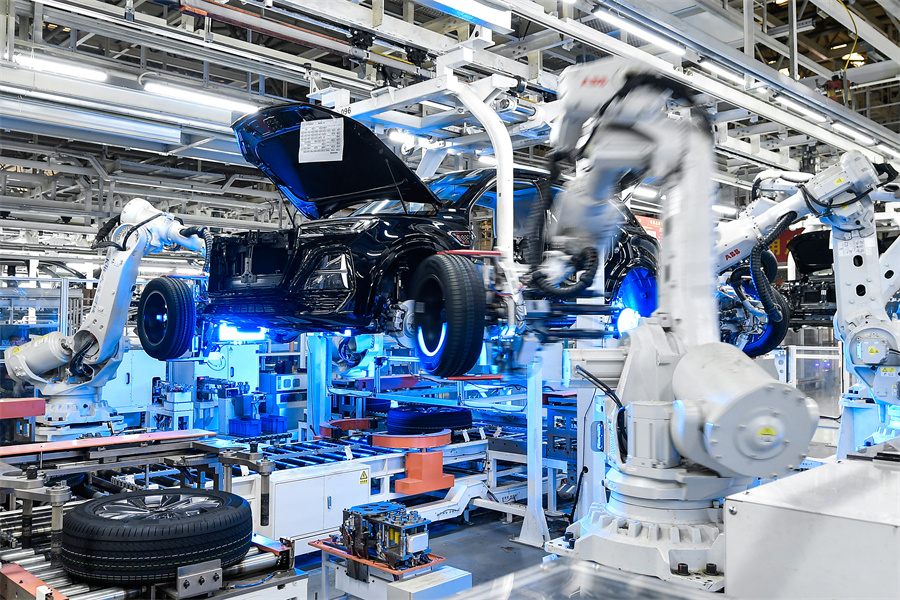
The core requirement of greater technological self-reliance is embedded deeply in China's task of building a modernized industrial system, including the efforts to "build new types of infrastructure with appropriate forward planning". This demonstrates the country's approach of driving industrial upgrading through innovation. Ultimately, the value of scientific and technological innovation should manifest itself in the upgrading of the industrial system.
The growth of emerging and future-oriented industries will play an important role in supporting innovation. China ranks high in the world in terms of the number of patents, but their industrialization rate is only about 40 percent. Many patents haven't been transformed into real productive forces. Therefore, efforts should focus on turning innovation into real productivity and an effective driving force for industrial development.
To cultivate new quality productive forces at a faster pace, the efforts should be based on the specific local conditions in different regions. Not all regions are suited to the development of high-end industries such as computer chips and large artificial intelligence models. Local authorities should take into account the specific local conditions, take advantage of new technologies to improve traditional industries, or develop emerging industries that are compatible with their local context.
Manufacturing is a vital part of a country's economy and the foundation of its strength. In 2024, the manufacturing sector accounted for about 25 percent of China's GDP. During the 14th Five-Year Plan (2021-25) period, the country attached special importance to stabilizing the manufacturing sector's share in the economy. Many provinces also initiated strategies to make manufacturing a major pillar of the local economy.
In recent years, some labor-intensive industries have moved out of China to Southeast Asia and Mexico. In this situation, a rapid drop in the manufacturing sector's share in China's GDP before it becomes a relatively developed economy may lead to hollowed-out industries.
In the 15th Five-Year Plan (2026-30) period, China's need for development and security will be met effectively if the manufacturing sector's share in the GDP stays around 25 percent. To achieve this goal, the manufacturing sector needs to transform from one that boasted lower costs into one that has advantages in innovation. Only by improving its competitiveness through continuous innovation can the country offset the impact of increased labor costs and tariffs — factors that have led to the relocation of industries — and stabilize its manufacturing sector.
It's widely believed in academic circles that for China's per capita GDP to be on a par with that of a mid-level developed country by 2035, its per capita GDP in 2035 should be double what it was in 2020. To achieve that goal, China's average annual GDP growth should be around 4.4 percent over the next 10 years. If the average annual growth reaches around 5 percent during the 15th Five-Year Plan period, China will have created more favorable conditions to hit the 2035 target.
But it's not easy to maintain such growth. To do so requires the country to implement more targeted and effective macroeconomic policies during the 15th Five-Year Plan period. It needs to try and tap the potential of domestic demand, unleash the dynamism of innovation and stimulate the vitality of opening-up.







Editor's Pick