Listening before time runs out
Memories of World War II veterans demonstrate the importance of oral history, Zhao Xu reports.
By Zhao Xu | China Daily | Updated: 2025-12-13 11:55


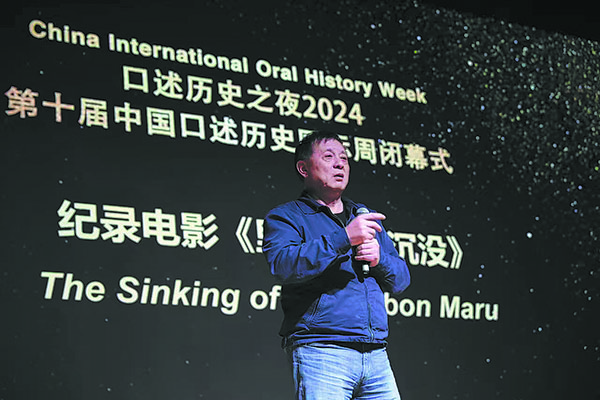
Her view is echoed by Fang Li, director of the 2024 documentary The Sinking of the Lisbon Maru, which recounts the 1942 tragedy of a Japanese-controlled ship carrying over 1,800 British POWs from Hong Kong. After the ship was torpedoed by a US submarine, Japanese troops sealed the POWs below deck, leaving many to drown or be shot, while nearby Chinese fishermen risked their lives to rescue around 384 survivors.
"Speak to an old man about his youth, and you awaken a memory that time cannot erase," says the director, who secured oral testimonies from the only two known survivors, Dennis Morley and William Beningfield, who were both aboard the Lisbon Maru when it was sunk en route to Japan.
"When I first met Morley — who had never spoken about his wartime experience even to his daughter — I showed him a photograph of himself as a teenage bandsman with the British Army's Royal Scots regiment. The moment he saw it, he began to talk," Fang recalls. "Beningfield, for his part, told me he had been a gunner operating a water-cooled heavy machine gun. I asked him, 'What did you do when there was no water?' He answered, 'We used our pee.' And from that moment, our conversation opened."
"The appeal of oral history lies in its intimacy. Breakthroughs come when the person across from you senses that you truly understand them," says Lin, who invited Fang to speak at last year's China International Exhibition of Oral History, which featured 300 projects from China and abroad.
"Many of these projects reveal that a Chinese story rarely stands alone — it is woven into the broader fabric of world history," she says, citing a project by a group of young Hong Kong residents that traced the lives of Chinese soldiers who took part in the Normandy landings (D-Day) on June 6, 1944, inspired by a diary penned by one of the soldiers and discovered in an abandoned apartment in Hong Kong.
"As we mark the 80th anniversary of the Allied victory in World War II, it is important to honor our heroes by filling in the memory gaps," Lin says.
In 2011, Lin interviewed three World War II veterans just before Aug 15, the day marking Japan's 1945 surrender and China's victory over Japanese aggression. One was Zhang Jin, the veteran who always began his story from the very start and had lost his right arm in a Japanese ambush.
"The first thing he did upon seeing me was to stand tall and give a left-handed salute," Lin recalls.
Related Stories