Restructured, diversified framework spurs trade
Jan-Nov exports increase 6.2 percent to $3.47 trillion, bringing surplus to $1.08 trillion
By Zhong Nan | China Daily | Updated: 2025-12-16 09:10


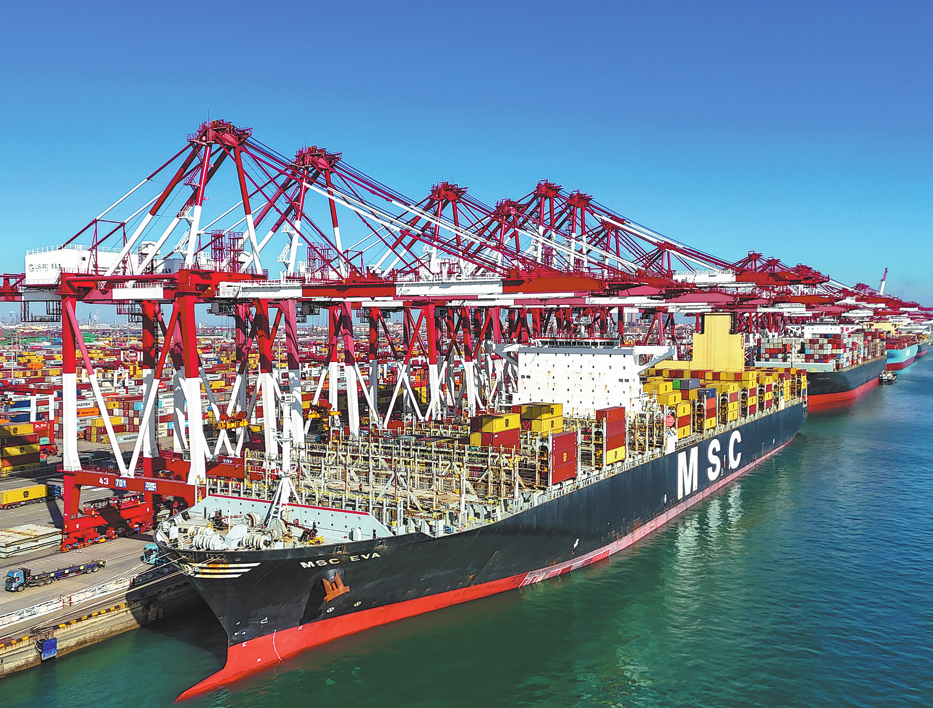
China's $1.08 trillion record foreign trade surplus in the first 11 months underscores its integral role in global production networks, a contribution that market watchers and business executives said has consistently lowered worldwide manufacturing costs and cushioned inflationary pressures across many economies.
While some foreign media outlets have raised concerns over trade imbalances amid China's substantial surplus, trade scholars emphasized that the figure stems from global supply-chain specialization and poses no threat to the world economy.
China's exports rose 6.2 percent year-on-year to 24.46 trillion yuan ($3.47 trillion) between January and November, while imports grew by just 0.2 percent to 16.75 trillion yuan, said the General Administration of Customs.
Wan Zhe, a professor specializing in regional economic development at Beijing Normal University, said this is not a zero-sum game. The surplus reflects the inherent structure of today's globalized production, a system that reduces costs for consumers worldwide while delivering consistent price stability.
"The idea that buying something means losing out doesn't hold up in any market," said Wan, adding that the essence of trade lies in mutual benefit and win-win outcomes — an effective market cannot operate otherwise.
Similar views were shared by Zhang Monan, a researcher at the China Center for International Economic Exchanges in Beijing.
"After navigating years of global trade protectionism and friction, China has actively restructured its trade framework and pursued diversification," Zhang said.
Emerging markets have become key drivers of incremental growth and vital engines of expansion, such as China's notable trade growth with the Association of Southeast Asian Nations and the European Union. This has effectively bolstered the overall resilience of the country's foreign trade, said Zhang.
Lili Yan Ing, secretary-general of the Paris-based International Economic Association, said that the trillion-dollar surplus is the outcome of a structural transformation in global manufacturing shaped by green technologies, advanced industrial systems and digital infrastructure. China's rise shows that global integration remains a powerful engine of growth.
Highlighting a structural shift up the value chain, China's exports of mechanical and electrical products — including energy storage equipment, smartphones and semiconductors — reached 14.89 trillion yuan during the January-November period, up 8.8 percent year-on-year and accounting for 60.9 percent of the nation's total exports.
For many emerging economies, China's export expansion brings both opportunities and important adjustments. Chinese electric vehicles, photovoltaic and digital manufacturing equipment offer a pathway to accelerate industrial upgrading, meet climate commitments and boost productivity, she added.
One concrete example of this trend is Zhejiang Zhonghuan Sunter PV Technology Co Ltd. The Ningbo-based manufacturer of solar modules will add new production lines in 2026 as the global energy transition accelerates.
Cen Tingchao, the company's foreign trade director, said that rapid industrialization and rising energy needs in emerging markets are driving strong solar power demand, making them key to the company's future growth.
The firm's export value amounted to 921 million yuan in the first 11 months, surging 44.36 percent year-on-year, said Ningbo Customs.
As foreign enterprises with a presence in China deepen their reliance on China's manufacturing ecosystem, the total import and export value of such companies rose 2.9 percent year-on-year to 10.91 trillion yuan in the first 10 months, accounting for 29.3 percent of the national total, according to the latest Customs data.
In the meantime, exports of foreign-funded businesses in China rose 4 percent on a yearly basis to 5.99 trillion yuan, indicating they are also active contributors to China's trade surplus given their deep integration into the country's industrial chains.
Salvatore Ruggiero, vice-president for marketing and communication at German specialty materials manufacturer Schott AG, said these facts have further highlighted the symbiotic relationship between sustained foreign investment and China's role as a central node in global manufacturing networks.
Schott plans to invest more than 60 million yuan to expand production capacity at its manufacturing base in Suzhou, Jiangsu province, in the coming months.
"Currently, about 90 percent of Schott's products made in the country are sold domestically, but the new investment will enable exports to Southeast Asia, South Korea and Japan," said Ruggiero.






Editor's Pick