


Japan's security moves draw sharp criticism
DPRK warns remilitarization efforts to revise nuclear principles 'dangerous'
By YANG HAN in Hong Kong | China Daily | Updated: 2025-12-19 09:22


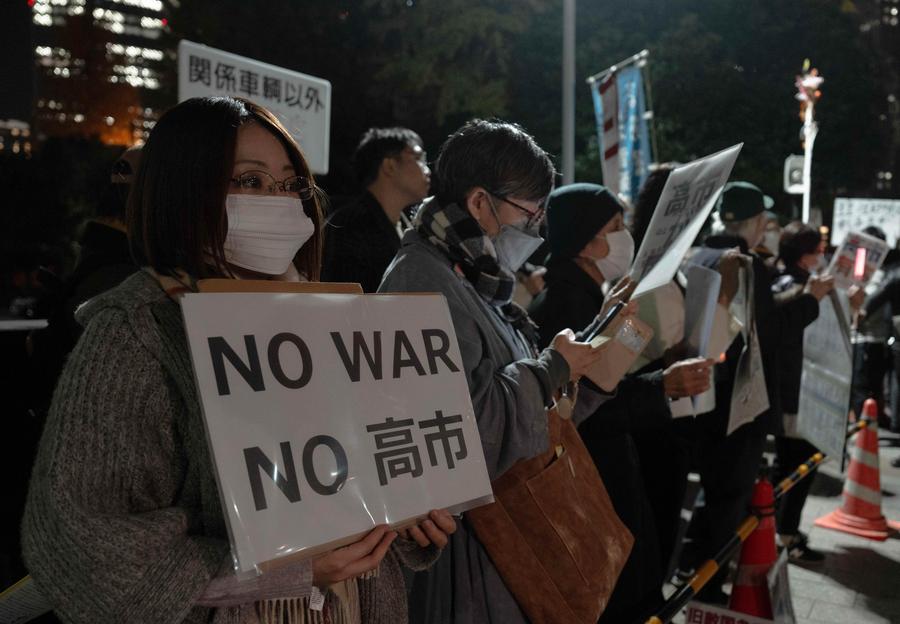
The Democratic People's Republic of Korea has denounced Japan's reported review of the Three Non-Nuclear Principles, describing it as showing highly concerning military trends.
In an article published on Thursday, the DPRK's state newspaper Rodong Sinmun said that Japan, under Prime Minister Sanae Takaichi's government, has significantly adjusted its military and security policies by increasing defense spending, strengthening preemptive strike capabilities, loosening restrictions on arms exports and even attempting to revise the Three Non-Nuclear Principles.
"This vividly demonstrates that Japan's decades-long remilitarization efforts since its defeat in World War II have now entered a critical and dangerous stage," the newspaper commented.
Japan's Kyodo News reported that the government is expected to revise its National Security Strategy and two other documents by the end of next year, with Takaichi considering reviewing the third of the Three Non-Nuclear Principles, which prohibits nuclear weapons from entering Japan's territory.
The principles — not possessing, not producing and not allowing the introduction of nuclear weapons into Japanese territory — were first declared in 1967 by then prime minister Eisaku Sato and have remained the foundation of Japan's nuclear policy.
The National Security Strategy, one of the three documents approved by the Cabinet in 2022, states, "The basic policy of adhering to the Three Non-Nuclear Principles will remain unchanged in the future." Analysts said any revision would represent a significant change in Japan's security policy.
Rodong Sinmun said the revisions will further expand the scope and depth of Japan's remilitarization. Japan's rush to expand its militarization step by step is a blatant challenge to peace, it added.
Citing Japan's wartime imperial ambitions, it said the recent move by the Japanese government reminds people of Japan's history of brainwashing its people to jump into a war of aggression to establish the "Greater East Asia Co-Prosperity Sphere".
"Japan must learn from its defeat 80 years ago and recognize that challenging the universal pursuit for peace is a blatant act leading only to its self-destruction," it said.
Submarine introduction
Before taking office, Takaichi, as president of the Liberal Democratic Party, signed a coalition agreement with the Japan Innovation Party on Oct 20. The agreement included content related to the introduction of submarines powered by "next-generation propulsion systems", such as nuclear technology.
When asked about the possibility of acquiring nuclear submarines later, Chief Cabinet Secretary Minoru Kihara said the government is "not ruling out any options" and is considering necessary measures to enhance deterrence and response capabilities.
In another development, China on Wednesday again slammed the erroneous remarks by Takaichi on the Taiwan question. Foreign Minister Wang Yi said Japanese militarists had launched wars of aggression under the pretext of a "survival-threatening situation" and that lessons from history must not be repeated.
Over the past month, several countries have voiced their support for the one-China principle.
Zaw Min Tun, spokesman for Myanmar's National Defense and Security Council and the country's deputy minister of information, said on Nov 21 that Myanmar has noted the relevant comments by the Japanese prime minister, and reaffirmed that the Myanmar government adheres to the one-China principle.
Myanmar has always followed the Five Principles of Peaceful Coexistence, respects China's sovereignty and territorial integrity, and will, as always, support China's efforts to safeguard national unity, he said.
Cambodia's Foreign Ministry said on Nov 26 that the kingdom resolutely adheres to the one-China principle and recognizes the government of the People's Republic of China as the sole lawful government representing the whole of China, and that Taiwan is an inalienable part of China's territory. Laos' Foreign Ministry said on Nov 28 that the country opposes any interference in China's internal affairs.
Recently, Jordan, Saudi Arabia and the United Arab Emirates also expressed firm adherence to the one-China principle and voiced opposition to outside interference in China's internal affairs in its Taiwan region.





Editor's Pick










