


Research: Israel expanding military outposts to prolong presence in Gaza
By JAN YUMUL in Hong Kong | China Daily | Updated: 2025-12-24 09:46


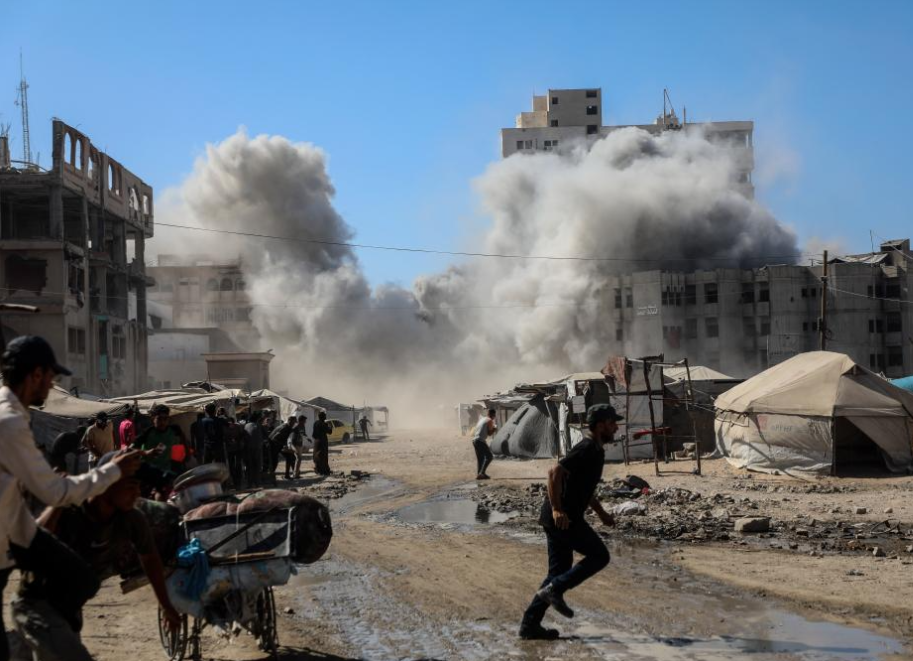
Israel looks to be preparing for a permanent presence in Gaza as it has constructed at least 13 new military outposts in the enclave, consolidated existing military infrastructure, built roads, and destroyed more Palestinian property, according to a British research agency.
The latest development was reported by investigative journalism outlet Drop Site News, citing research by Forensic Architecture based at Goldsmiths, University of London.
Forensic Architecture's findings noted that since the Gaza ceasefire took effect in October, the Palestinian territory had been divided into two zones by a "yellow line". East of the line is a "dangerous combat zone" under Israeli control, with the military shooting anyone who enters or comes near. West of the line, Hamas is the de facto governing body.
"Israel appears to be turning the 'yellow line' into a permanent divide, expanding military infrastructure along the line and systematically clearing all land under its control," the report said. "The effect is the ethnic cleansing of 53 percent of Gaza."
In previous operations, the Israeli military justified targeting individuals as "terrorists" if they crossed the line, claiming they posed "an immediate threat".
From Oct 10 to Dec 2, Israel maintained 48 military outposts east of the line, connected by a network of roads that have been created, expanded, or appropriated by its military, the report said. In turn, these link to Israeli bases, roads, and settlements outside Gaza.
Discrepancies found
Forensic Architecture said it found discrepancies between the location of the line in Israeli maps and its military's physical placement of yellow blocks in Gaza.
"Of the 27 yellow blocks we identified, all were beyond the yellow line as indicated on Israeli maps. They encroach up to 940 meters further into Gaza," the agency said.
It said that despite the ceasefire, Israel "continues to target civilians, homes, and infrastructure, such that nowhere in Gaza is safe".
On Tuesday, the Palestinian news agency WAFA reported that the Israeli army had renewed aerial bombardments across Gaza, opening fire on eastern areas of Gaza City and the Tuffah neighborhood.
In similar findings, Israeli human rights group B'Tselem published a report on forced displacement in Gaza, concluding that the ceasefire did not lead to any "meaningful change" in Israel's conduct.
Over the past two years of continuous military assault, Israeli forces have inflicted severe damage through airstrikes, shelling, and bulldozers, destroying more than 90 percent of Gazan homes, 70 percent of all structures, and 81 percent of the road network.
Belal Alakhras, a research fellow at the University of Malaya in Kuala Lumpur, described Israel's posture in Gaza as "calculated dominance masquerading as security, leveraging military supremacy" to entrench control despite the ceasefire.
"This strategy yields no strategic dividend," Alakhras told China Daily. "It merely lays bare the (Israeli) occupation's contradictions and drags Washington deeper into complicity as guarantor of an agreement its dependent ally violates without even a serious pretext.
"What Israel is engineering is not stability, but institutionalized fragility that further undermines its own regional standing and forces its backers to bankroll disorder," he added. "The colonial logic is now impossible to obscure as the Israeli government is not pursuing safety, but rather the management of subjugation."





Editor's Pick










