Kazakhstan's ambassador hails 'landmark' growth of China ties
By Zhao Manfeng | chinadaily.com.cn | Updated: 2025-12-31 12:12


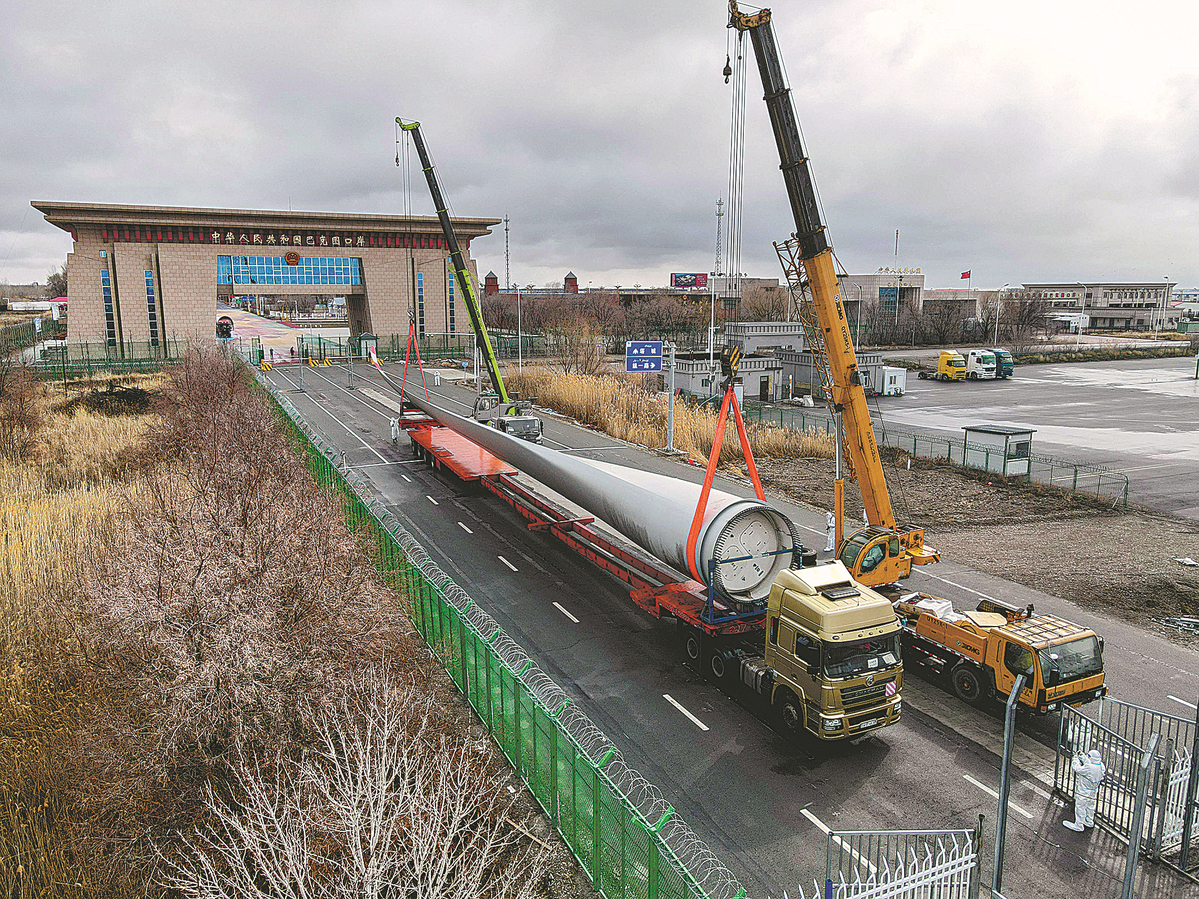
A large wind turbine blade is hoisted at Baketu Port, in the Xinjiang Uygur autonomous region. An increasing number of large wind turbine equipment is being exported from Baketu Port to Kazakhstan. [Photo/Xinhua]
Kazakhstan's Ambassador to China Nuryshev Shakhrat has hailed the "unprecedented" strategic partnership between his country and China based on political trust, mutual respect for core interests and positions, as well as close coordination on international issues.
In the context of Taiwan question, Kazakhstan consistently adheres to the "one China policy".
In an interview with China Daily, Nuryshev outlined the progress made in bilateral cooperation throughout the course of the year 2025.
"The year 2025 has become a truly landmark stage," he said, adding that 46 intergovernmental and interdepartmental agreements were signed by China and Kazakhstan during state visits which covered energy, aerospace, digitalization, customs regulation, agriculture, e-commerce, tourism, intellectual property, healthcare, media, science and inter-regional cooperation.
In addition, 172 commercial agreements worth approximately $56 billion were concluded in 2025, while rail freight between the two nations is expected to reach 35 million tons by the end of the year.
Beyond concrete infrastructure and trade figures, the ambassador hailed a "vibrant new era" in people-to-people exchanges. The visa-free regime introduced in 2023 has fueled a tourism boom, with more than 870,000 visits by Chinese citizens to Kazakhstan in 2025. Today more than 5,000 Kazakhstani students study at leading universities in China, while over 3,000 Chinese students are attending universities in Kazakhstan. Three "Luban Workshops" are also currently operating in Kazakhstan.
The ambassador added that there are ambitious plans for future cooperation within the framework of the Belt and Road Initiative (BRI).
"Today, Kazakhstan plays a key role as a central transit hub" that connects China to Europe, the Middle East and the Caspian region, he said. Key projects like the Khorgos dry port and the logistics center at Lianyungang Port are already operational, with negotiations underway for a joint railway logistics terminal in Chengdu.
A pivotal new focus is the Trans-Caspian International Transport Route. The signing of an agreement on its expansion, with China's support, "strengthens Kazakhstan's role as one of the most important transit bridges between East and West", Nuryshev said.
He also spoke of Kazakh synergy with China's 15th Five-Year Plan (2026-30), particularly in digitalizing logistics and developing cross-border e-commerce under the "Digital Silk Road".
The ambassador shed light on critically important border cooperation with China's Xinjiang Uygur autonomous region, which accounts for half of the bilateral trade between the two countries.
"Inter-regional and cross-border cooperation... is one of the most practically oriented areas," he said, adding that efforts are ongoing to upgrade checkpoints and develop industrial zones to "move from transit to value creation".
Regarding Kazakhstan's drive for economic diversification, Nuryshev identified renewable energy, agro-industrial processing and the digital economy as prime areas for Chinese partnership.
"China is viewed not merely as a source of capital, but as a key technological and industrial partner," he stressed, pointing to vast potential in wind and solar power collaboration and the deep processing of agricultural goods.
Nuryshev also underscored the importance of the China-Central Asia mechanism for regional stability. Proceeding from the principle that "a successful Central Asia means a successful Kazakhstan", he reiterated Astana's strong support for the format.
"Kazakhstan is confident that the 'Central Asia-China' format can become one of the key factors in strengthening regional resilience," he said, adding that it would help promote a common space of trust, economic development and shared prosperity across Eurasia.






Editor's Pick