Zhang Li's book traces a century of Chinese women's awakening
By Rya Zhu | chinadaily.com.cn | Updated: 2026-01-07 10:10


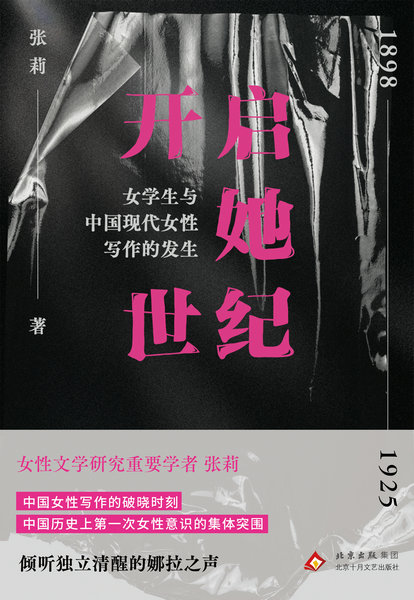
In modern Chinese literary studies, Professor Zhang Li, associate dean of the School of Chinese Language and Literature at Beijing Normal University, offers a powerful exploration of women's consciousness over a hundred years in her book The Occurrence of Modern Chinese Women's Writing (1898-1925).
Moving beyond simple "oppression versus resistance" frameworks, the book traces a vivid arc of self-discovery through a group of female writers such as Qiu Jin, Zhang Jie, Chen Ran and Fan Yusu. It shows how "breaking silence" has grown from a revolutionary act into a shared language of everyday resilience—a spirit that resonates deeply with movements like #MeToo, both past and present.
This is the chorus that Zhang listens to and amplifies in her work. In her book, Zhang weaves individual voices into a collective story of awakening.
The journey begins with Qiu Jin (1900s–1910s), a pioneer of women's liberation. In Qiu's essay "To the Two Hundred Million Women of China", she declared: "Women are the mothers of the nation," condemning foot-binding and the idea that "ignorance is a woman's virtue". Qiu lived her words—fleeing an arranged marriage, studying in Japan, and joining the revolution. As Zhang notes, Qiu's courage to speak out laid a foundation for generations, an early form of "refusing to be objectified." Qiu's defiant voice a century ago shares a clear bond with today's calls for justice and autonomy.
By the 1980s, Zhang Jie captured women's struggles between self and marriage in the early reform era. Zhang Jie's story Love Must Not Be Forgotten questions whether a marriage without love is worth keeping. In the story Ark, three intellectual women navigate broken marriages, seeking independence yet facing setbacks. Zhang Li observes that Zhang Jie's writing reflects a key moment—the rise of "female subjectivity" amid competing roles. The tension between personal freedom and relationship remains just as relevant today.
In the 1990s and 2000s, Chen Ran turned inward, exploring women's spiritual emancipation. Her novel Private Life shifts focus from marriage and family to bodily awareness and inner life. Through characters who reject reliance on men, Chen championed "personal writing", challenging the notion that women's literature must address grand themes. Zhang sees in her work a source of strength for modern women balancing career and family—a reminder that true independence begins within.
In the 2020s, grassroots writer Fan Yusu brings the journey full circle. Her memoir I Am Fan Yusu, written in plain, moving prose, tells of her life as a nanny. Without lofty language, she finds redemption through writing about her own experiences. Fan's success, Zhang emphasizes, shows that women's awakening is not limited to intellectuals. Her voice echoes Qiu Jin's in a new key—proof that ordinary lives, too, carry extraordinary resilience.
What makes the book The Occurrence of Modern Chinese Women's Writing so compelling is how Zhang Li connects these lives across time. Each writer faces her own struggle—against feudal bonds, marital confines, social expectations, or sheer hardship—showing that women's awakening in China is not an abstract idea, but a lived reality, passed from one generation to the next.
From Qiu Jin's bold cry to Fan Yusu's quiet strength, the book reveals how breaking silence remains an act of courage, transforming private experience into public power. It is a testament to the enduring role of women's writing—to witness, to resist, and to reclaim one's own story.