


Rough year for UN amid wars, calls for reform
Intl organization confronted rifts while China led appeals for multilateralism
By SHI GUANG in New York | China Daily | Updated: 2026-01-02 06:59


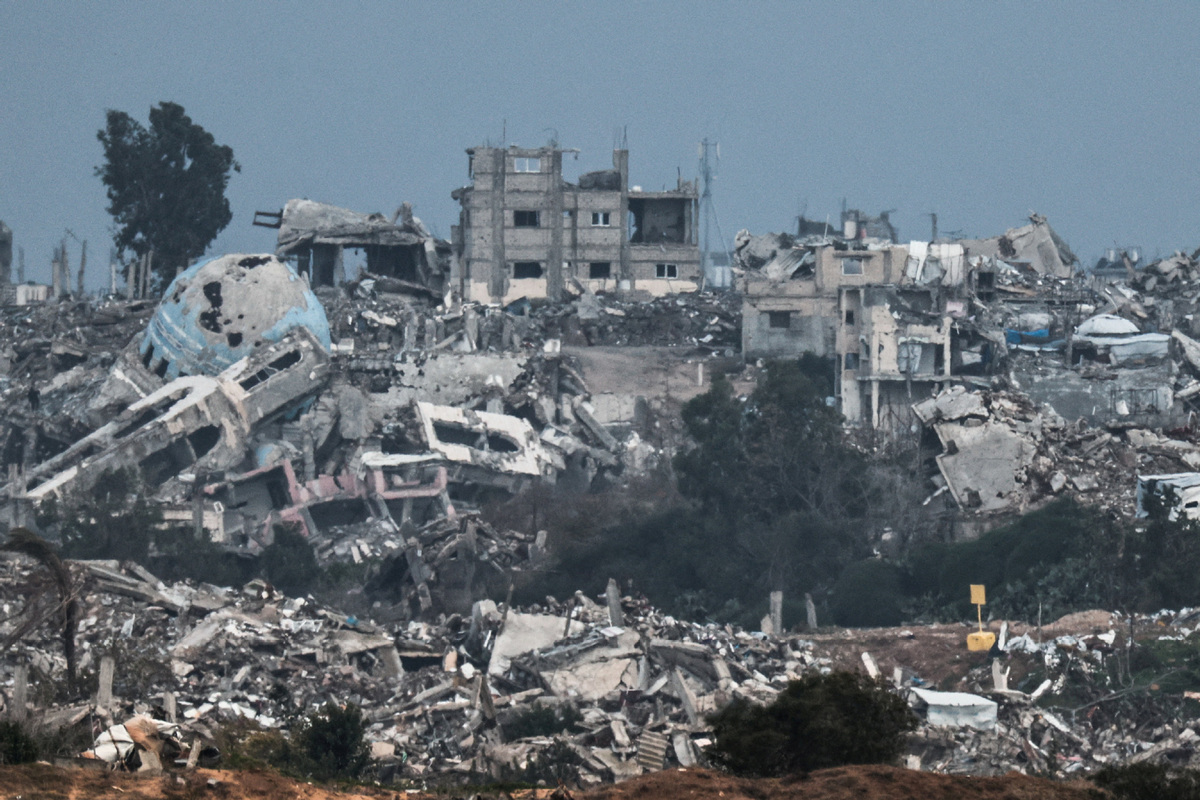
The past year has not been a peaceful one inside the United Nations headquarters in New York, as the world continued to be entangled in wars, humanitarian crises and growing geopolitical divisions amid mounting pressure on the multilateral system.
One of the most prominent issues throughout the year was the situation in Gaza and the broader Palestinian question.
On Sept 12, the 80th UN General Assembly adopted a resolution supporting the "New York Declaration" to advance a two-state solution, with 142 countries voting in favor, 10 against and 12 abstaining. It called for an immediate ceasefire, release of detainees and the establishment of a viable and sovereign Palestinian state.
A growing number of countries, including Belgium, Canada and the United Kingdom, announced their formal recognition of Palestine as a state. By late September, more than 80 percent of UN member states had formally recognized the State of Palestine.
In November, the Security Council adopted the US ceasefire plan for Gaza, endorsing an internationally backed peace plan and authorizing an International Stabilization Force as part of long-term efforts to support reconstruction and governance in the enclave.
The resolution was adopted after more than two years in which the Security Council failed to pass a ceasefire resolution on Gaza. The US had repeatedly used its veto power to block such measures.
"Gaza is already facing famine, with disease spreading rapidly," Fu Cong, China's permanent representative to the UN, told the Security Council in September.
"As a permanent member, the US must face up to its responsibilities, support the council in performing its duties effectively, and safeguard the role and authority of the UN, rather than the opposite."
During the general debate of the 80th session of the UN General Assembly, US President Donald Trump delivered a speech that far exceeded the assembly's standard 15-minute time limit, using the occasion to criticize the UN's structure and decision-making procedures.
"These are the two things I got from the United Nations: a bad escalator and a bad teleprompter," Trump said. He also accused the UN of "funding an assault" through migration on Western countries that he said were "going to hell".
Trump's remarks came amid a broader reassessment of US engagement with the world body, as his administration reduced financial contributions and joined several Western donors in withholding payments to the UN's regular budget.
Funding constraints have become a growing challenge for multilateral action, as the UN's long-running liquidity crisis deepened over the year.
On UN reform, the Group of Friends of Global Governance, launched in December with 43 founding member states under the framework of the Global Governance Initiative, told a General Assembly briefing on the UN80 Initiative that a stronger, more efficient and more inclusive UN is needed.
The UN80 Initiative comes at a time of heightened global uncertainty and should reflect the shared expectations of the majority of UN members, "that is to uphold multilateralism, to strengthen the UN, to safeguard the international rule of law and to improve global governance", the group said in a joint statement delivered by Fu.
Recurring topic
Beyond immediate crises, structural reform of the UN remained a recurring topic. China stressed that reform must enhance the representation of developing countries and reflect contemporary global realities.
"We must adhere to the purposes and principles of the UN Charter; uphold the sovereign equality of all states, large and small; oppose unilateralism, hegemonism and power politics; advance the democratization of international relations; and enhance the representation and voice of developing countries in international affairs," Fu said at the Security Council last month.
In November, Fu told the General Assembly that Japan is "totally unqualified" to become a permanent member of the Security Council. The opposition was prompted by Japanese Prime Minister Sanae Takaichi's remarks on Nov 7 that claimed a "Taiwan contingency" could be a "survival-threatening situation" for Japan.
China had twice submitted letters to UN Secretary-General Antonio Guterres objecting to Japan's remarks on the Taiwan question, reaffirming its stance that the island falls within China's internal affairs.
As the year drew to a close amid continuing conflicts, Guterres released his New Year message for 2026 on Monday, calling on world leaders to "choose people and planet over pain".
"As we enter the new year, the world stands at a crossroads. Chaos and uncertainty surround us," he said. "People everywhere are asking: Are leaders even listening? Are they ready to act?"








Editor's Pick










