


Expert calls for inclusive, equitable system for delivering climate action
By Liu Jianqiao | China Daily | Updated: 2026-01-05 11:20


In 2025, the global community faced a defining year in its efforts to combat climate change and pursue sustainable development. The world crossed several climate "tipping points", and scientific assessments warned that temperatures are continuing on an upward trajectory that risks destabilizing ecosystems and economies, especially in the Global South.
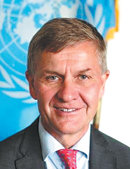
At the same time, geopolitical tensions and divergent policies among major powers have complicated the unification of climate action, said Erik Solheim, cochair of the Europe-Asia Center and former under-secretary-general of the United Nations.
Countries in the Global South, which encompass many of the world's developing nations across Africa, Asia, Latin America and the Pacific Islands, have seen both rapid green energy growth and persistent structural challenges.
Renewable energy deployment in these regions has grown faster than the global average, driven by abundant solar and wind resources and urgent development needs. Yet many of these countries continue to struggle with financing, technological access, and adaptive capacity to confront climate impacts and industrial transformation.
In July 2025, United Nations Secretary-General Antonio Guterres emphasized that while Africa is enriched with renewable resources, the continent remains underserved when it comes to investments. "Africa is home to 60 percent of the world's best solar resources. But it received just 2 percent of global clean energy investment last year."
Moreover, recent shifts in the global geopolitical environment, such as the United States' retreat from the Paris Agreement under its current leadership, have introduced additional uncertainties in global climate governance mechanisms, heightening climate "critical risk" for nations already confronting extreme weather events, food and water insecurity, and ecological degradation, said Solheim, also former executive director of the United Nations Environment Programme.
"These structural and geopolitical challenges have underscored the need for a more inclusive and equitable global governance system that can deliver climate action and sustainable development outcomes for all nations," he said.
Amid this complex landscape, China's expanding engagement with other Global South members on climate and sustainable development has emerged as a significant global force, shaping new pathways for cooperation, capacity building, and shared progress, Solheim said.
"Reflecting these needs, China's proposals for the reform of global governance, including the Global Governance Initiative and the Global Development Initiative, seek to advance a model of multilateral cooperation grounded in sovereign equality, consultation, inclusiveness, fairness and shared benefits," said the former UN diplomat.
He said these principles resonate with the aspirations of most developing countries for greater influence and fairness in international decision-making. "Truly effective governance must be people-centered and responsive to changing global realities, rather than confined to structures shaped in the mid-20th century."
"Principles such as respecting sovereignty equally and prioritizing tangible outcomes for ordinary people resonate across the Global South, offering a foundation for building a fairer system of global cooperation. But principles must translate into political action and institutional change to deliver real results," he added.
Remarkable transformation
In terms of climate action and sustainable development, China's transformation over the past decade has been remarkable, Solheim said.
"The country has pursued ambitious targets to expand renewable energy capacity, with solar, wind and hydropower leading global deployment and emerging as key engines of growth," he said.
Moreover, in September 2025,China set new climate targets in line with the Paris Agreement framework. The country has been committed to advancing systemic low-carbon and resilience-oriented policies, including increasing the share of nonfossil energy consumption, significantly expanding renewable capacity, broadening the coverage of its carbon market, and integrating climate adaptation into policies and systems to support a long-term transition, according to the Ministry of Ecology and Environment of China.
China's progress has helped propel broader global climate goals. Its green development experience has enabled many developing nations to access affordable solar and wind solutions, accelerating local energy transitions, Solheim said.





Editor's Pick










