Roots that cross the Pacific
From 19th-century sailors to the 50th anniversary of diplomatic ties, personal stories continue to define China-Fiji relations.
By Zhang Yunbi | China Daily | Updated: 2026-01-05 11:44


The past year not only marks 50 years of diplomatic relations between China and the Pacific Island country of Fiji, but also celebrates 170 years of deep personal ties between the peoples of the two countries.
In 1855, Fiji saw the arrival of the first Chinese settler, whose descendants now live throughout the world, including in Fiji, New Zealand, Australia, North America, Europe and Asia, said Fiji's ambassador to China, Robert Lee.
"On a personal note, I too am part of that story as a second-generation Chinese person in Fiji, whose parents migrated to Fiji in the early part of the 20th century," he added.
Lee is no stranger to China. He lived and worked in Beijing and Shanghai for many years before being appointed as Fiji's seventh ambassador to the country.
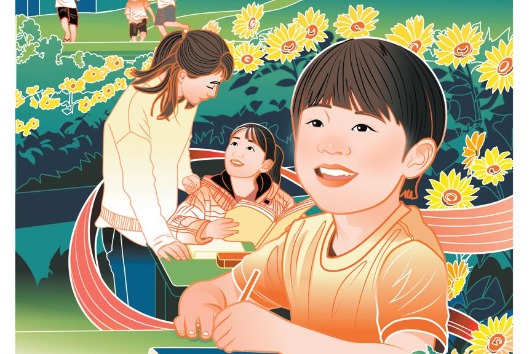
In 1989, he visited his ancestral hometown of Zhongshan in Guangdong province for the first time to trace the origins and roots of his family. His father gave a donation there for the construction of a local elementary school — now Lantian Central Primary School in Dachong town, Zhongshan city — and returned multiple times to watch and oversee it being built.
On July 24, 2025, Ambassador Lee and his family returned to the school, with the local people holding a grand homecoming ceremony. Li Jiaoyan, head teacher of the school, personally greeted him at the entrance.
When Lee's father Lee Wah Yip visited the same school in 2004, accompanied by his daughter-in-law and Ambassador Lee's wife, Jeanette Kai Chan, Li was a teacher there and met and spoke with him.
There are various photos of the Lee family hanging in the school building. "We introduce the school's history to each of our new students," she said.
During the visit, Lee told local media that it was the first time his daughter had returned to their ancestral home.
"I hope to take this opportunity to tell her that this is the root of the family," Lee said.
"The last time I was in Zhongshan was almost 25 years ago, and today the pace of development and how fast Zhongshan has become bear no resemblance to that time," he added.
Over the past two years, Lee and his team at the Fijian embassy have traveled across China, visiting provinces, municipalities, counties and even villages.
"It has been a journey of discovery, as we explored potential areas of opportunity and cooperation between Fiji and China going forward. During that journey we visited the cities of Zhongshan, Jiangmen and Dongguan in Guangdong province," he said.
He referred to those three cities specifically because up until China's opening up to the outside world in 1978, all the Chinese migrants to Fiji came from those three areas.
Lyu Guixia, a researcher at the Institute of World History at the Chinese Academy of Social Sciences and author of the book History of China-Fiji Relations, noted that the early Chinese immigrants arrived in Fiji "with the aim of pursuing better lives, working in sectors such as catering, hairdressing, retail, and tourism".
They "have made significant contributions to Fiji's economic and social development, becoming the facilitators, promoters, and champions of China-Fiji relations", Lyu wrote in an article last year.
Fiji was the first of the Pacific Island countries to build diplomatic ties with China, and this encouraged other Pacific Island nations to develop relations, thus opening a new chapter in China's dealings with the wider world, Lyu noted.
"China-Fiji relations have, to a certain extent, become a trendsetter for the development of China's relations with other Pacific Island countries, and they will continue to influence the evolution of these ties," she said.
Related Stories