


Striking a fresh chord
The Hong Kong Philharmonic's first New Year concert on the mainland reflects smoother travel, talent-friendly policies and growing cultural integration
By CUI XIAOHUO | China Daily | Updated: 2026-01-12 06:56


For Moermond and Luxenberg, both Juilliard School alumni, their routine teaching at the School of Music at the Chinese University of Hong Kong (Shenzhen), is supported by a 10-year multi-entry visa, known as the "R visa", for specialized high-level talent.
Among the 40-plus foreign musicians at the orchestra, about 30 still need to apply for the common work visa, or the "Z visa", for each performance on the mainland. But that is also changing.
"The orchestra has done a great job helping to improve the visa situation for our colleagues," says Luxenberg, the principal tuba. "The (high-level talent) visa is becoming something that more of my colleagues are using these days."
The orchestra's New Year's concert serves as a harbinger for further cultural integration with the mainland. The management team, traveling with the orchestra, delivered a clear message on the sidelines of the concert: the orchestra needs to venture deeper into the Chinese mainland, treating it as its own turf.
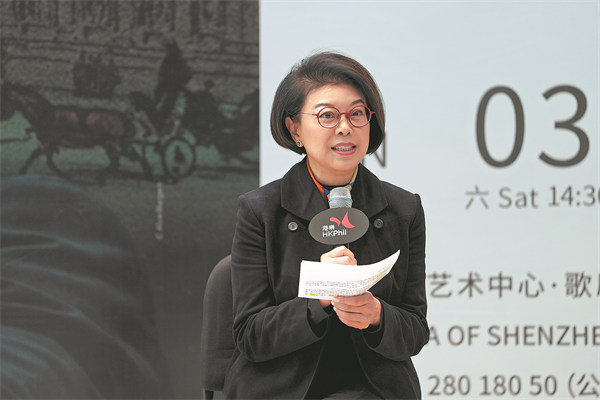
"As a world-class orchestra, the Hong Kong Philharmonic is not just an orchestra for Hong Kong, but also an orchestra for the Greater Bay Area and China at large," says Winnie Tam, vice-chairman of the board of governors, Hong Kong Philharmonic Society.
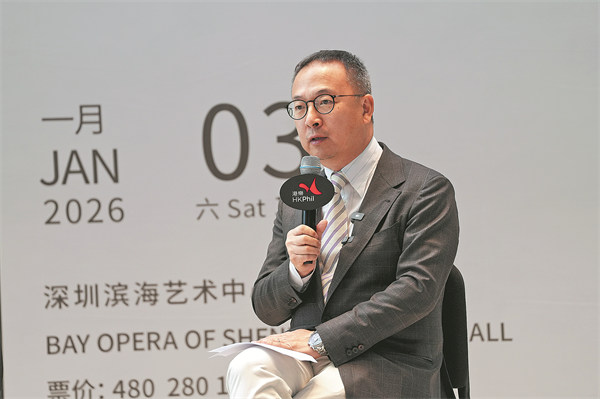
"The integration of the cultural life between Shenzhen and Hong Kong is an unstoppable trend," says deputy chief executive Patrick Ren Xiaolong."I was told by the ticket office that about 10 to 15 percent of today's audience comes from Hong Kong."
Ren, a seasoned administrator known for his tenure as CEO of the orchestra at Beijing's National Centre for the Performing Arts, relocated to Hong Kong in 2025 to take his new post at the Hong Kong Philharmonic.
To lure more mainland audiences, he says, the orchestra has scheduled many of its weekend concerts for the afternoon rather than the evening. It is also expected to stage more concerts on the Chinese mainland, once every three months, starting from the 2026-27 season. An upcoming afternoon concert will be held at the Xinghai Concert Hall in late January with world-renowned conductor Daniele Gatti returning to Guangzhou for the second consecutive year with the orchestra to perform Gustav Mahler's Symphony No 7 in E Minor.
With the future in mind, the orchestra picked 25-year-old Tarmo Peltokoski as the next music director. The Finnish conductor will lead the orchestra for his mainland debut at Guangzhou's Xinghai Concert Hall on April 26, with Dmitri Shostakovich's Symphony No 11 in G Minor, as well as the Violin Concerto composed by Peltokoski's mentor, Esa-Pekka Salonen, alongside violinist Leila Josefowicz. In late June, the orchestra will collaborate at the Shenzhen Concert Hall with conductor Roberto Abbado in Dmitri Shostakovich's Symphony No 1 in F Minor and share the stage with pianist Aristo Sham in Sergei Rachmaninoff's Piano Concerto No 3 in D Minor.
"There is a real excitement within the orchestra for new projects and new energy," says Moermond.
The Cincinnati-born musician also travels to Guangzhou, playing an active role working with young artists at the Youth Music Culture the Greater Bay Area, known as YMCG. The annual event, which collaborates closely with veteran musicians of leading orchestras from around the world, serves as a springboard for aspiring young talent worldwide.
For the itinerary to Guangzhou, Moermond says that he has found a shortcut.
"Shenzhen has many train stations, right? Out in Longgang district, there is Pinghu Station. And it is quite quick to get to Guangzhou East Station, which is closer to where the Xinghai Concert Hall is. You see I know all the routes now," the musician says with a smile.
The author is a freelance writer for China Daily.
Related Stories






Editor's Pick










