AI auto race enters fast lane at CES
Global automakers and suppliers unveil cutting-edge solutions for autonomous driving at Consumer Electronics Show
By CAO YINGYING | China Daily | Updated: 2026-01-12 09:45


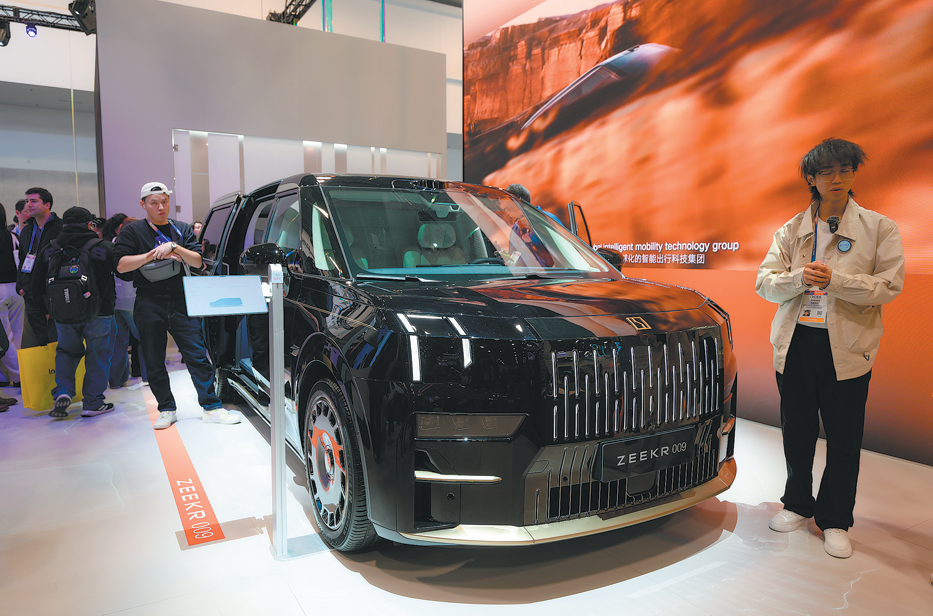
Autonomous driving technology and artificial intelligence were the focus of automotive displays at this year's Consumer Electronics Show, held in Las Vegas from Tuesday to Friday, where industry players launched cutting-edge technologies to reshape future mobility.
Geely Auto CEO Gan Jiayue said that AI is reshaping the auto industry, transforming it from powertrains and components toward a systematic reconfiguration of mobility ecosystems and lifestyles.
Making its third consecutive appearance at CES, the Chinese automaker unveiled the G-ASD (Geely Afari Smart Driving) system, designed to accelerate the transition to high-level autonomous driving.
The system is featured in 16 models under the Zeekr and Lynk & Co brands, enabling the vehicle to autonomously navigate between floors and roundabouts in an underground garage, and recognize highway and parking lot entrances.
Geely plans to roll out highway Level 3 and low-speed L4 autonomous driving functions and launch commercial robotaxi operations this year.
With its World Action Model, Geely's full-domain AI technology has entered the 2.0 era, the company said at CES.
Li Chuanhai, CTO of Geely Auto, described G-ASD and Full-Domain AI 2.0 as tangible innovations that integrate with cockpits and chassis to deliver highly humanlike, intelligent and user-friendly experiences.
Li predicted that by 2030, cars will become "super intelligent" with emotional awareness, proactive service and continuous evolution.
Great Wall Motor made its second appearance at CES, aiming to boost its global recognition. Chairman Wei Jianjun emphasized that developing products in isolation is not feasible, stressing the importance of engaging with the global market.
The automaker showcased its ASL 2.0 smart agent, capable of processing information and making decisions based on road conditions and user needs, as well as its Vision-Language-Action large model, which expands application scenarios to urban commuting and long-distance travel.
GWM also displayed its Hi4-Z hybrid architecture, semi-solid-state batteries and hydrogen fuel cell engines.
Chinese startup Leapmotor and US chipmaker Qualcomm unveiled the world's first cross-domain integration solution powered by the Snapdragon Cockpit Elite and Ride Elite platforms at CES.
The Leapmotor D19 SUV will be the first production model equipped with the setup, supporting gesture control and subarea voice commands, with deliveries to begin in April.
Auto suppliers, key enablers of the intelligent vehicle road maps, also premiered core component innovations at the trade event.
Chinese lidar supplier Hesai marked its eighth consecutive participation at CES, presenting an upgraded version of its ATX lidar with a detection range of 230 meters — doubling the performance of its predecessor.
Hesai also announced its role as the lidar partner for the Nvidia Drive AGX Hyperion 10 platform, an architecture designed to enable L4 autonomous driving.
To date, Hesai has secured mass-production designations for over 120 models from 24 global automakers. Orders for the latest ATX have exceeded 4 million units, driving a planned doubling of its annual production. Mass production and delivery are scheduled to begin in April.
US tech giant Nvidia unveiled the Alpamayo, a family of open Vision-Language-Action large models that brings humanlike, chain-of-thought reasoning to autonomous vehicle decision-making.
The Mercedes-Benz CLA will be the first vehicle to integrate the platform, with Nvidia-powered cars launching in the US in the first quarter, followed by Europe in the second quarter and the Asia-Pacific region in the second half of 2026.
Nvidia CEO Jensen Huang noted that automakers such as Lucid and Jaguar Land Rover have expressed interest in Alpamayo. The company plans to test robotaxi services in 2027.
He predicted that most cars worldwide will achieve autonomous or high-level autonomous driving within the next decade.
Bosch launched its seventh-generation millimeter-wave radar that integrates sensors with AI to enhance highway advanced driving-assisted functions. It can detect small objects up to 200 meters away and navigate complex traffic scenarios effectively.
The company forecasts that by early 2030, its revenue from software and services will exceed 6 billion euros ($6.99 billion), largely driven by AI offerings, with about two-thirds coming from the smart mobility segment.
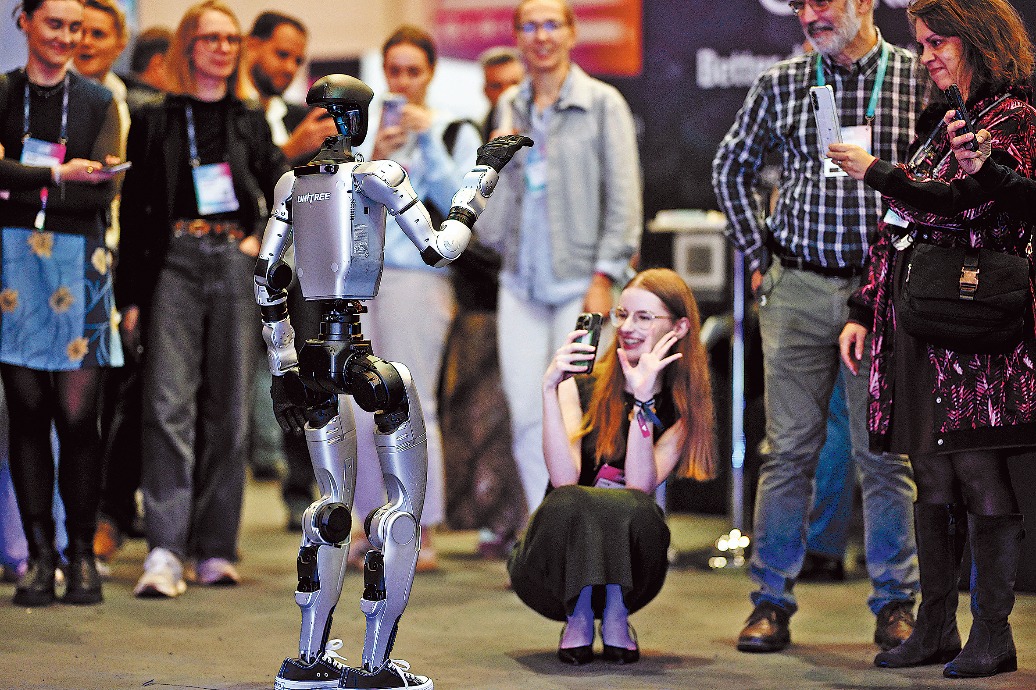
Beyond core auto components, the integration of robotics into future mobility ecosystems drew attention. Hyundai Motor showcased the production-ready version of its new Atlas humanoid robot at CES.
The group plans to integrate Atlas into its global manufacturing network, including its large-scale US production base, to perform practical tasks on-site.
Consultancy Roland Berger said in a report that the strategic importance of automobile plus AI has reached unprecedented levels. Generative AI has resulted in a 30-50 percent efficiency improvement in certain scenarios.
The year 2026 is anticipated to be pivotal for the large-scale deployment of these scenarios and the validation of business models, it said.
While fewer eye-catching concept cars appeared compared to previous years, Chinese cleaning appliance maker Dreame made its automotive debut at CES. The company had announced its entry into the auto sector in August.
It launched the Kosmera brand along with two concept cars, including an all-electric hypercar with a combined output of 1,903 horsepower that accelerates from 0-100 kilometers per hour in 1.8 seconds. The vehicle incorporates cutting-edge technologies such as axial flux motors and a 3D-printed chassis.
Meanwhile, Sony Honda Mobility unveiled its new electric vehicle prototype. CEO Yasuhide Mizuno said the joint venture between Sony and Honda Motor aims to deliver a US model based on the Afeela Prototype as early as 2028.
The company's first EV, the Afeela 1 introduced in 2025 and priced from $89,900, is expected to begin deliveries in California later this year.
caoyingying@chinadaily.com.cn
Related Stories