


Pingju Opera reaches out to new audiences
Efforts made to make traditional art form appeal to more young people
By Yan Dongjie in Tianjin | China Daily | Updated: 2026-01-13 08:55


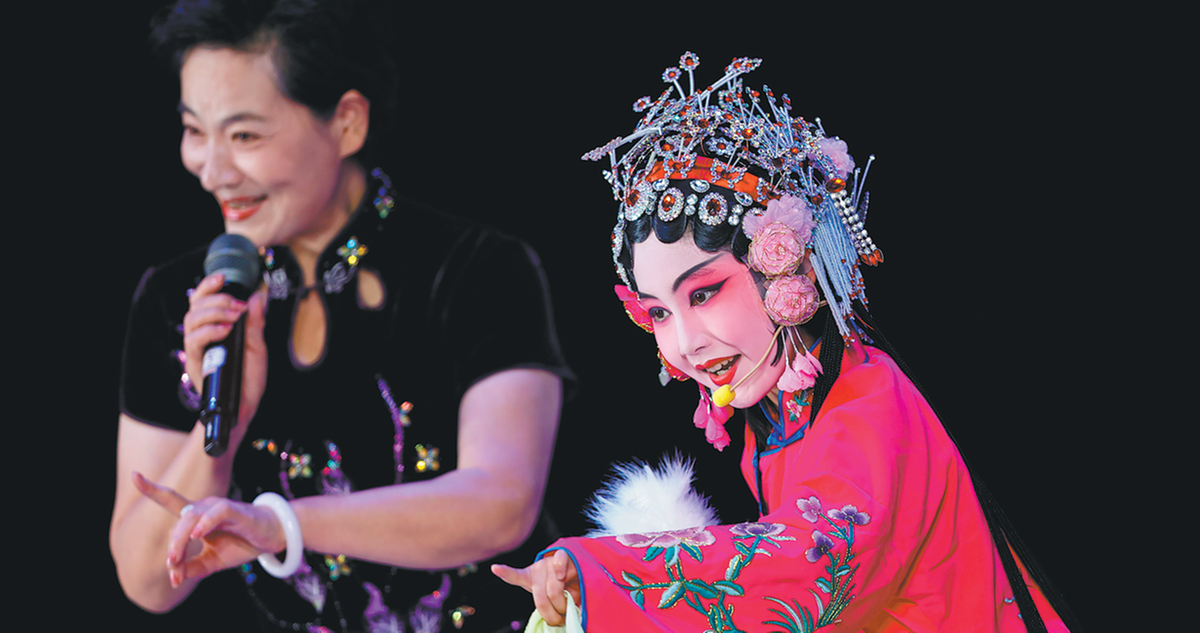
At the Red Flag Theater in Tianjin the unique skills of Pingju Opera are passed down for the seventh generation. "Moves such as 'water-sleeve throwing' and 'handkerchief flipping' are honed over a gruelling six-year period," said director Zeng Zhaojuan. "Water-sleeve flipping" involves a flick of the wrist used to gather and toss the actors' long sleeves, while "handkerchief throwing" features spinning, tossing and catching weighted handkerchiefs.
"Pingju Opera and the city of Tianjin have mutually enhanced each other," said Zeng. "Tianjin people have a strong sense of loyalty. Pingju Opera is good at depicting daily life stories and human emotions. It perfectly aligns with the temperament of Tianjin."
Pingju's unique history began in the late 19th century as a raw, improvisational form of storytelling performed by artists in the marketplaces of Tianjin and the neighboring city of Tangshan in Hebei province. Originally, it was the only major opera performed in the common vernacular, making it the first genre to tackle domestic scandals and the social injustices facing the working class. Three of the four legendary "founding mothers" — Li Jinshun, Liu Cuixia, and Ai Lianjun — honed their craft in local teahouses, transforming a folk tradition into a national phenomenon.
"With many similarities to the costumes and makeup of Peking Opera, Pingju Opera is one of the five major Chinese opera genres. As a national intangible cultural heritage, it is popular in Beijing, Tianjin, Hebei, and other areas in Northeast China," said Li Xuanjie, a young male lead from the Red Flag Theater, which is also known as Tianjin Pingju Opera Theater.
The theater was established in 1958 and has staged a diverse range of classic plays, including The Legend of the Seal, Zhao Jintang and Revolutionary Family — which have all won the Splendor Award for professional theatrical artworks, the highest government award for professional theatrical arts in China.
Li said that Pingju Opera has evolved in recent years from the original "one or two actor" street shows to modern 150-person epics such as Revolutionary Family.
"We attach great importance to the cultivation of young actors," Li said. Each actor undergoes six years of professional training before debut performances."
As traditional arts face unprecedented competition from digital media, the theater is doubling down on its "Opera Entering Campus" initiative, said Li, adding that they aim to turn university students from institutions such as Tianjin Normal University and Tianjin University of Technology into the next generation of patrons. Students are invited to the 700-seat theater to experience drama classes on stage, and then backstage for makeup and costume fittings.
Director Zeng said, "This performance style is very appealing to students, and we're seeing more young people develop passion for Pingju Opera."
Zeng is aiming to find new audiences for Pingju among young people through new media such as short videos and livestreams. He insists on both preserving classics and creating modern works that reflect the spirit of the times. "How to attract more young actors to join the Pingju Opera has been a question we have been constantly pondering," Zeng said, expressing hope that over the next decade, more outstanding Pingju plays would emerge, with more young actors nurtured and more young audiences attracted.
In 2025, the theater collaborated with cross-talk titan Guo Degang. By merging the fan base of the De Yun She comedy club in Beijing with traditional opera, the theater hopes to capture a new audience.
Recently, over 20 foreign journalists from countries including the United States and Italy visited Tianjin Pingju Opera Theater.
They were given unprecedented backstage access to the seventh generation of Pingju performers, discovering that classic plays like Du Shiniang share the same "star-crossed lover" DNA as Shakespeare's Romeo and Juliet. By opening its doors to global media and conducting workshops for foreigners, the theater is repositioning Pingju Opera not just as local heritage, but as a globally accessible narrative form capable of cross-cultural dialogue.
Chen Yijun contributed to this story.
yandongjie@chinadaily.com.cn






Editor's Pick










