Role as transformer producer enhanced
By Zheng Xin | China Daily | Updated: 2026-01-14 09:04


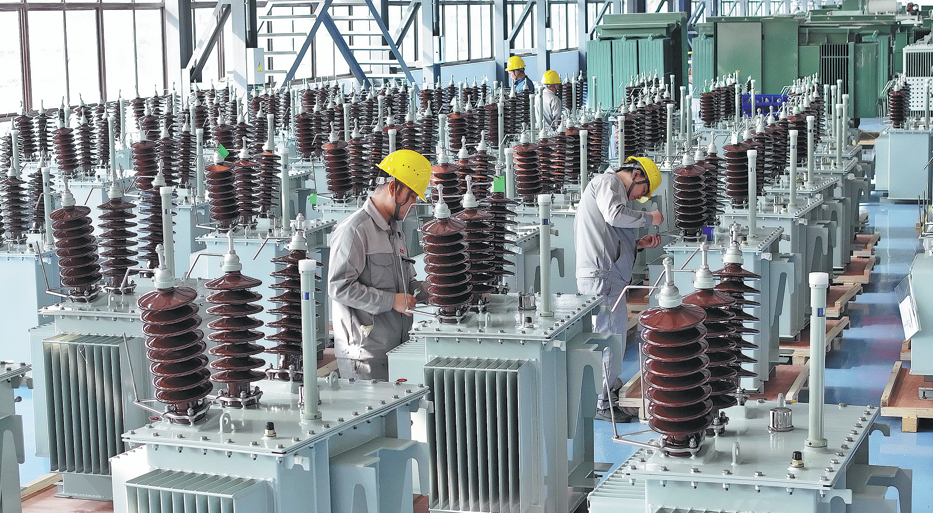
China is at the forefront of a booming $103 billion market, emerging as the dominant player even as a global shortage of power transformers threatens to stall progress in both artificial intelligence and the shift to green energy, said industry experts and analysts.
China currently controls approximately 60 percent of global transformer production capacity, according to the International Energy Agency, a dominance built on a sophisticated industrial ecosystem that has transitioned from domestic technology dependence to global leadership in Ultra-High-Voltage (UHV) systems.
Analysts describe this concentration of manufacturing power as an industrial "dream team", where State-owned giants and agile private firms define international grid standards.
China can build transformers and grid substations faster and cheaper than Western peers and scale AI data centers without the infrastructure lag currently hitting North American markets, said Lin Boqiang, head of the China Institute for Studies in Energy Policy at Xiamen University.
As the AI-driven "power crunch" is expected to intensify throughout 2026, these "hearts of the grid" — responsible for regulating voltage levels — have become as critical as the semiconductors they power.
According to Lin, China is moving from exporting low-value goods to controlling the "hearts of the grid."
Because power transformers are essential for everything including EV charging networks, this dominance allows Beijing to exert leverage over global industrial resilience, he said.
Lin said China's dominance is anchored by a potent combination of State-owned giants and agile private firms.
While State conglomerates provide the industrial backbone for massive strategic infrastructure, private manufacturers have achieved immense global scale, successfully penetrating key Western markets to cement China's role over the international supply chain, he said.
The global surge in demand is fueled by the explosive growth of data centers, with electricity requirements forecast to double by 2030 as AI training and inference requirements hit a "power wall".
Total data center power consumption is projected to rise from 860 terawatt-hours in 2025 to 1,587 TWh by 2030, according to S&P Global Market Intelligence.
Analysts expect these shortages to persist through 2026, creating a prolonged peak cycle for the equipment market.
While global rivals are launching aggressive expansion plans, China's internal infrastructure provides a foundation that competitors struggle to match.
Siemens Energy is planning to invest 2 billion euros ($2.3 billion) in its global network of transformer and switchgear factories by 2028, while Hitachi has said it would invest more than $6 billion globally between 2024 and 2027 in its grid equipment business.
State Grid Corp of China reported record fixed-asset investment of over 650 billion yuan ($93 billion) in 2025 alone as it builds a new power system for the nation's 15th Five-Year Plan (2026-30).
This domestic investment peak, combined with world-leading UHV technology — which operates at voltages exceeding 800 kilovolts of direct current or 1,000 kV of alternating current — allows Chinese firms to dominate the entire value chain.
Zhao Yongzhan, president of Hitachi Energy Greater China, noted that China's advanced transmission networks are essential for linking remote renewable energy hubs to urban centers, a trend that is setting global standards for grid resilience.
China has emerged as the central pillar of a massive global investment strategy by Hitachi Energy, as the industry leader aligns its expansion with the country's world-leading UHV networks and surging AI-driven power demand.
The company is aggressively scaling its operations across Chinese industrial hubs, including Xi'an, Chongqing, and Xiamen, to capitalize on a domestic market that is outpacing global peers in grid modernization.
"China, with world-class UHV capabilities and robust local manufacturing, is in a peak period of power grid investment, and this high-intensity commitment to UHV technology will continue," said Zhao.
"This high-intensity commitment to UHV technology is expected to strengthen further under the nation's 15th Five-Year Plan as renewable energy is transported from remote hubs to urban centers."