FTZs key to unlock institutional opening-up
CHINA DAILY | Updated: 2026-01-15 07:21


Editor's note: China's Central Economic Work Conference held in December underscored the need to optimize the layout of pilot free trade zones. National Business Daily spoke to Sang Baichuan, dean of the Institute of International Economy at the University of International Business and Economics, on how FTZs can vitalize trade development. Below are excerpts of the interview. The views don't necessarily represent those of China Daily.
The FTZs have advanced high-level opening-up and generated a wealth of experience in institutional innovation. The process of optimizing the layout of FTZs does not mean reducing their numbers, on the contrary, a more likely approach is to add new FTZs with a sharper focus on border provinces as well as the central and western regions. This will improve the balance in regional development and expand the scope of opening-up.
Stabilizing foreign trade and investment is important for China's opening-up process because it responds to changes in both the domestic and international economic environments. China is well positioned to maintain steady growth in its external trade in the coming years amid the increasingly complex and volatile global environment.
Opening-up is one of the key pathways to China's high-quality economic development. Cooperation across multiple fields goes far beyond trade and investment, extending to a wide range of economic activities such as regional and global economic governance and the development of overseas industrial parks. It encompasses not only emerging forms of foreign trade, but also negotiations and cooperation on regional free trade agreements and other institutional arrangements.
Against this backdrop, the central authorities' emphasis on promoting cooperation across multiple fields is not simply about expanding exports. Rather, it underscores the importance of engaging with countries around the world in diverse areas, to achieve mutual benefit and jointly contribute to an open world economy.
Amid the profound changes taking place in the international environment and rising external pressures, expanding domestic demand will remain a top priority of the country's economic policies going forward. This, however, does not mean that external demand is unimportant. On the contrary, efforts to expand domestic demand can help enterprises build a more solid foundation, enabling them to compete more effectively in overseas markets and play a bigger role in international trade and investment cooperation.
Due to growing unilateralism, many countries have realized that only through strengthened international economic and trade cooperation can genuine mutual benefit be achieved. This is conducive to advancing international cooperation in the coming years.
While China continues to adhere to a development strategy with domestic demand as the mainstay, it is widely expected that it will establish partnerships with more countries in areas such as trade and investment, industry and supply chain cooperation and regional economic governance.
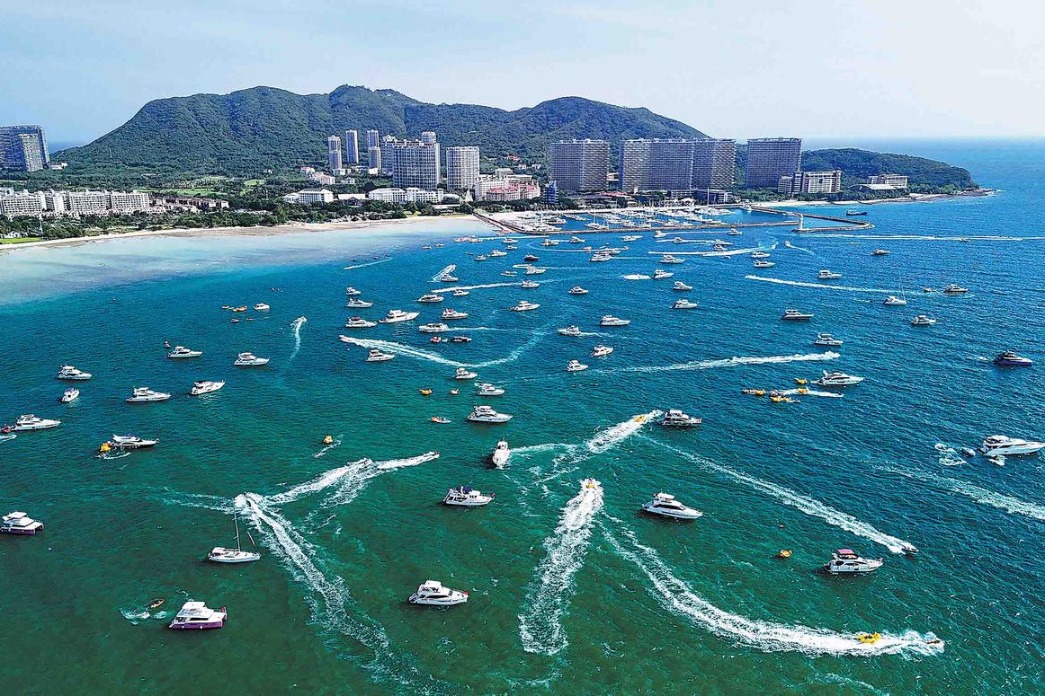
In the future, an important opportunity for China's exports lies in its long-accumulated advantages in production capacity and its complete industry chains, which will further support the upgrading of the foreign trade structure. The Hainan Free Trade Port is a perfect example of this transformation.
Since special customs operations have been launched in the Hainan FTP, the port will face a series of institutional challenges. Trade liberalization, facilitation and innovative forms of trade development require further improvements in institutional arrangements. Therefore, advancing the development of the Hainan FTP in a pragmatic manner is a key task under this new milestone.