


Inside China's expanding partnership with Africa
Beyond bridges and rails, collaboration widens through zero-tariff policy, reinforcing South-South trade amid global protectionism
By EDITH MUTETHYA and SHARON NAKOLA in Nairobi | CHINA DAILY | Updated: 2026-01-15 09:26


The Plan for China-Africa Cooperation on Talent Development aims to train thousands of technical experts and vocational educators annually by combining language training with vocational skills tailored to local demand, he said.
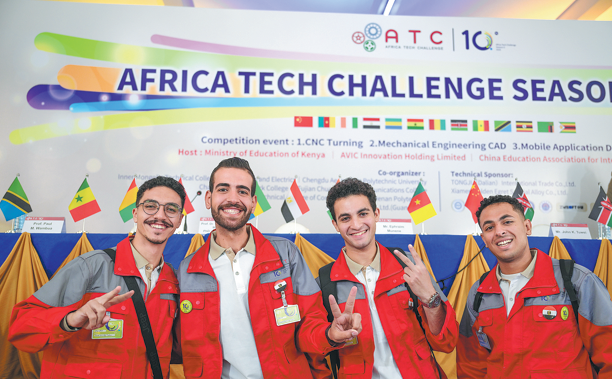
The Africa Tech Challenge, a corporate social responsibility initiative by China's AVIC Innovation Holding, has also contributed to technical skills development across the continent.
Held annually, the program offers intensive training and culminates in a competition for technical and vocational education and training students. It focuses on areas such as computer numerical control machining, computer-aided design for mechanical engineering, programmable logic controller technology and design thinking.
Otieno said the program equips young people with advanced technical skills, preparing them for the fourth Industrial Revolution.
China continues to offer scholarships to African students through government and university partnership programs.
In August, 11 South African students received Chinese government scholarships, while eight others were selected for academic degree programs in fields including cybersecurity, engineering management and healthcare.
During the same period, 52 Kenyan students were awarded Chinese government scholarships. An additional 20 students from the University of Nairobi received scholarships under a tripartite agreement signed in December 2023 between China's Ministry of Education, the University of Nairobi and Tianjin Normal University, aimed at promoting Chinese-language education.
Otieno said China's talent development efforts align closely with Africa's priorities, particularly skills for industrialization, infrastructure development, agriculture and digital transformation — areas highlighted in national development plans across the continent.
Through these initiatives, he said, Africa has recorded increased employability, stronger technical competencies and enhanced cross-sector professional skills.
Graduates of China-supported language and vocational programs have found employment in sectors such as railways, construction and manufacturing, while scholarships and professional training in agriculture, engineering and other fields have helped build local capacity in critical industries.
The key beneficiaries of Chinese talent development initiatives include the youth and recent graduates, local industries and participants in China-Africa academic exchange programs, who gain exposure to international curricula and professional networks, Otieno said.
However, he stressed the need to expand outreach beyond urban centers, saying rural and underprivileged communities often have limited access to such programs.
African governments and stakeholders should act as active partners rather than passive beneficiaries by developing clear national skills agendas aligned with labor market needs, including renewable energy and digital services, he said.
Governments, he added, should also regulate and accredit training programs to ensure quality, relevance and recognition both within Africa and internationally.
This should be complemented by measures to guarantee equitable benefits for all segments of society, particularly disadvantaged groups, and by fostering public-private partnerships with local businesses to jointly develop training curricula and employ graduates, he said.
For inclusive and sustainable growth, Otieno said China-Africa skills development initiatives must be collaboratively structured, with African priorities at the center.
He advocated partnerships that strengthen local agency, equity and long-term resilience in addressing skill gaps in key economic areas such as digital, health, agri-tech and manufacturing.
Otieno urged a stronger focus on entrepreneurship and the development of micro-, small — and medium-sized enterprises through technical and business skills support.
Investment in teacher training and technology transfer is essential to ensuring lasting effects in African contexts, he said.
Otieno called for the integration of regional skills standards to enhance labor mobility and build a competitive African workforce across borders, while prioritizing inclusivity for disadvantaged groups.
To ensure China's initiatives support Africa's development goals, Otieno emphasized the importance of political goodwill and co-design at the negotiating table.
African governments and regional bodies should lead priority-setting to ensure that training programs respond to country-specific labor market needs and align with long-term frameworks such as the AU's Agenda 2063, he said.
He also underscored the need for transparent performance-monitoring frameworks to track outcomes such as employment rates, startups and the application of skills in priority industries.
Contact the writers at edithmutethya@chinadaily.com.cn




Editor's Pick










