Shanghai to further boost advanced manufacturing
By Wang Ying in Shanghai | China Daily | Updated: 2026-01-16 09:06


Shanghai's efforts to transform and upgrade its advanced manufacturing over the coming three years are expected to consolidate the city's manufacturing capabilities, enhance industrial chain stability, and further catapult the East China cosmopolis into a global high-end manufacturing center, experts said on Wednesday while digesting the Chinese economic hub's latest action plan to support advanced manufacturing.
Unveiled by the municipal government of Shanghai on Jan 9, the three-year action plan is designed to support the transformation and upgrade of Shanghai's advanced manufacturing sector in the coming three years and charts ambitious goals including nurturing 100 manufacturing enterprises each with an annual output of above 1 billion yuan ($143.49 million) and raising the city's robot density to 600 robots per 10,000 employees by 2028.
"By achieving such goals, there would be no doubt that Shanghai would, on the one hand, generate vitality among various enterprises, especially privately owned companies, and, on the other hand, its manufacturing sector would reach a new level, featuring unique strengths and a well-developed and complete industrial chain with a stable, reliable and promising outlook," said Shen Nanyan, director of the Shanghai Key Laboratory of Intelligent Manufacturing and Robotics.
"Many of the 1-billion-yuan-scale enterprises would have their respective areas of focus, and they would work together to better facilitate a complete and stable industrial chain in Shanghai, particularly in key strategic industries," Shen said.
"From a long-term perspective, leading companies in many key strategic industries will drive Shanghai's overall manufacturing sector to develop rapidly, while ensuring the safety of the entire industrial chain."
Consisting of 17 detailed measures, the action plan is designed to accelerate the formation of a modern industry system centering around advanced manufacturing, therefore fully driving companies of various sizes to develop in a coordinated and integrated manner.
"Shanghai has already obtained many mature technologies, and the action plan is tasked with introducing these existing technologies into manufacturing, thereby enabling traditional industries to add value and increase competitiveness," said Cao Qixin, a professor specializing in robot research at Shanghai Jiao Tong University.
"Transformation in manufacturing has already taken place in many benchmark companies in Shanghai, but with regard to the city's ambition to become a global benchmark in advanced technology and innovation, more parallel advancement across the broad manufacturing sector is required," Cao said, adding that Shanghai's outstanding pool of global talent will further give the city an edge in popularizing cutting-edge technologies in manufacturing.
In terms of advancing AI in manufacturing, large enterprises are expected to achieve full digital and intelligent applications by 2027.
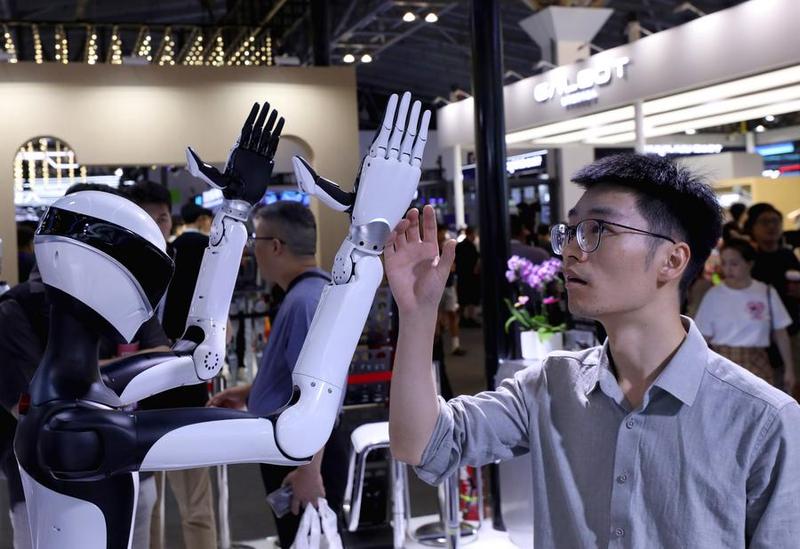
Robot density, a key gauge to measure the adoption of automation in manufacturing, is the number of robots per 10,000 people in the manufacturing industry. Currently, Shanghai's robot density is above 500 robots per 10,000 employees, up from 260 in 2023, according to Xinhua News Agency.
Shanghai's robot density reached a level on par with the world's top countries, including South Korea, Japan and Singapore, during the 14th Five-Year Plan (2021-25) period, said Shen.
"It is worth mentioning that robot density is uneven across different industries. Taking the automotive sector as an example, a vehicle manufacturing line can operate automatically with about two dozen robots collaborating with each other. But in other sectors, such as textiles, the automation rate remains extremely low," Shen said.
"Under the guidance of the action plan, we can expect the application of robots to expand into many industries that currently have very low robot density," Shen added.
Effective from Jan 1 through Dec 31, 2028, the plan aims to add 100 new manufacturing enterprises each with an annual output value exceeding 1 billion yuan, bringing the total to over 600. This initiative also seeks to drive the industrial chain to create 500 new industrial enterprises above the designated size, or those with an annual revenue of 20 million yuan or above.
wang_ying@chinadaily.com.cn