


New trade-in policy boosting retail sector
By WANG ZHUOQIONG | CHINA DAILY | Updated: 2026-01-20 07:40


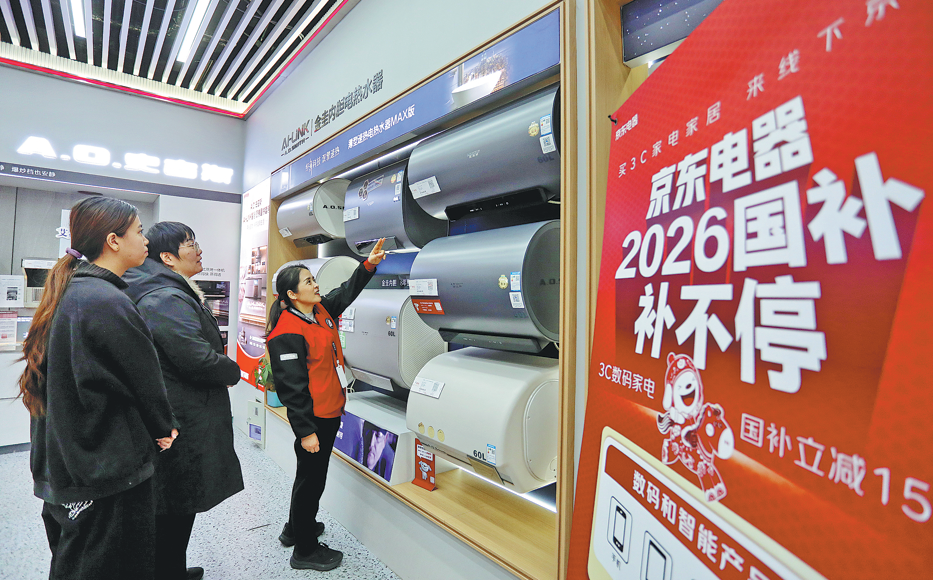
The consumer goods trade-in policy for this year has already increased retail activity significantly, benefiting both retailers as well as consumers, said retailers and industry experts.
Designed to promote green, smart, and energy-efficient products, the renewed policy offers targeted subsidies to replace old goods for new ones, thereby generating strong demand in sectors including home appliances and consumer electronics.
For retailers such as Suning.com, the impact has been immediate. From Jan 1 to 3, foot traffic at Suning stores surged by 110 percent, while sales of energy-efficient home appliances like refrigerators and washing machines doubled month-on-month. The proportion of first-tier energy/water-efficient appliances sold through Suning's platform has increased to 92 percent during the period.
"The new trade-in program focuses on categories that raise energy efficiency, injecting vitality into the update of home appliances that are green, smart, and healthy," said Yan Zhengkui, head of the management center at Suning stores.
The retailer has also embraced a dual-channel strategy, making it easy for consumers to claim subsidies both online and offline.
"We've seen an overwhelming response from customers eager to take advantage of the trade-in policy. The new national subsidies have made first-tier energy-efficient products the mainstream for consumers," said Liu Meichen, a store manager at Suning Max Beijing.
For consumers, the trade-in policy is about more than just discounts. It provides them the opportunity to purchase cutting-edge smart appliances at more affordable prices. Products like AI-powered refrigerators, smart washing machines, and energy-efficient air conditioners are now in high demand. Over 70 percent of consumers are also prioritizing health-related features, such as self-cleaning or odor-removal functions while buying appliances.
In the 3C sector, sales of smartphones and smartwatches rose 170 percent and 115 percent, respectively, reflecting the growing popularity of tech bundles, according to Suning.com.
"The smartwatch is a great tool for health tracking, and with the subsidies, it's good value," said Li Shunying, a Beijing resident who runs 2-3 times a week.
The policy's focus on green and smart technology is expected to reshape the market over the long term. Analysts predict that it will continue to guide consumption toward higher-end, energy-efficient products.
Liu Chunsheng, associate professor at the School of International Trade and Economics, Central University of Finance and Economics, said that the trade-in policy sparked strong consumer enthusiasm last year, leading to significant volumes and high replacement rates for products like automobiles, home appliances, and 3C digital devices, thus fueling continued consumption growth.
According to data from the Ministry of Commerce, in 2025, sales of trade-in-related products exceeded 2.6 trillion yuan ($388.6 billion), benefiting over 360 million people. The initiative facilitated the trade-in of more than 11.5 million automobiles, 129 million home appliances, 91 million mobile phones and other digital products, as well as 120 million pieces of home renovation items and kitchenware.
wangzhuoqiong@chinadaily.com.cn








Editor's Pick










