China's economy, trade remain resilient amid global headwinds
Xinhua | Updated: 2026-01-20 15:00


BEIJING - China announced on Monday that its economy posted a 5 percent increase in 2025 amid domestic and external challenges, showing a trajectory of resilient and stable growth and remaining a powerhouse of the world economy.
Analysts believe the number is impressive given the US tariff war, highlighting the flexibility and resilience of the Chinese market.
STABLE GROWTH
China's GDP reached a record 140.1879 trillion yuan (about $20.01 trillion) last year, data from the National Bureau of Statistics (NBS) revealed.
"For a super-large economy like China, achieving such stable development is by no means easy amid intertwined risks and challenges," Kang Yi, head of the NBS, told a press conference.
Facing abrupt changes in the external environment and mounting domestic difficulties and challenges, China adopted more proactive and effective macro policies, which helped offset adverse external shocks and stabilize the foundation for development amid headwinds, he added.
"The description of China's economic growth performance in 2025, in one word, is resilience," Sandile Swana, a South African governance and political analyst, told Xinhua.
John Bryson, expert in economic geography and professor at the University of Birmingham, said: "Some commentators might be surprised with this outcome given that this occurred during (US President) Donald Trump's tariff war. However, this 5 percent demonstrates that Chinese politicians, policymakers and companies were able to adjust."
"China has been extremely effective in pivoting rapidly in response to Trump by searching out alternative markets for its products," he told Xinhua. "There were short-term negative impacts, but the search for alternative markets by Chinese firms has led to a positive overall outcome."
The International Monetary Fund (IMF) on Monday upgraded its projections for China's growth to 5 percent in 2025 and 4.5 percent in 2026, up by 0.2 and 0.3 percentage points from its October forecast, respectively, according to its latest World Economic Outlook report.
"China's economy has shown notable resilience despite facing multiple shocks in recent years," said Sonali Jain-Chandra, who led an IMF team that visited Beijing and Shanghai in December. She said the revised outlook partly reflects recent macroeconomic policy stimulus measures.
The IMF recognized China's recent moves to bolster consumption-led growth, including expansionary fiscal policies, monetary easing, and targeted steps to support consumption and the property sector.
RESILIENT TRADE AMID HEADWINDS
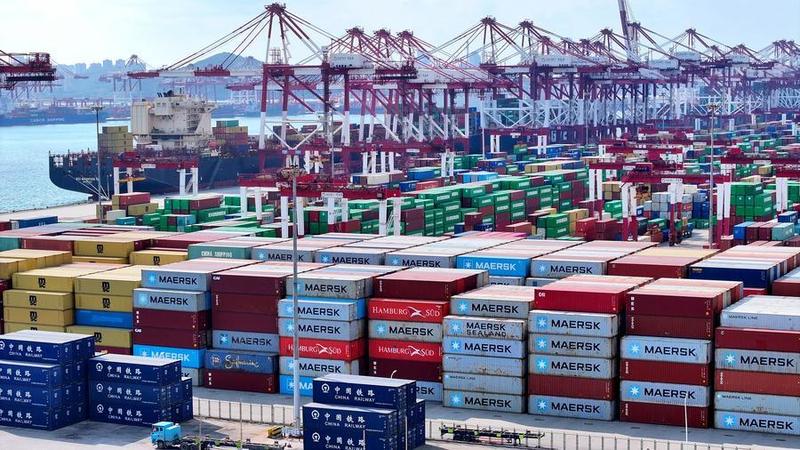
Last year, China's foreign trade hit a new high despite global headwinds, retaining its position as the world's largest goods trading nation. According to data released by the General Administration of Customs last week, China's foreign trade value hit 45.47 trillion yuan ($6.48 trillion), up 3.8 percent year-on-year, marking the ninth consecutive year of growth since 2017.
Wang Jun, deputy head of the General Administration of Customs, said that the achievements are "truly remarkable and hard-won" amid global economic challenges.
Wang attributed the steady growth of China's foreign trade to three major drivers: the country's pro-trade stabilization policies, the sustained release of import demand from its vast domestic market, and a sophisticated industrial system that continuously adapts to evolving overseas needs.
While the external environment facing China's foreign trade this year remains severe and complex, the fundamentals of the country's foreign trade remain solid, which will inject more certainty into global economic and trade development, he said.
Liao Wei, senior economist for China at Standard Chartered, attributed the resilience of China's foreign trade to an expanding trade network and the ever-strengthening competitive edge of Chinese goods exports.
She said that China's total factor productivity has been rising since 2021 on the back of continued sci-tech breakthroughs, which could lower costs for exports enough to absorb impacts from tariffs.
Looking into 2026, Liao believes that trade will continue to shore up China's economic growth while cooperation between emerging markets will maintain steam as global economies diversify trade partners and the country's total factor productivity is still climbing.
"External demand is unlikely to add headwinds in 2026 because major economies showed no sign of a significant downturn. The global AI frenzy as well as market expectations of major economies gravitating toward fiscal stimulus will bolster China's export outlook, particularly for tech-intensive products," she said.
INNOVATION-DRIVEN GROWTH
China will remain an engine of the world economy, driven by innovation that fosters high-quality development and empowers developing countries to achieve sustainable growth. China has entered the top 10 of the Global Innovation Index for the first time, according to the 2025 report released by the World Intellectual Property Organization.
"By the end of 2025, China remained a primary engine for the global economy, though the nature of its contribution was shifting from being just the world's factory to a leader in advanced technology and green energy," said Joseph Matthews, a senior professor at the BELTEI International University in Cambodia.
"By opening its markets at a time when the United States was disrupting access, China has saved many nations from economic disaster," Swana said. He noted that the country is pivoting towards high-tech and more technology-intensive jobs across its production sectors and playing a major role in supporting developing countries in innovation, science and technology.
"By prioritizing infrastructure development and technological innovation, China offers developing countries practical means to build sustainable growth and achieve genuine economic autonomy," said Herman Tiu Laurel, president of the Asian Century Philippines Strategic Studies Institute, a Manila-based think tank.
"China has helped reframe the global agenda around high-quality development and win-win cooperation," he added.
Echoing the view, Ismael Buchanan, senior lecturer in the Department of Political Science at the University of Rwanda, said, "China's approach emphasizes mutual benefit, respect for national sovereignty, and practical cooperation."
"By sharing development experience, expanding South-South cooperation, and supporting multilateral development mechanisms, China has offered additional development options for Global South countries," Buchanan added.