


Dog weddings — how new industry laps up puppy love
Lifestyle trend sees rapid growth in extravagant canine celebrations, events
By YU RAN | CHINA DAILY | Updated: 2026-01-22 07:18


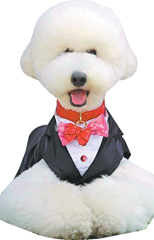
"It became a real team effort. Some of our friends even drove from Shanghai, and Jiangsu and Anhui provinces to attend. Around 20 guests came — and 50 dogs," said Bai.
The ceremony mirrored a real wedding with playful twists such as invitations addressed to dogs, a dress code, a marriage celebrant Yu Xiaochun, founder of Petstar, a local pet company, and toy robot dogs serving as bridesmaids and groomsmen.
"We arranged pet strollers as gifts, set up a small stage, and had a one-hour ceremony. The most touching moment was when Elio and Mira exchanged collars — a floral one for the bride, a blue one for the groom," said Bai, who hosted the event.
For Bai, the ceremony was more than a novelty. It was deeply personal.
"Dogs don't understand birthdays or weddings, but they understand happiness. When they're by our side, and we're happy, they're happy too. That's enough," he said.
Bai added: "In many ways, the wedding was also for us — for the emotions we rarely know where to place. People say pets accompany humans, but I think they help us release our love."
Bai and Ju, who have no children, never had a wedding themselves, choosing to travel instead. "We didn't need a wedding, but giving one to our dogs made us genuinely happy — maybe it fulfilled the dream we never realized," Bai said.
China's urban pet population surpassed the number of children under the age of 4 in 2024, according to a Goldman Sachs report. It projected that by 2030, the number of urban pets could exceed 70 million, while the population of children under age 4 might fall below 40 million.
Sun Zhe, a sociologist at Chinese Modernization Institute of Shanghai University of Finance and Economics, said the growing "ritualization" of pet culture reflects profound emotional and social shifts among China's youth.
"When people celebrate their pets through ceremonies such as weddings or birthdays, they are not only expressing affection but also affirming a new kind of intimacy — one that connects humans and animals, and through them, connects people with each other," he said.
The phenomenon speaks to the deep psychological and cultural evolution of urban living, Sun Zhe said.
"In the past, pets were mainly friends or companions. Today, they've become extensions of the self — what I call 'self-projections'. Because pets cannot speak, they carry the gentlest, most stable part of their owners' emotional world. Investing time, money, and emotion in them is a way of nurturing one's better self," he said.
Liu Jing, 35, from Nanjing, Jiangsu province, is an accountant and mother of a 3-year-old daughter. She lives with two cats and a small mixed-breed dog. For her, affection for her pets lies in everyday companionship rather than ceremonial display.
"I completely understand why some people want to hold weddings or parties for their pets — it's a beautiful way of expressing love," said Liu. "But for me, love doesn't have to take the form of rituals. It's in the quiet moments — feeding them, walking them, or just sitting together on the sofa."
Liu said her pets are part of the family and her daughter has grown up with them, learning gentleness and care.
"I think that's the most meaningful part — passing love and empathy on to the next generation," she said.
While some critics see pet weddings or celebrations as unnecessary or extravagant, Sun Zhe views them as part of a broader "symbolic economy".
"In the agricultural era, animals served practical purposes. But in the information age, urban life is built around symbols and emotional meaning rather than production. Pets have shifted from functional beings to emotional symbols — a way for people to consume, express, and connect in search of psychological fulfillment," he said.





Editor's Pick










